

Back-office outsourcing is when businesses delegate non-customer-facing tasks – like payroll, data entry, IT support, and compliance – to external providers. This approach helps reduce costs, improve efficiency, and free up internal teams to focus on growth. By outsourcing, companies can save up to 70-85% on labor costs while scaling operations without the need for full-time hires.
Key benefits include:
- Cost Savings: Cut recruitment, training, and infrastructure expenses.
- Efficiency: Providers use automation and standardized processes to minimize errors and speed up workflows.
- Scalability: Adjust capacity quickly to meet demand.
- Access to Expertise: Gain specialized talent, such as accountants, IT professionals, or multilingual staff.
Common tasks outsourced include:
- Administrative Work: Data entry, report creation, and calendar management.
- Finance: Payroll, bookkeeping, and tax preparation.
- IT Support: Network monitoring, helpdesk services, and cybersecurity.
Outsourcing is widely used across industries like e-commerce, SaaS, healthcare, and retail to handle repetitive tasks, meet regulatory standards, and stay agile in competitive markets.
Back-Office Outsourcing Benefits: Cost Savings and Efficiency Statistics
Benefits of Back-Office Outsourcing
Lower Costs and Better Efficiency
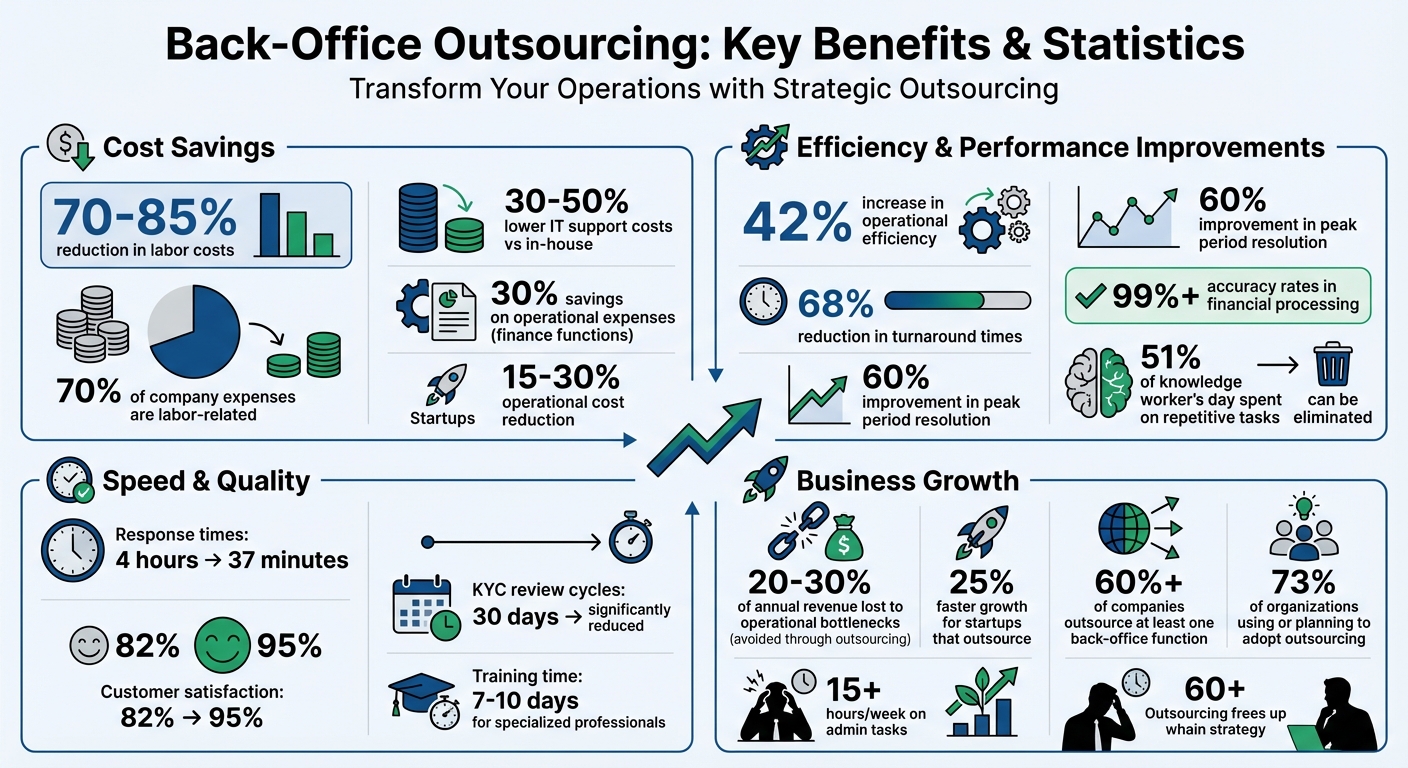
Shifting back-office tasks to outsourcing providers can dramatically cut costs. You avoid hefty overhead expenses like recruitment, employee benefits, office space, and technology infrastructure. In fact, labor costs alone can drop by 70% to 85% with outsourcing. Considering that labor often accounts for up to 70% of a company’s total expenses, these savings can have a big impact on your bottom line.
But it’s not just about saving money – efficiency gets a boost too. Outsourcing providers bring standardized operating procedures (SOPs), automation, and strong quality controls to the table, which help reduce errors and speed up workflows. By offloading repetitive, time-consuming tasks, your internal team can focus on more strategic priorities like building customer relationships and driving revenue. Plus, smoother operations help avoid bottlenecks, which can cost businesses 20% to 30% of their annual revenue. This creates the agility needed to scale quickly and meet changing business demands.
Scalability and Flexibility
Outsourcing offers the ability to adjust capacity in real-time without the hassle of hiring or layoffs. Providers can scale operations within as little as 24 hours to handle sudden increases in demand. This flexibility ensures your staffing aligns with current needs rather than locking you into fixed costs.
Take this example: A publicly traded SaaS company with $170 million in revenue faced 40% spikes in workload during financial close periods. In 2025, they partnered with an outsourcing provider to bring in bilingual accounting professionals who were trained in just 7–10 days. The results? First response times dropped from 4 hours to 37 minutes, peak period resolution improved by 60%, and customer satisfaction soared from 82% to 95%.
Access to Specialized Professionals
Outsourcing removes geographic limits on hiring, giving you access to top-tier talent worldwide. Whether you need certified accountants, IT engineers, cybersecurity experts, or multilingual professionals, outsourcing providers can supply the expertise that might be too expensive or hard to find locally. These providers also invest in continuous training, ensuring their teams stay current with best practices and regulatory requirements.
For instance, a leading cryptocurrency company struggled with lengthy 30-day KYC review cycles. By partnering with outsourcing specialists, they re-engineered workflows and introduced targeted automation. The results were impressive: operational efficiency improved by 42%, compliance was fully maintained, operational costs dropped by 53%, and turnaround times decreased by 68%.
sbb-itb-8132e49
Back-Office Tasks You Can Outsource
Administrative and Data Processing
Tasks like data entry, document organization, and report creation can be time-consuming and monotonous. By outsourcing these, your internal teams can dedicate their energy to more strategic initiatives. On average, 51% of a knowledge worker’s day is consumed by repetitive tasks like these. Virtual assistants can also take over responsibilities such as managing calendars, emails, and transcriptions, giving your team more bandwidth to focus on activities that drive revenue. It’s no surprise that over 60% of companies outsource at least one back-office function, with administrative work being a popular choice because of its high volume and straightforward nature.
Payroll, Accounting, and Finance
Financial operations, including payroll, bookkeeping, and tax preparation, are another area where outsourcing can make a big impact. These tasks not only demand accuracy but also compliance with regulations – something external experts excel at. Outsourcing these functions can save businesses 30% on operational expenses, while also letting internal teams focus on core goals. For context, businesses typically spend $500–$1,500 per month on specialized financial services, or around $25 per hour for back-office support – a fraction of the cost of hiring full-time staff. This is a smart move, especially considering the $26.8 billion in civil penalties assessed by the IRS on employment tax returns in fiscal year 2024. Expert outsourcing can help businesses avoid costly mistakes while ensuring compliance.
IT Support and System Maintenance
IT functions like helpdesk support, network monitoring, software updates, and cybersecurity assessments are critical for maintaining smooth operations. Outsourcing these roles ensures 24/7 global coverage, so your systems are always monitored, and technical issues are addressed promptly. Outsourcing IT typically costs 30% to 50% less than hiring local, in-house specialists, making it an attractive option for businesses of all sizes. Startups and small businesses, in particular, benefit from gaining access to top-tier engineers and cybersecurity experts without the financial burden of maintaining an internal IT department. This approach delivers enterprise-level capabilities at a fraction of the cost.
Back Office: How Outsourcing Back Office can help your business.
Industries That Use Back-Office Outsourcing
Different industries leverage back-office outsourcing to address unique challenges and improve operations.
E-Commerce and Retail
For online retailers, managing demand fluctuations during peak shopping seasons like Black Friday or the holidays can be overwhelming. Outsourcing tasks like inventory updates, order processing, and billing reconciliation allows businesses to scale up during busy periods and scale down when demand slows. Routine tasks, such as SKU updates and returns processing, can also be delegated, ensuring smooth operations without burdening internal teams.
This approach isn’t limited to retail; startups and SaaS companies also use outsourcing to stay efficient.
Startups and SaaS Companies
Time and cost efficiency are top priorities for startups and SaaS businesses. By outsourcing back-office tasks, founders and engineers can focus on core priorities like product development, customer acquisition, and strategic growth. A survey found that 68% of founders spend over 15 hours a week on administrative tasks. Delegating functions such as payroll, CRM data entry, and subscription analytics not only frees up time but also enhances productivity. Startups that outsource non-core tasks have been shown to grow 25% faster than those managing everything in-house, while also cutting operational costs by 15% to 30%. This lean strategy is especially valuable during rapid growth phases when hiring and onboarding full-time staff would be too time-consuming.
Healthcare and insurance sectors take a similar approach, prioritizing compliance and accuracy.
Healthcare and Insurance
Healthcare providers and insurance companies handle sensitive data, including patient records and claims. Outsourcing tasks like medical billing, claims processing, and medical coding ensures compliance with regulations like HIPAA while maintaining high accuracy. Specialized professionals manage complex processes such as ICD-10 coding, eligibility verification, and electronic health records management. This approach not only reduces processing costs by 30%–40% but also achieves accuracy rates exceeding 99%, which is critical for handling sensitive patient information.
Quality and Security in Outsourced Operations
Outsourcing back-office tasks requires a strong focus on data protection and service quality. Providers rely on layered security measures and strict quality controls to ensure consistent performance. Here’s a closer look at the technical, regulatory, and performance strategies that support secure and reliable outsourced operations.
Data Security Measures
Outsourcing providers often implement advanced technical safeguards that surpass many in-house systems. These include end-to-end encryption (SSL/TLS protocols for data in transit) and AES-256 encryption for stored information. Additional layers of protection, like Multi-Factor Authentication (MFA), secure Virtual Private Networks (VPNs), and Identity and Access Management (IAM) systems, help restrict access to sensitive data.
Physical security is just as rigorous. Many facilities are located in Special Economic Zones with 24/7 video surveillance, trained security personnel, and biometric access controls. Policies like clean room environments – where mobile phones are stored away and USB ports are disabled – minimize data extraction risks. Employees are required to sign lifelong Non-Disclosure Agreements (NDAs), undergo thorough background checks, and participate in ongoing security awareness training.
By early 2025, privacy regulations were in place across 144 countries, impacting nearly 80% of the global population. Despite these measures, over 80% of companies reported at least one insider-related security breach in 2024. This highlights the importance of robust internal controls and continuous vigilance.
Compliance with Regulations
In addition to technical safeguards, outsourcing providers align with global regulatory frameworks to ensure compliance. Common standards include GDPR, HIPAA, PCI-DSS, and SOX, alongside certifications like ISO 27001, ISO 9001, and SOC 2 Type II. In 2024, fines for GDPR violations exceeded €2.1 billion, driving providers to invest heavily in compliance systems.
"Data security in outsourcing is often a key pillar in the BPO-brand partnership and a major consideration when selecting a vendor." – Conectys
When choosing a provider, ask for up-to-date certifications and confirm that your contract allows for independent security audits. If the provider uses subcontractors, ensure they meet the same high standards to avoid compliance gaps.
Performance Monitoring and Quality Control
Service Level Agreements (SLAs) are the backbone of quality assurance, specifying metrics like accuracy rates, turnaround times, and error thresholds. Leading providers establish governance routines, such as weekly performance reports and Monthly or Quarterly Business Reviews (QBRs), to track trends and address potential issues early. Poor data management can cost organizations an average of $12.9 million annually, making regular quality audits essential. Providers often conduct random checks and focus on high-risk tasks, such as handling large payments or sensitive claims.
Many providers now leverage AI-driven tools for real-time performance monitoring and anomaly detection, reducing manual errors by up to 99.9%. Additionally, process-level certifications ensure agents meet quality standards before taking on live tasks. SLAs should also outline clear timelines for responding to security incidents and include transparent logging systems for defect tracking and resolution.
"Quality in outsourcing lives and dies in governance." – Liveops
To maximize the benefits of outsourcing, work with your provider to define accuracy benchmarks tailored to your needs and establish clear escalation paths for resolving defects. These practices ensure efficient operations and minimize risks, reinforcing the value of outsourcing partnerships.
Conclusion
Back-office outsourcing offers a way to cut fixed costs while providing scalable, predictable expenses. It also opens doors to specialized skills and advanced tools like AI and RPA, which might otherwise be too expensive to develop in-house. It’s no surprise that 73% of organizations are already using or planning to adopt outsourcing services. What used to be a short-term solution is now becoming a core part of how businesses aim for sustainable growth.
The advantages go beyond cost savings. By outsourcing repetitive administrative tasks, companies free up their internal teams to concentrate on activities that drive growth. The results speak for themselves: a 42% increase in operational efficiency, a 68% drop in turnaround times, and noticeable improvements in customer satisfaction – some businesses have seen their CSAT scores jump from 82% to 95%.
"Back office outsourcing is not just about cutting costs. It is about building a leaner, smarter operating model where internal teams focus on strategy and relationships." – Avatara Garcia, Digital Content Writer, Liveops
This shift highlights a growing understanding among businesses: not every function needs to be handled internally. In fact, outsourcing providers often achieve higher accuracy rates – over 99% in financial processing – and deliver results faster than in-house teams ever could.