

When deciding between onshore and offshore support, the choice boils down to cost vs. quality. Offshore support is significantly cheaper, with hourly rates ranging from $5–$18 compared to $25–$60 for onshore teams in the U.S. However, onshore support offers better alignment with local norms, easier collaboration, and stronger compliance with regulations like HIPAA and GDPR. Offshore support is ideal for high-volume, repetitive tasks, while onshore excels in handling complex or sensitive issues.
Key Points:
- Cost Savings: Offshore support can reduce labor costs by up to 70%.
- Quality Trade-offs: Onshore support delivers better fluency and customer experience.
- Hybrid Model: Combining both can optimize costs while maintaining service quality.
Quick Comparison:
| Factor | Onshore Support | Offshore Support |
|---|---|---|
| Hourly Rate | $25–$60/hr | $5–$18/hr |
| Annual Cost/Agent | $71,000–$103,000 | $17,000–$31,000 |
| Best For | Complex, sensitive issues | High-volume, repetitive tasks |
| Coverage | Limited (business hours) | 24/7 (global time zones) |
| Compliance | Easier | More challenging |
For most SaaS companies, learning how to scale customer support with a hybrid approach is often the best option, balancing cost savings with high-quality service.
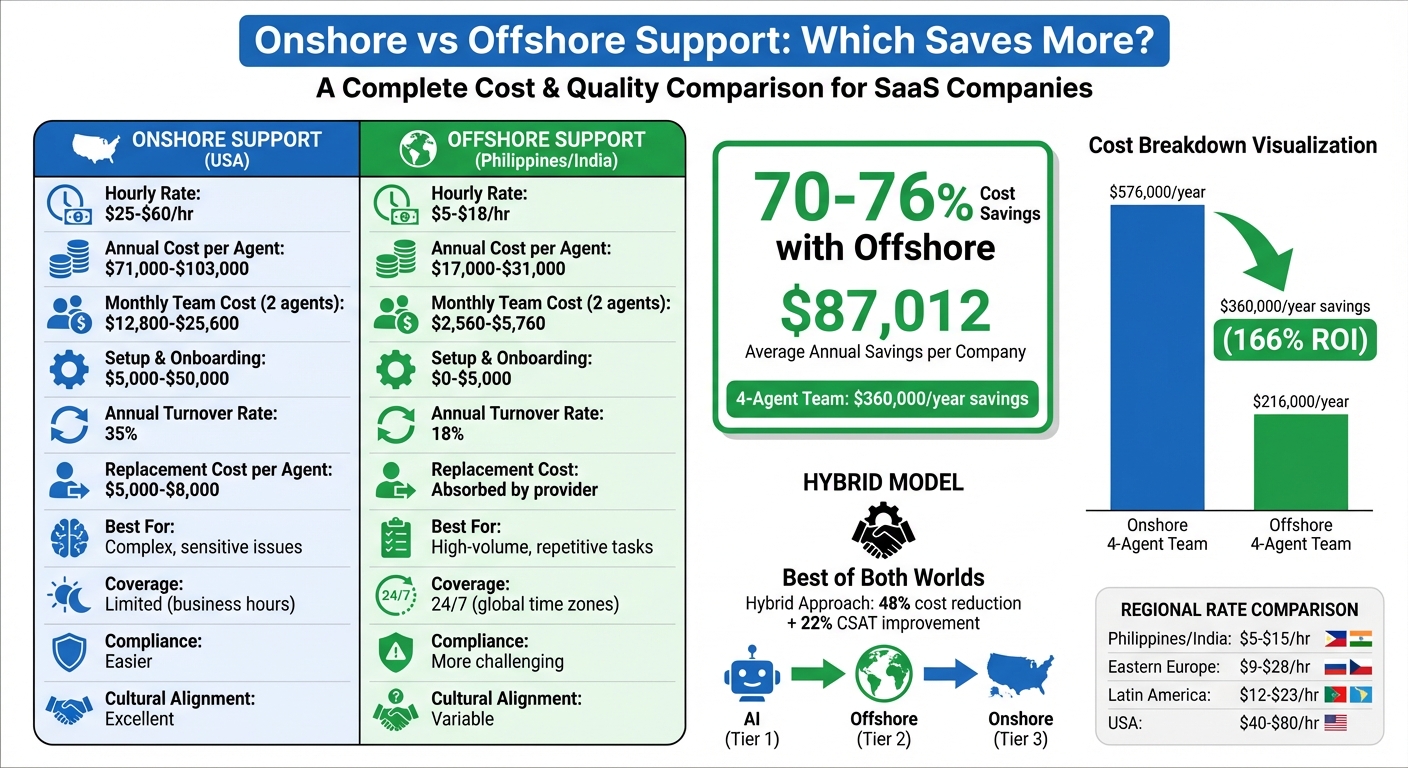
Onshore vs Offshore Support Cost Comparison 2025
Onshore Support: Costs, Benefits, and Drawbacks
Benefits of Onshore Support
Onshore support offers a clear advantage when it comes to cultural and linguistic alignment. U.S.-based agents inherently understand local slang, regional quirks, and subtle nuances, which can make customer interactions feel more personal and empathetic. This is especially valuable during high-stakes or emotionally charged conversations.
"Onshore support remains the gold standard for satisfaction scores, brand control, and regulatory peace of mind."
– Regina Ongkiko, LTVplus
Operating within the same time zone as customers also enables real-time communication during shared business hours. This setup not only speeds up issue resolution but also allows onshore teams to handle complex, technical problems that demand in-depth product expertise.
Another major advantage is regulatory compliance. Domestic operations simplify adherence to standards like HIPAA, GDPR, CCPA, and PCI DSS, reducing the risks associated with data protection. Additionally, being closer to company headquarters makes it easier to conduct training, collaborate effectively, and implement product updates quickly.
However, these benefits come with a hefty price tag.
Costs of Onshore Support
While the quality of onshore support is hard to beat, it comes at a high financial cost. U.S.-based agents typically earn base wages of $25–$30 per hour. When you include benefits, payroll taxes, and other overhead costs, the fully loaded rate can rise to $30–$40 or more per hour. Annually, this means a single full-time customer service representative can cost between $40,000 and $50,000 before factoring in additional expenses.
Operational costs add another layer of expense. Benefits alone account for about 30% of total compensation, while recruitment and training costs average $7,500 per agent. Then, there are technology expenses: CRM licenses ($120–$180 per agent per month) and AI routing tools ($25–$35 per agent per month) can pile up quickly. Internal compliance audits for data security – ranging from $75,000 to $150,000 per cycle – further strain budgets.
"In 2025, once you tally labor churn, tech subscriptions, and compliance overhead, in-house support is rarely the cheaper option."
– The Office Gurus
Attrition is another costly factor. With an average annual turnover rate of 35%, the cost of replacing and retraining agents can reach $7,000 per seat. This means the total annual cost per onshore agent can range from $71,000 to $103,000.
Beyond these financial considerations, onshore support presents operational hurdles that can’t be ignored.
Drawbacks of Onshore Support
One of the biggest challenges of onshore support is scalability. Building a full team requires a significant upfront investment in salaries, benefits, infrastructure, and management. This makes it difficult for companies to scale quickly during periods of growth or seasonal demand spikes.
Another limitation is providing 24/7 coverage. Staffing for non-business hours often involves paying premium wages for night shifts and weekends, which can dramatically increase labor costs. For SaaS companies with a global customer base, this is a particularly tough obstacle to overcome.
For smaller SaaS teams, these challenges often force a trade-off: focus on delivering high-quality service during limited hours or attempt broader coverage at the expense of quality.
sbb-itb-8132e49
Offshore Support: Costs, Benefits, and Drawbacks
Benefits of Offshore Support
One of the biggest draws of offshore support is the cost savings. For example, agents in countries like the Philippines or India typically earn between $5 and $15 per hour, compared to $28–$65 for their U.S. counterparts. This translates to labor costs that are roughly 60% to 70% lower. To put it in perspective, mid-level professionals offshore might cost $15,000–$20,000 annually, while the same role onshore could range from $60,000–$80,000. For SaaS companies, these savings can significantly impact recurring revenue models.
Offshore providers also simplify operations by bundling infrastructure costs – such as office space, utilities, recruitment, and training – into their services, making budgeting easier and reducing administrative overhead.
Another perk is the time zone advantage. Offshore teams can provide round-the-clock support without the need for premium night shifts. This ensures uninterrupted service for global customers.
Scalability is another strong point. With access to large talent pools, businesses can quickly ramp up support during growth phases or seasonal spikes in demand.
These benefits explain why 59% of companies prioritize cost reduction as their main reason for offshoring. Offshore support currently accounts for 43% of the global outsourcing market.
Still, while the base rates are appealing, hidden costs can creep in, making the true expense higher than expected.
Costs of Offshore Support
Although offshore support starts with low hourly rates, there are often hidden expenses that can increase costs by 50–85%, especially for technically complex products.
Management overhead is one such factor. Companies need internal product owners to oversee the partnership, align on performance metrics, and maintain documentation. Additionally, tools for remote collaboration and communication add to these indirect costs.
Training and onboarding are another area to consider. While many providers include basic training, aligning offshore teams with your brand voice and product knowledge may require an additional 20–30% above the base rate.
Currency fluctuations also introduce financial unpredictability. For instance, a 23.3% drop in the Indian rupee once resulted in a vendor profiting an extra $2 million on a $10 million contract.
Here’s a quick comparison of typical offshore rates by region:
| Region | Hourly Rate | Best For |
|---|---|---|
| Philippines / India | $5–$15 | High-volume, 24/7 transactional support |
| Eastern Europe | $9–$28 | Technical support, specialized IT services |
| Latin America | $12–$23 | Time zone alignment with North America |
While these rates seem attractive, the truth about outsourcing customer support is that challenges can sometimes offset these financial benefits.
Drawbacks of Offshore Support
Offshore support often faces communication challenges, even when agents are technically proficient. Differences in accents, tone, and local slang can create barriers. In fact, 70% of international outsourcing failures are linked to cultural differences rather than technical skills.
"Saving $10 an hour sounds great until one bad customer interaction costs you $1,500."
– Regina Ongkiko, LTVplus
Communication issues can lead to 56% of project failures. A single negative customer experience could cost your business up to $1,500 in lost revenue. Globally, poor customer service results in losses exceeding $75 billion annually.
Other challenges include cultural differences and time zone misalignments, which can delay feedback, complicate management, and result in expensive rework.
Maintaining control and oversight with offshore teams requires extra effort. Since you’re relying on the provider’s management systems, it’s crucial to establish clear communication protocols and management processes, conduct regular audits, and implement strong remote oversight. Without these safeguards, quality issues can lead to rework that eats into your initial savings.
For SaaS companies managing sensitive customer data, compliance with regulations like HIPAA, GDPR, or SOC 2 adds another layer of complexity and cost. The risk of data breaches, if not properly managed, can result in significant legal expenses – often outweighing the savings from lower labor rates.
Understanding Onshore vs Offshore Outsourcing in 2025
Cost Comparison: Onshore vs Offshore Support
When comparing costs, location accounts for 40–60% of the price difference, driven by factors like local labor markets, taxes, and the cost of living. This difference becomes clear when you look at the numbers: onshore support in the U.S. typically costs 3 to 5 times more per hour than offshore options in countries like the Philippines or India.
But it’s not just about hourly rates. Once you include infrastructure, benefits, and management overhead, the savings from offshore outsourcing become even more pronounced. On average, companies can save $87,012 by outsourcing offshore instead of maintaining in-house domestic operations. Offshore locations offer 70–76% savings compared to running operations in-house in the U.S..
The biggest expense in both models? Labor. It makes up 60–80% of total call center spending. Onshore employers in the U.S. face additional costs, paying 1.25 to 1.4 times the base salary to cover benefits, taxes, and equipment. The table below captures the key cost differences.
Cost Breakdown Table
| Cost Component | Onshore (USA) | Offshore (Philippines/India) |
|---|---|---|
| Hourly Labor Rate | $40–$80/hr | $8–$18/hr |
| Monthly Team Cost (2 agents, 320 hrs) | $12,800–$25,600 | $2,560–$5,760 |
| Setup & Onboarding Fees | $5,000–$50,000 | $0–$5,000 |
| Total Annual Cost (per agent) | $71,000–$103,000 | $17,000–$31,000 |
Interestingly, the Philippines tends to charge 20–30% more than India, largely due to the demand for neutral English accents and expertise in voice support. Meanwhile, onshore rates for specialized or regulated industries can climb as high as $65 per hour.
SaaS Cost Examples: Onshore vs Offshore Teams
Example: 4-Agent Team Cost Comparison
Let’s calculate the costs: a 4-agent onshore team in the U.S. comes with an annual price tag of about $576,000. This figure includes salaries, benefits, office space, licenses, and management overhead.
In contrast, an equivalent offshore team costs about $216,000 per year. Offshore providers usually handle recruitment, quality assurance, training, and technology as part of their package. This setup results in annual savings of $360,000, which represents a return of approximately 166% compared to the offshore investment. The financial advantage here is hard to ignore.
"When you add it up, the average U.S. business pays around $77,000 a year for each in-house support rep. That’s salary, tools, and overhead combined."
- Darius Talemwa, Founder, SiteChatify
Breaking this down further, the per-agent cost for an onshore team averages $72,700 annually. This includes expenses like labor, technology, compliance, recruiting, turnover, and facilities. Compare that to offshore support, where the cost per agent is around $28,000.
Attrition also plays a significant role in overall expenses. Onshore teams typically face a 35% annual turnover rate, while offshore partners average closer to 18%. Replacing a single onshore agent can cost between $5,000 and $8,000 for recruitment and onboarding. Offshore providers, however, usually absorb these costs, keeping their monthly fees consistent. This stability adds another layer of financial predictability for businesses.
How to Choose: Quality vs Cost Trade-offs
Now that the cost differences are clear, it’s time to weigh quality against cost when selecting your support model. The key is finding the balance that aligns with your customers’ needs and your operational goals.
Start by categorizing your support tickets into two types: transactional and emotional. Transactional queries – like password resets or checking order statuses – don’t demand deep cultural alignment. But emotional issues, such as VIP complaints, intricate technical problems, or high-stakes B2B scenarios, often require native-level empathy and a shared context. Use these distinctions, along with earlier cost comparisons, to determine the best fit for your service demands.
When Onshore Support Makes Sense
"If you target a premium market, elevate your support experience."
- Regina Ongkiko, Content Writer, LTVplus
Onshore support is the go-to option when quality and control take priority over cost. As highlighted in the earlier cost analysis, industries like luxury retail, healthcare, or complex B2B software often benefit from the cultural alignment and fluency that onshore agents provide. For businesses dealing with sensitive data or strict regulations like HIPAA, GDPR, or PCI DSS, onshore teams make compliance management easier.
Onshore support also excels in environments requiring close collaboration. For example, when support agents and engineering teams need to communicate frequently, onshore or nearshore teams (like those in Mexico or Latin America) can speed up project timelines by as much as 30% due to real-time accessibility.
Additionally, if your customers value local accents and cultural familiarity, onshore support can enhance their experience. For premium products, where customer satisfaction directly impacts loyalty, having agents who understand the local context can make a big difference. After all, 65% of customers say positive service experiences influence their loyalty more than advertising.
However, if scaling efficiently and keeping costs low is your primary focus, offshore support may be the better choice.
When Offshore Support Makes Sense
Offshore support is ideal for managing high-volume transactional queries, where speed and availability are more critical than cultural alignment.
One of the standout benefits of offshore support is its ability to provide 24/7 service. With a "Follow-the-Sun" model, teams are strategically placed across different time zones – Americas, Europe, and Asia – so tickets are handed off seamlessly as one region’s workday ends and another’s begins. This setup ensures agents are always working during their local daytime hours, avoiding domestic overnight premiums while reducing burnout.
For startups or businesses with tight budgets, offshore support offers significant savings, with costs averaging around $28,000 per agent. This affordability makes it easier to scale quickly without sacrificing service availability.
Often, the best approach combines the strengths of both models. A hybrid strategy uses AI for quick Tier 1 resolutions, offshore teams for Tier 2 general support, and onshore specialists for Tier 3 issues like high-value retention or complex technical challenges.
Conclusion: Which Model Saves More Money?
The best support model depends on your company’s growth stage and whether your priority leans more toward saving money or maintaining quality. Offshore support offers a clear cost advantage, often saving startups and smaller SaaS companies 60–80% compared to in-house onshore teams. This cost efficiency makes it a popular choice for businesses aiming to scale quickly.
That said, cost isn’t the only factor. Onshore support, while more expensive, can be worth the investment when quality, compliance, or brand reputation are critical. Industries like healthcare, enterprise B2B, or luxury retail often require the cultural alignment and regulatory expertise that onshore teams provide, making the higher cost justifiable.
For most SaaS businesses, a hybrid model often strikes the right balance. By outsourcing routine, transactional tickets offshore while reserving complex, high-stakes issues for onshore teams, companies can optimize both cost and quality. In 2025, a U.S.-based fashion tech SaaS company partnered with 1840 & Company to implement this strategy, achieving a 48% reduction in support costs and a 22% improvement in CSAT scores in just 90 days.
A hybrid approach not only keeps costs in check but also enhances customer service. Aidey’s flexible solutions make it easy to adopt this model, combining the affordability of offshore support with the expertise of onshore teams. Whether you need 24/7 offshore coverage, dedicated onshore specialists, or a scalable tiered system, Aidey offers free onboarding and the ability to adjust your structure as you grow. The focus is on building a support operation that reduces costs while maintaining an excellent customer experience.
FAQs
What support tasks should stay onshore vs go offshore?
Support tasks that demand language fluency, cultural understanding, advanced problem-solving, or rapid response – like handling technical problems, resolving billing disputes, or managing customer complaints – are best kept onshore. This approach ensures better service quality and the ability to adjust quickly to customer needs.
On the other hand, routine tasks – such as answering basic questions, processing orders, or addressing straightforward troubleshooting – can be offshored to regions with lower labor costs. With the help of automation and well-trained agents, these processes can remain efficient and cost-effective without sacrificing acceptable service standards.
What hidden costs can make offshore support less cheap?
Offshore support might seem like a cost-effective option at first glance, but hidden expenses can quickly eat into those savings. For instance, quality issues can lead to dissatisfied customers, increased churn, and even damage to your brand’s reputation. On top of that, there are often overlooked costs tied to onboarding, training, and ongoing governance.
Then there are the operational risks to consider. Challenges such as language barriers, differences in work practices, and time zone misalignments can result in inefficiencies, repeated work, and escalations. When you factor in these complications, the initial cost savings of offshore support may not always translate into better overall performance or reduced expenses.
How do I set up a hybrid support model for my SaaS?
To build a hybrid support model, blend your in-house team with an outsourced partner to handle increased demand effectively. Delegate straightforward tasks, like Tier 1 inquiries (think password resets), to the external team, while reserving more complex issues for your internal experts. Carefully map out workflows, define communication protocols, and clarify responsibilities for both teams. Leverage collaboration tools and data-sharing platforms to ensure smooth integration, allowing you to scale efficiently while maintaining high service standards.