

Loyalty programs are powerful tools for retaining customers, increasing profits, and driving growth. But managing them in-house can strain resources, limit scalability, and lead to inconsistent service. Outsourcing solves these challenges by offering:
- 24/7 customer support to improve response times and resolve issues quickly.
- Personalized interactions using advanced CRM tools for tailored service.
- Cost savings by reducing overhead and leveraging external expertise.
- Scalability to handle seasonal spikes or business growth without hiring more staff.
Businesses that outsource loyalty programs often see higher retention rates, increased customer satisfaction, and better ROI. For example, a global airline achieved a 20% engagement boost and a 15% increase in reward redemptions after outsourcing. By delegating complex tasks, companies can focus on innovation while ensuring a seamless customer experience.
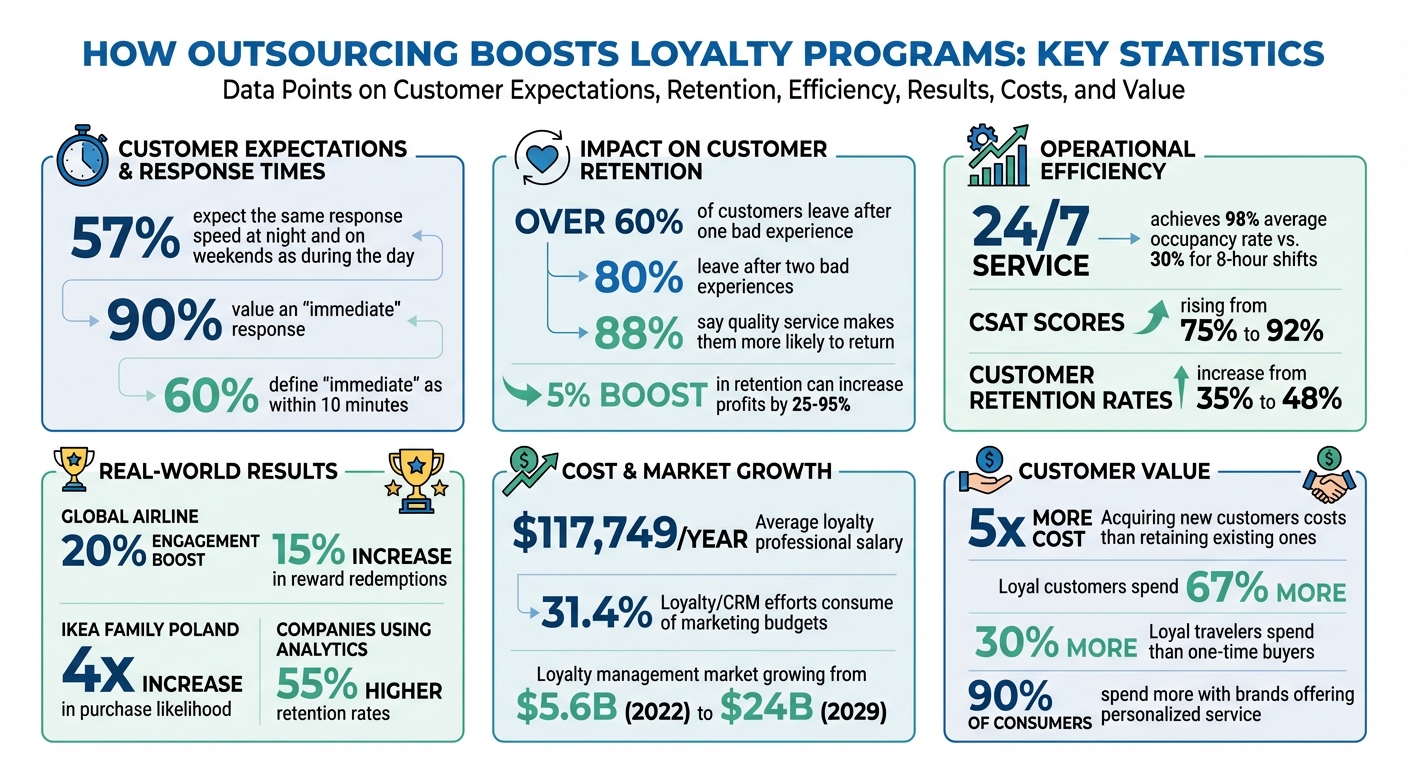
Key Statistics: How Outsourcing Improves Loyalty Program Performance
24/7 Support Improves Customer Experience
Why Always-On Support Matters
When loyalty program members need assistance outside regular business hours, delays can quickly lead to frustration. Research shows that 57% of customers expect the same response speed at night and on weekends as they do during the day. Even more striking, 90% of customers value an "immediate" response, with 60% defining "immediate" as a reply within just 10 minutes. For global brands, this means customers in cities like Tokyo, London, or Sydney shouldn’t have to wait for U.S.-based offices to open to fix a points issue or redeem a reward.
Outsourcing makes it possible to offer 24/7 support without the hefty costs of maintaining in-house night shifts. Companies with round-the-clock service often achieve an average occupancy rate of 98%, compared to just 30% during standard eight-hour shifts. This follow-the-sun model ensures that customers always have someone available in their time zone. Such availability isn’t just convenient – it’s essential for addressing loyalty-related issues as they arise.
Solving Loyalty Member Issues in Real Time
Being available at all times does more than meet expectations; it allows companies to resolve loyalty issues immediately. These disputes often feel personal to customers. Problems like missing points, tier status errors, or failed reward redemptions can quickly turn even the most loyal customers into detractors. As Richard Tait, a seasoned retail executive, puts it:
"Customers don’t remember what you said. They remember what you did – especially when they were upset".
Speed is critical: over 60% of customers leave after one bad experience, and 80% after two. For instance, when a global airline outsourced its frequent flyer program management in March 2025, the results spoke volumes. Within a year, member engagement jumped by 20%, and reward redemptions increased by 15%. By leveraging specialized support teams, the airline was able to resolve issues like missing miles or tier disputes on the spot, avoiding what experts refer to as "broken promises" that damage trust.
Outsourced teams equipped with integrated CRM systems can access full member histories, enabling them to resolve issues in a single call. This First Contact Resolution (FCR) approach focuses on delivering effective solutions quickly, rather than rushing through calls, and is a powerful driver of long-term customer loyalty.
sbb-itb-8132e49
Personalized Customer Interactions Through Outsourcing
How Skilled Remote Teams Help
Skilled remote teams do more than just provide around-the-clock support – they take customer interactions to the next level by making them personal. Outsourcing partners don’t just add manpower; they integrate seamlessly with your CRM to give agents a complete view of each customer’s history. This includes details like purchase habits and past interactions, allowing for service that feels tailored to the individual. As Enshored puts it:
"Personalized interactions by external customer teams are made possible through the analytics provided by CRM systems… identifying customer preferences, past purchasing behaviors, and potential future needs".
Top outsourcing providers also prioritize training their agents in soft skills such as empathy and effective communication. They often use AI tools to anticipate customer needs before they even arise. For instance, if a customer frequently books beach vacations, the system can identify this pattern and suggest rewards or offers that align perfectly with their preferences. Companies combining Voice of the Customer analytics with rewards programs report 55% higher customer retention rates.
For global brands, multilingual and culturally aware teams are a game-changer. Leading outsourcing providers can offer support in over 95% of the world’s languages. This ensures that a loyalty member in Tokyo experiences the same personalized service as one in New York. These teams excel at understanding regional customs and cultural nuances, fostering trust and connection in diverse markets. Such deep personalization doesn’t just enhance service – it builds emotional bonds that strengthen loyalty programs.
Building Emotional Connections with Members
True personalization goes beyond simply using a customer’s name – it’s about making them feel genuinely valued. Outsourced teams achieve this by going the extra mile: sending birthday offers, following up with tailored recommendations after a purchase, or giving top-tier members early access to sales. These thoughtful touches create emotional connections that drive loyalty. Research backs this up: 88% of customers say quality service makes them more likely to return, and loyal travelers spend an average of 30% more than one-time buyers.
When agents are empowered to step away from rigid scripts, they can address each customer’s unique needs in a way that feels personal and authentic. As Valor Global highlights:
"BPO partners integrate sophisticated data analytics and machine learning tools to refine loyalty strategies and predict consumer trends".
This combination of human empathy and data-driven insights turns everyday interactions into meaningful moments that inspire brand loyalty and reduce churn.
Community, Loyalty, and Human Touch in Customer Experience
Cost Savings and Scalability for Growing Businesses
Outsourcing loyalty programs offers a practical solution to the challenges of managing them in-house, delivering both financial relief and the flexibility to grow.
Cutting Down Overhead Costs
Running a loyalty program internally is no small expense. It typically requires a team of 16 employees, with the average annual compensation for a customer loyalty professional sitting at around $117,749. On top of salaries, there are added costs for benefits, taxes, recruitment, and the necessary technology infrastructure.
Outsourcing simplifies this. Instead of juggling separate expenses for marketing managers, designers, rewards fulfillment teams, and IT platforms, businesses pay a single, predictable fee. This approach eliminates the need for hefty upfront investments in CRM and IT systems by utilizing the provider’s existing technology. As Level 6 explains:
"Outsourcing turns your internal cost swings into predictable, steady fees and can give you some access to expertise without capital outlays."
Many outsourcing partners operate on performance-based pricing, meaning you pay for measurable results – like increased customer retention or acquisition – rather than maintaining a large internal team. With loyalty and CRM efforts consuming 31.4% of marketing budgets, outsourcing shifts payroll and related expenses to the provider. This predictable cost model not only reduces financial strain but also enables businesses to expand their loyalty initiatives with ease.
Adapting Loyalty Programs to Business Growth
Growth brings complexity. As your customer base grows, so do the demands on your loyalty program. Seasonal spikes, like Black Friday or holiday shopping, can overwhelm an in-house team. Outsourcing partners provide instant scalability, allowing you to ramp up resources during peak times without the need to hire and train new staff. When demand subsides, scaling back is just as simple – no layoffs required.
Take IKEA Family in Poland, for instance. By leveraging machine learning, they saw a fourfold increase in purchase likelihood among engaged members. These results are made possible by the advanced tools and expertise outsourcing providers bring – resources that would take years for an in-house team to develop.
Outsourcing also accelerates implementation. External providers can launch loyalty programs up to 10 times faster than building an internal solution. In a competitive market, speed matters. Providers deliver fully integrated tools like omnichannel platforms, AI-driven chatbots, and advanced CRM systems that are ready to go from day one. This rapid deployment minimizes delays and avoids the pitfalls of trial-and-error development, ensuring your program is responsive and effective from the start. By outsourcing, you can focus on broader business strategies while leaving the operational details to the experts.
Measuring the Impact of Outsourcing on Loyalty Programs
After outsourcing your loyalty program support, the next step is tracking performance. Measuring key metrics ensures your investment is paying off and helps identify areas for improvement. Without clear data, you risk unnecessary expenses and missed opportunities to enhance your program.
Key Metrics to Monitor
Start with Customer Lifetime Value (CLV), which reflects the total revenue each customer generates over time. Studies show that just a 5% boost in customer retention can lead to profit increases ranging from 25% to 95%. Alongside CLV, keep an eye on Repeat Purchase Rate (RPR) and purchase frequency to understand if outsourcing is encouraging repeat business [30,31].
To measure customer sentiment and interaction quality, focus on Net Promoter Score (NPS) and Customer Satisfaction (CSAT). These scores are crucial since 90% of consumers are willing to spend more with brands that offer personalized service. Additionally, redemption rates – ideally between 70% and 80% – can indicate whether your rewards are appealing and the process is user-friendly.
Operational metrics like response times, resolution rates, and SLA compliance are equally important [2,17]. As loyalty expert Pawel Dziadkowiec notes:
"The best situation is when customers actively use points because this means that your loyalty program is ‘healthy’ and your customers enjoy using it".
These metrics provide a foundation for assessing the long-term effectiveness of outsourcing.
Before and After Comparison
To measure the true impact of outsourcing, establish baseline KPIs before making the switch. Many companies report significant improvements, such as CSAT scores rising from 75% to 92% and customer retention rates increasing from 35% to 48% [2,13]. Redemption rates often see a 15% or greater boost when specialized partners streamline the process.
Focus on long-term trends over 6 to 12 months rather than short-term spikes, as meaningful changes in metrics like CLV and retention take time. A/B testing or dividing new members into test and control groups can provide deeper insights. This is particularly useful given that 41% of corporate loyalty leaders find it challenging to measure their programs’ financial impact.
Aidey: Tailored Outsourcing for Loyalty Program Success
When it comes to loyalty program support, finding a solution that offers both flexibility and reliability is key. That’s where Aidey steps in. Specializing in 24/7 outsourcing customer support for SaaS, startups, e-commerce, and hospitality, Aidey provides a service designed to tackle the challenges of in-house management while reducing support costs. From inconsistent service to difficulties scaling, Aidey helps businesses deliver seamless support while keeping customers happy.
Aidey’s Key Features and Benefits
Round-the-clock availability is one of Aidey’s standout features. Whether customers are redeeming points at midnight or checking balances during a holiday, Aidey ensures someone is always there to help. This constant support builds trust and minimizes frustration. As Ethan Davis, CHRO at MCI, puts it:
"Knowing that someone is ready to assist at any time fosters a sense of trust".
Aidey also employs skilled remote teams that seamlessly integrate with your CRM, acting as an extension of your brand. With the loyalty management market projected to grow from $5.6 billion in 2022 to $24 billion by 2029, having a dedicated, knowledgeable team is more crucial than ever.
Another advantage? Free onboarding. Aidey covers recruitment, training, and system setup without charging extra, helping businesses launch professional support quickly. And thanks to their global scalability, expanding into new markets and scaling customer support becomes manageable without straining internal resources. These features directly address the challenges businesses face, offering a smooth path to enhanced customer loyalty.
How Aidey Solves Loyalty Program Challenges
Many loyalty programs falter due to inconsistent service and limited scalability. Aidey tackles these issues head-on by providing dedicated teams that deliver consistent, high-quality support across all customer interactions. Unlike rigid, scripted responses, their agents are trained to make independent decisions, ensuring personalized solutions for each customer.
For growing businesses, Aidey’s model allows teams to focus on innovation while maintaining excellent customer care. By integrating with your existing systems, Aidey’s agents can anticipate customer needs and offer tailored recommendations based on purchase history and past interactions. This kind of personalized service can significantly boost retention – companies using advanced analytics alongside loyalty programs report 55% higher customer retention rates.
Conclusion
Outsourcing customer support transforms loyalty programs into powerful tools for retaining customers. With 24/7 multichannel support, businesses ensure members can redeem rewards or solve issues anytime, fostering trust and satisfaction. These advantages directly tackle the challenges businesses often face.
What makes outsourcing stand out is its ability to combine personalization with scalability. Remote teams, equipped with AI-driven analytics, craft tailored rewards based on customer shopping habits. At the same time, flexible staffing models allow businesses to quickly adapt during peak seasons – avoiding the complications of internal hiring. This approach turns unpredictable payroll expenses into steady, manageable costs while eliminating the need for significant investments in new technology. Companies using these methods consistently report higher retention and engagement rates.
Here’s a key consideration: acquiring new customers costs five times more than retaining existing ones, and loyal customers tend to spend up to 67% more. Outsourcing enables businesses to tap into this value by handing off complex administrative tasks to specialists, freeing internal teams to focus on innovation and strategic growth.
Aidey exemplifies this approach by providing expert, scalable support solutions. With no setup fees, seamless integration into existing systems, and a focus on flexibility and data security, Aidey helps businesses run loyalty programs that deliver results – without the overhead or risks of building everything internally.
For companies looking to turn loyalty programs into a competitive edge, outsourcing isn’t just about saving money – it’s a strategic choice that enhances customer satisfaction, boosts retention, and drives long-term growth.
FAQs
How do I choose the right loyalty support outsourcing partner?
To choose the best outsourcing partner for loyalty support, start by evaluating their experience with loyalty programs, such as point-based or tiered systems, as well as their approach to customer engagement. Look for partners that provide flexible operations and have access to advanced tools for handling data and performing analytics. Additionally, take the time to review their track record, ensure they provide reliable 24/7 support, and assess how well their values and working style align with your business. These factors will help ensure they can effectively strengthen your loyalty program and address your unique requirements.
How can I keep my loyalty program’s brand voice with an outsourced team?
To keep your loyalty program’s brand voice intact when outsourcing, start by providing clear style guides that outline your tone, language, and messaging standards. Pair this with specialized training for the outsourced team to help them understand your brand’s personality and values.
Regular quality checks are crucial to ensure the team stays on track. Foster ongoing collaboration and feedback to address any misalignments quickly and effectively. Additionally, monitoring customer interactions and using tools designed to reinforce your brand identity can help maintain consistency across every channel.
Which KPIs best prove outsourcing improved my loyalty program ROI?
When evaluating how outsourcing affects your loyalty program’s ROI, certain KPIs provide valuable insights. Metrics such as activation rates, redemption rates, and repeat purchase frequency reveal shifts in customer activity and participation. These numbers can show whether your program is driving the desired engagement.
Additionally, tracking customer lifetime value (CLV), retention rates, and engagement levels – like how often rewards are redeemed – offers a clearer picture of loyalty improvements and profitability. By focusing on KPIs that connect outsourcing initiatives to revenue growth and customer retention, you’ll have concrete evidence of the program’s financial impact.