

Outsourcing customer support can reduce your costs by up to 60% while improving efficiency. Here’s why:
- Lower Labor Costs: U.S.-based agents cost $65,000–$72,000 annually, while offshore agents cost $26,000–$28,000.
- Reduced Overhead: No need for office space, equipment, or software licenses – outsourcing providers bundle these into a single fee.
- Minimized Turnover Costs: In-house teams face 35% turnover, costing $7,000 per agent annually. Outsourcing cuts this to $2,000.
- Scalable Expenses: Pay only for productive hours or ticket volume, avoiding fixed costs during slow periods.
- Improved Operations: Providers use advanced tools to reduce idle time and streamline workflows.
Outsourcing isn’t just about saving money – it frees up resources for growth, improves response times, and enhances customer satisfaction. For SaaS companies, this means reallocating funds to innovation and scaling without sacrificing quality.
Why Outsourcing Customer Service Saves You Money
sbb-itb-8132e49
The Real Cost of In-House Support Teams
Many businesses underestimate how much it truly costs to maintain an in-house support team. The total expense often runs 25% to 40% higher than base salaries. For instance, a single support agent in the U.S. can cost between $60,000 and $80,000 annually when factoring in base pay, health insurance, 401(k) contributions, payroll taxes, and bonuses. But that’s just the beginning. Companies also face costs for recruitment, training, office space, equipment, software, and management overhead. Here’s a closer look at these expenses.
Staff Salaries and Hiring Expenses
Base salaries for U.S.-based support agents start at $42,000 to $48,000 for entry-level positions and climb to $55,000 to $65,000 for technical or SaaS-specific roles. Hiring isn’t cheap either – recruitment costs alone range from $4,000 to $7,000 per new hire, covering job postings, interviews, and background checks. On top of that, training costs about $1,300 per employee annually.
Turnover adds another layer of expense. With annual attrition rates between 20% and 35% for support roles, each departure can cost $5,000 to $8,000 in replacement expenses. For technical roles, this figure can climb to 1.5 times the employee’s annual salary. Plus, new hires typically need two to three months to reach full productivity.
For a team of 10 agents, salaries and benefits alone can total $600,000 per year. When you factor in the constant churn of recruiting and retraining, the costs climb even higher.
Infrastructure and Overhead Costs
Operational infrastructure is another major cost driver. Office-related expenses – like space, utilities, furniture, and equipment – add about $5,000 per agent annually. For a 10-person team, that’s an additional $50,000 per year.
Technology is another big-ticket item. CRM platforms, helpdesk software, VoIP systems, and AI tools cost $120 to $180 per agent per month, which adds up to $3,200 annually per seat. For mid-sized teams, these tools can cost anywhere between $100,000 and $250,000 per year. Training and management overhead for a 10-person team tacks on another $80,000 annually.
And don’t forget compliance. Handling sensitive data often requires adhering to standards like HIPAA, PCI-DSS, or GDPR. Regular audits for these can cost between $75,000 and $150,000 per cycle. These are fixed costs that don’t shrink during slower periods. Unlike outsourcing, where costs scale with demand, in-house teams bear these expenses regardless of ticket volume.
| Cost Component | Annualized In-House Cost (Per Seat) |
|---|---|
| Direct Labor (Loaded) | $55,000 |
| Technology & Telecom | $3,200 |
| Compliance & QA | $2,500 |
| Recruiting & Churn | $7,000 |
| Facilities & Utilities | $5,000 |
| Total | ≈ $72,700 |
Source: The Office Gurus 2025 Cost Comparison
When you add it all up, the financial burden of an in-house support team becomes clear. Outsourcing, by contrast, offers a way to convert these hefty fixed costs into more flexible, scalable expenses.
How Outsourcing Cuts Support Costs by 60%
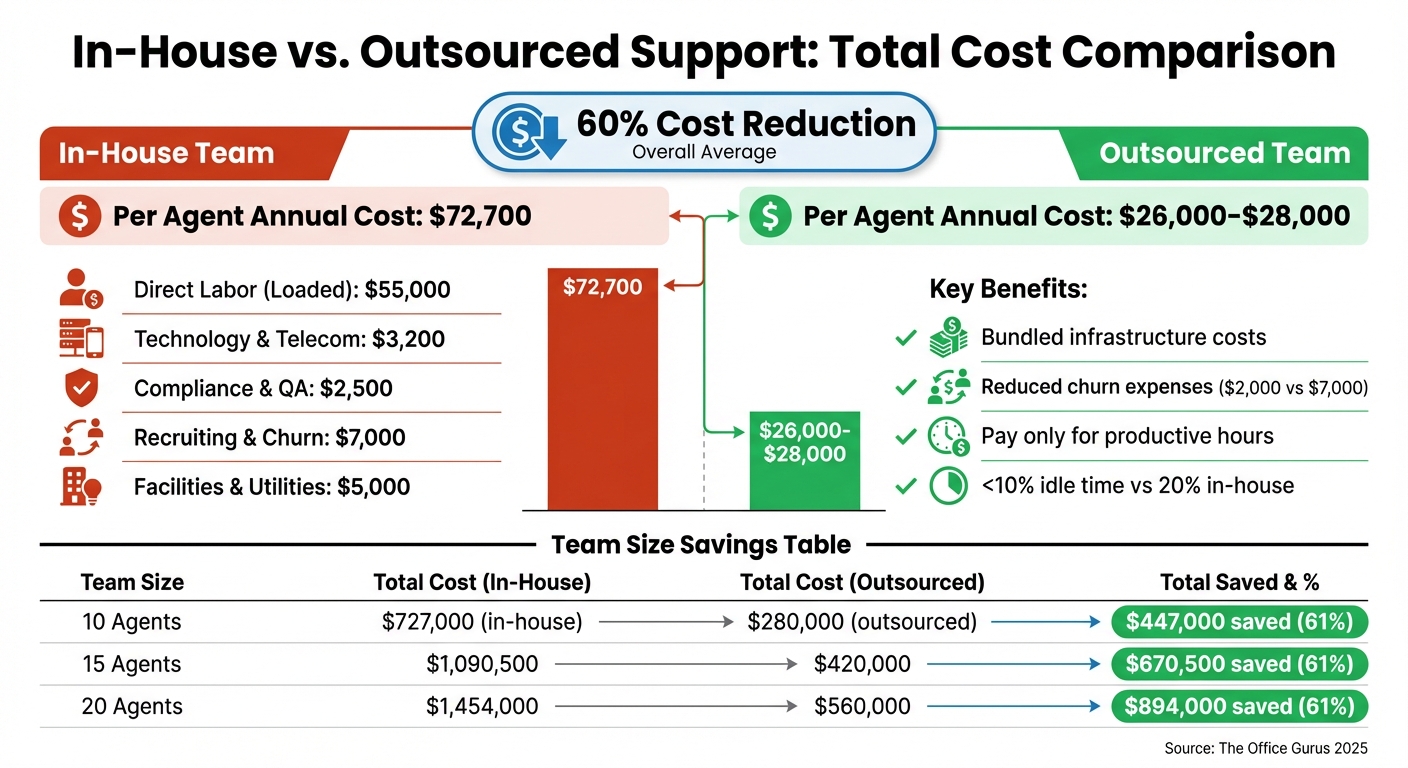
In-House vs Outsourced Customer Support Cost Comparison
Outsourcing can slash support costs by up to 60% by streamlining multiple expense categories. It’s not just about replacing expensive domestic labor with lower-cost alternatives – it’s about turning fixed costs into flexible ones, avoiding infrastructure investments, and leveraging efficiencies that in-house operations often struggle to achieve. Let’s break down where these savings come from.
Where the Savings Come From
The biggest cost saver is labor. A U.S.-based support agent, including benefits, costs around $65,000 to $72,000 annually. In comparison, an offshore or nearshore agent costs roughly $26,000 to $28,000 per year. This alone can cut labor costs by 20–40%. For technical support roles, the savings can climb as high as 50%. When scaling to larger teams, total cost reductions can reach anywhere from 52% to 70%.
But it’s not just labor. Outsourcing eliminates what’s often called the "churn tax" – the recurring costs of hiring, onboarding, and replacing agents. In-house teams usually face a 35% annual turnover rate, with replacement costs of about $7,000 per agent. Outsourcing reduces these churn-related expenses to around $2,000 per seat. Plus, outsourcing providers bundle costs like office space, equipment, CRM licenses, VoIP systems, and compliance audits into a single service fee.
Operational efficiencies also play a big role. Outsourcing partners can keep paid idle time under 10%, while in-house teams often hover around 20%. Advanced workforce management tools and shared queues allow providers to charge only for productive hours, aligning costs with ticket volume rather than fixed headcounts.
"In 2025, once you tally labor churn, tech subscriptions, and compliance overhead, in-house support is rarely the cheaper option." – The Office Gurus
Cost Comparison: In-House vs. Outsourcing
Here’s a side-by-side look at the total costs for in-house teams versus outsourced ones, factoring in salaries, benefits, technology, facilities, recruiting, and overhead:
| Team Size | In-House Total Cost | Outsourced Total Cost | Annual Savings |
|---|---|---|---|
| 10 Agents | $727,000 | $280,000 | $447,000 (61%) |
| 15 Agents | $1,090,500 | $420,000 | $670,500 (61%) |
| 20 Agents | $1,454,000 | $560,000 | $894,000 (61%) |
Source: The Office Gurus 2025 Total Cost of Ownership Analysis
For a 10-person team, outsourcing can save $447,000 annually – funds that could be redirected toward scaling your business. As team sizes grow, the cost advantages of outsourcing only become more compelling, making it an attractive option for startups and SaaS companies looking to optimize their budgets.
Aidey‘s Outsourcing Solutions for SaaS Companies
Aidey takes the proven benefits of outsourcing and turns them into practical, scalable support services tailored specifically for SaaS companies and startups.
What Aidey Offers
Aidey provides round-the-clock customer support designed to help SaaS companies grow without unnecessary headaches. Their onboarding process is completely free and covers everything – recruitment, training, and system setup – making the transition seamless and cost-free.
The platform features native English-speaking teams with expertise in advanced technical support. Thanks to optimized workflows and a follow-the-sun model, customers get help during their local business hours, while agents avoid overnight shifts.
Aidey’s flexible plans adapt to your ticket volume. Whether you need shared teams for steady workloads or dedicated teams for more complex support needs, you only pay for productive output. This approach transforms fixed labor costs into variable expenses, letting you align your support budget with your actual business demands.
These features don’t just improve support quality – they also deliver measurable savings.
How Aidey Reduces Costs
Aidey keeps costs low with efficient training and a tiered support system. By combining AI for routine Tier 1 tasks with human agents for more technical issues, they reduce reliance on expensive specialists. Their follow-the-sun model also eliminates the need for costly graveyard shift premiums, cutting these expenses by 20–30%.
The shared team model further reduces costs by spreading infrastructure expenses – like CRM licenses, VoIP systems, and office space – across multiple clients. For companies needing dedicated teams, Aidey handles recruitment and onboarding in-house, saving you from hiring additional vendors or taking on extra overhead. This bundled approach not only lowers costs but also maintains service quality through structured onboarding and ongoing performance checks. By turning fixed expenses into variable costs, Aidey aligns perfectly with the article’s cost-savings framework.
Strategies to Maximize Savings with Outsourcing
Using Offshore Support Teams
Offshore support teams can cut costs significantly – by about 60% compared to onshore agents. While onshore agents typically cost between $65,000 and $72,000 annually, offshore agents cost around $26,000 to $28,000 per year. By distributing teams across different time zones, businesses can adopt a follow-the-sun model, eliminating the need for costly domestic overnight shifts. To ensure quality, it’s essential to enforce strict C1/C2 English proficiency standards, provide targeted training, and implement a tiered support structure. For example:
- L1: Handles routine inquiries.
- L2: Focuses on more technical troubleshooting.
- L3: Reserved for mission-critical or complex issues.
This approach ensures that highly skilled (and more expensive) specialists only deal with high-priority problems. Additionally, leveraging technology can further drive down infrastructure costs and enhance efficiency.
Reducing Infrastructure Costs with Technology
Adopting cloud-based tools and virtual phone systems can eliminate the need for physical office spaces, on-site hardware, and dedicated landlines. A virtual auto-attendant, for instance, can cost as little as $30 per month.
AI-powered solutions are another game-changer. Ticket deflection driven by AI can reduce the number of inquiries reaching human agents by 40–80%. For mid-sized SaaS companies, this translates to annual savings of $150,000 to $250,000 by automating routine tasks, which often make up 70–80% of ticket volume. With AI, the cost per ticket drops to just $0.99 compared to $6–$12 for human-handled tickets, offering a clear return on investment.
Consolidating all support channels – email, chat, voice, and social media – into a single omnichannel platform can prevent duplicate efforts and reduce expenses tied to managing multiple software tools. Live chat, for example, is 76% cheaper than phone support. By combining improved ticket deflection with streamlined workflows, businesses can achieve both cost savings and enhanced customer self-service.
Improving Ticket Deflection and Workflows
Start by auditing your support processes to pinpoint the top 20 inquiries, which typically account for 70% of ticket volume. Deploy in-app help widgets to address these common concerns before users even create a ticket.
Using product analytics, you can trigger help modals or chatbot prompts when users struggle – like spending too much time on a screen or failing an action repeatedly. Since 81% of customers try to resolve issues on their own before reaching out to support, improving self-service options can deliver immediate results.
To maintain quality, set AI to handle responses only when it has an 85% or higher confidence level. Lower-confidence queries should be routed to human agents. Companies that use this hybrid model often see resolution times improve by up to 50% and customer satisfaction rise by 25–45%. AI Copilots further enhance efficiency, enabling agents to handle 14% more tickets per hour and cutting training time in half. Instead of starting from scratch, agents can focus on reviewing and refining AI-generated responses. By refining ticket deflection and response workflows, these strategies work hand-in-hand with offshore teams and technology investments to drive significant savings and improved service quality.
Results from Outsourcing Customer Support
Measurable Outcomes and Metrics
Outsourcing customer support often leads to impressive gains across key performance indicators. Take, for instance, a healthcare technology company that managed to slash its annual helpdesk costs from $1.2 million to $520,000, a 57% reduction, all while improving service quality. Similarly, a healthcare SaaS provider achieved a 45% reduction in costs, cut resolution times by 35%, and boosted customer satisfaction (CSAT) scores from 82% to 91%.
Response times improve dramatically as well. A Series B fintech company reduced its first response time from 14 hours to just 38 minutes within 60 days. Other organizations have reported time reductions ranging from 35% to 82% – some even cutting response times from 45 minutes to 8 minutes.
Specialized outsourcing providers also enhance First Contact Resolution (FCR) rates, typically increasing them from 60–70% to 80–85%. Average resolution times can drop significantly too, with one case showing a 63% reduction, from 4 hours to 1.5 hours. For SaaS companies, these efficiencies are transformative. One firm, for example, reclaimed over 200 engineering hours per month, letting developers focus on advancing the product rather than handling support tickets.
These measurable improvements don’t just reduce costs – they create opportunities for reinvestment and strategic growth.
How Savings Enable Business Growth
The financial savings from outsourcing often go directly into scaling businesses. One Series A company, for example, redirected $400,000 in annual support savings to hire senior engineers. This enabled them to release three major product features in a single year instead of just one. Similarly, U.S.-based MSP Novatech saved $3.5 million annually by leveraging over 70 offshore engineers, which helped them grow their IT team by an astonishing 1,600%.
"When we outsourced our help desk, it wasn’t just about lowering costs. It was about gaining a partner that could keep pace with our growth and deliver resilience we couldn’t build alone."
– CIO, Harvard Business Review
The impact isn’t limited to financial metrics. One e-commerce founder reclaimed over 30 hours per week – time previously spent answering tickets late into the night. This freed them to focus on strategic planning and growing the business. Outsourcing doesn’t just save money; it unlocks resources and time, enabling companies to innovate, expand their market presence, and strengthen their competitive edge.
Conclusion
Outsourcing customer support can transform how SaaS companies and startups manage their resources. Instead of dealing with fixed expenses like salaries, office space, and equipment, businesses can shift to paying only for actual outcomes. For instance, outsourcing has the potential to cut per-agent costs by more than 50%, leading to a substantial reduction in overall support expenses.
But the advantages go far beyond just saving money. By outsourcing, companies can free up hundreds of engineering hours every month, improve response times, and boost customer satisfaction scores by 15–25%. These improvements have a direct impact on both revenue and customer retention.
This cost efficiency creates opportunities for reinvestment and greater flexibility. The key is finding the right balance. Businesses can retain control over high-touch, sensitive interactions while outsourcing high-volume, routine queries. This approach ensures cost savings without compromising quality. Additionally, implementing strict service level agreements, integrating outsourced teams with existing CRM systems, and using hybrid AI-human models can help maintain top-tier service while maximizing efficiency.
"The question isn’t whether you can afford to outsource. It’s whether you can afford not to." – Epicenter
For SaaS companies looking to scale customer support without escalating costs, outsourcing provides a reliable solution. The savings achieved can be redirected toward growth initiatives, innovation, and strengthening competitive advantages.
FAQs
How fast can I start outsourcing support?
You can usually begin outsourcing customer support within 2 to 4 weeks, though the exact timeline depends on your specific needs and how complex your operations are. Things like the size of your team, any customization you require, and how your systems integrate can all influence the process. Partnering with a provider that has a smooth onboarding process can help speed things up, allowing startups and SaaS companies to scale their support teams quickly without unnecessary delays.
How do I keep support quality high with an outsourced team?
To ensure top-notch support with an outsourced team, start by setting up clear processes that reflect your standards. Regular training sessions are essential to keep the team aligned with your expectations, and quality assurance measures help maintain consistency.
When selecting a partner, look for one that tailors their teams to meet your specific needs and values alignment with your company’s culture. Keep a close eye on performance metrics, establish feedback loops to address issues promptly, and use outcome-based SLAs to drive consistent results. This approach not only maintains quality but also helps scale operations smoothly.
What should I include in an outsourcing SLA?
An outsourcing Service Level Agreement (SLA) needs to outline specific, measurable commitments to ensure high service standards. It should include key performance indicators such as response times, resolution times, and customer satisfaction scores. The agreement must also clearly define the range of services provided – whether it’s email, chat, phone support, or all three – along with availability expectations like 24/7 coverage. Additionally, it should detail escalation procedures for handling issues and specify penalties for missed targets or incentives for exceeding them. Regular reviews and detailed reporting play a crucial role in maintaining compliance and driving ongoing improvements.