

Growing pains in customer support are common for startups. If you’re spending too much time on tickets, seeing slower response times, or struggling to scale during busy periods, outsourcing customer support could be the solution. Here’s a quick rundown of the key signs that it might be time to make the switch:
- Overwhelmed team: Your in-house staff can’t keep up with ticket volume.
- Slower responses: Customers are waiting longer, and satisfaction is dropping.
- Escalations piling up: Routine issues require specialized help your team lacks.
- High turnover: Constant hiring and training are draining resources.
- No 24/7 coverage: Global customers expect round-the-clock service.
- Rising costs: Support expenses are growing faster than revenue.
- Inconsistent service: Quality varies across time zones and channels.
- Scaling struggles: Growth surges leave your team scrambling.
Outsourcing can save costs, improve efficiency, and help you focus on building your business. If you’re facing three or more of these challenges, it’s worth considering. Let’s dive into the details.
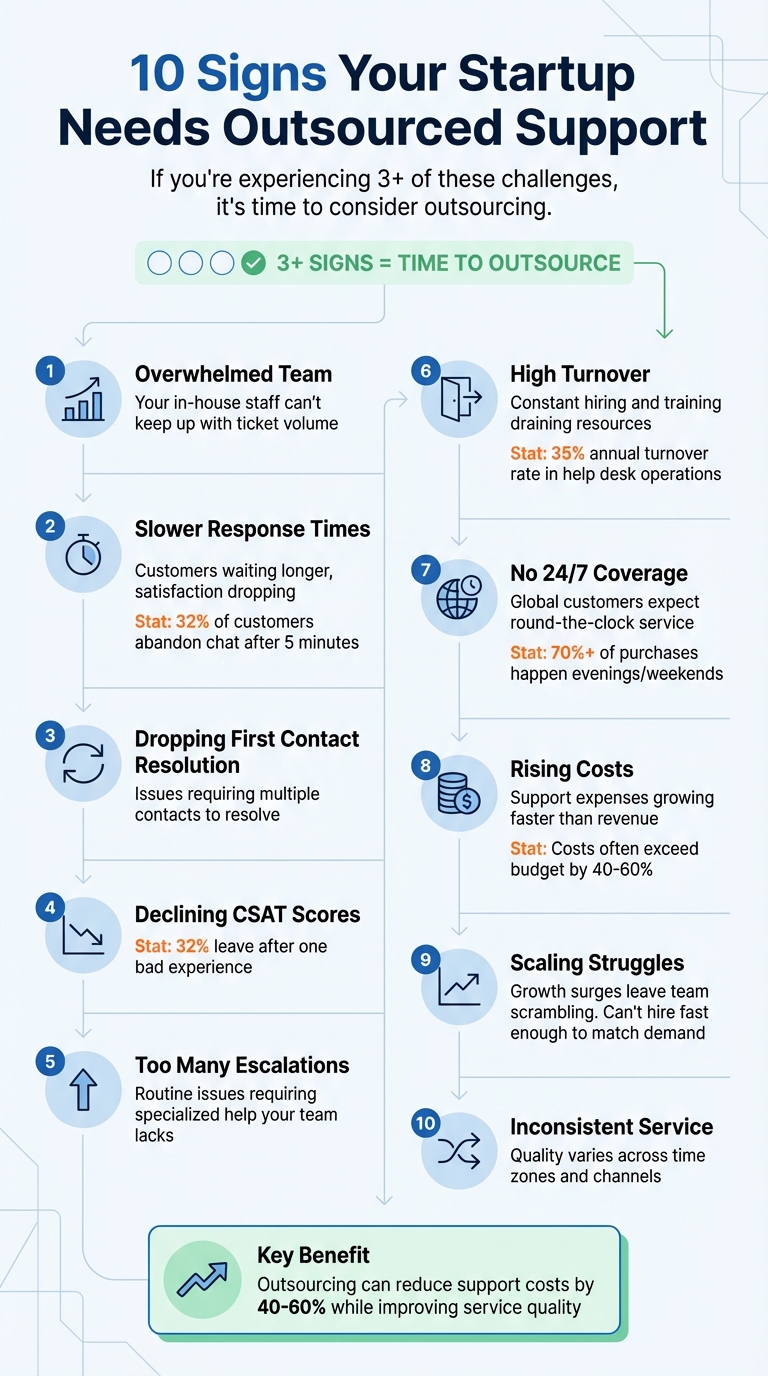
10 Signs Your Startup Needs Outsourced Customer Support
Ep.19: A guide to customer service outsourcing (Feat. Roman Siepelmeyer, GetYourGuide)
sbb-itb-8132e49
1. Your In-House Team Can’t Keep Up with Ticket Volume
The most obvious red flag? Your support queue keeps piling up. When ticket volumes grow, it’s a sign your internal operations are struggling to keep pace. Teams get swamped with repetitive tasks, leaving little room for essential projects. This backlog doesn’t just slow things down – it can throw your key metrics off track.
Impact on Operational Efficiency
When tickets start exceeding SLA resolution times or technical issues crop up regularly, it’s a clear sign of operational strain. These delays chip away at productivity and expose capacity limits. For instance, a drop in completion rates – how often tasks are finished on time – shows your team is stretched too thin.
Ability to Meet Customer Expectations
Longer wait times and unresolved issues don’t go unnoticed. Negative reviews on platforms like Google, Yelp, or Facebook often highlight these shortcomings. And here’s the kicker: 32% of customers will leave a brand they love after just one bad experience.
Take the example of a SaaS founder in San Francisco. Their first response times had ballooned to 8 hours, frustrating customers. By outsourcing and implementing 24/7 coverage, they cut response times to just 6 minutes, improving customer satisfaction by 9 points. This shift also freed up over 10 hours a week for the founder to focus on fundraising and product development.
Scalability to Handle Growth
Outsourcing offers a flexible way to scale. Instead of being weighed down by fixed costs, you can adapt to fluctuating demand. For example, a robotic vacuum company preparing for a U.S. launch on Amazon Prime Day partnered with an outsourced team. Within just 10 days, the team managed over 200,000 customer interactions, achieved 15-minute response times for 90% of emails, and boosted customer satisfaction to 93%. The results? Product returns dropped by 35%, and the app’s rating jumped from 2.1 to 3.6 stars.
2. Response Times and Handle Times Are Getting Longer
When response and resolution times start to drag, it’s a clear sign of mounting challenges. As ticket volumes increase, your team can struggle to keep up, and those delays often lead to unhappy customers. Consider this: 32% of consumers will abandon a live chat inquiry if they don’t get a response within 5 minutes. That’s a short window to make a lasting impression.
Impact on Operational Efficiency
Slow resolution times don’t just frustrate customers – they can throw your entire operation off balance. Overwhelmed teams may rush to close tickets without fully solving the issue or bounce customers between departments, creating repeat contacts and lowering service quality. The ripple effect doesn’t stop there. When founders or product managers have to step in to manage backlogs, it pulls them away from critical tasks like product development or securing funding.
"Every hour you spend triaging is an hour not spent building, selling, or hiring. The signal you loved is now buried under noise." – Daria Littlefield, Silicon Valley Support
Ability to Meet Customer Expectations
Customers know what they want – and they’re not shy about it. For live chat, they expect a response in under 30 seconds. For email and social media, the bar is set at under an hour. Phone calls? 95% should be answered within 1 minute. Fail to meet these standards, and you risk losing them. In fact, one out of three consumers will walk away from a brand after a bad service experience.
Scalability to Handle Growth
Meeting customer expectations is one thing, but scaling to handle growth is another. Outsourcing can give your startup the flexibility it needs during high-demand periods like product launches or the holiday rush. Instead of spending months hiring and training new team members, outsourcing allows you to instantly scale your support. This model also shifts fixed costs into variable ones – you only pay for what you use. It’s a smart way to keep up with customer demands without overloading your internal team.
3. First Contact Resolution Rates Are Dropping
When customers have to reach out multiple times to fix the same issue, it’s a clear sign something’s broken. A declining first contact resolution (FCR) rate frustrates customers, clogs up your ticket queue, and keeps your team stuck in a loop of repetitive tasks.
Impact on Operational Efficiency
Low FCR has ripple effects that can disrupt your entire operation. When issues don’t get solved on the first try, agents might rush to close tickets just to clear the backlog or redirect customers to different departments. Both are signs that your team is overwhelmed.
"Prematurely closing tickets or bouncing customers to another department are both major signs of support teams that can’t handle their workload." – The Functionary
This inefficiency doesn’t just stay within the support team. Founders and product managers often get dragged into inbox escalations, taking valuable time away from creating new features or closing deals. And when time is wasted, customer satisfaction takes a hit.
Ability to Meet Customer Expectations
Here’s a tough truth: 60% of customers will stop using your product if they consistently experience poor customer service. Even one bad experience can drive away 32% of them. That’s a lot of potential churn.
The disconnect between what companies think they’re delivering and what customers actually experience is stark. While 87% of founders believe they’re providing excellent service, only 61% of customers agree. A falling FCR often points to deeper challenges, like outdated tools, inconsistent training, or gaps in your team’s expertise. When your team struggles to provide quick, accurate answers, customers notice – and they walk away.
Scalability to Handle Growth
As your business grows, keeping FCR high becomes even more challenging. Outsourcing can help bridge the gap. While hiring and training new staff takes time, ticket volumes can spike overnight. Outsourcing gives you access to experienced professionals who can handle routine tasks – like password resets or shipping updates – so your in-house team can focus on more complex issues. This flexible approach ensures you can scale up support capacity as demand grows.
4. Customer Satisfaction Scores Are Declining
When customer satisfaction (CSAT) scores start to fall, it’s a clear sign that something’s off. Nearly one-third of customers will leave after just one bad experience. It’s not just about unhappy customers – it’s a warning sign of deeper issues within your operations that can snowball into bigger problems for your startup.
Impact on Operational Efficiency
Lower satisfaction scores often point to cracks in your operations. Overworked teams are more prone to mistakes – think sloppy spelling errors, incorrect answers, and rushed responses. These aren’t just minor slip-ups; they’re signs of burnout. For founders, this means spending hours putting out fires in the support queue instead of focusing on growth. Multitasking across too many roles can slash productivity by up to 40%. It’s a vicious cycle that drains time and energy from the tasks that matter most.
Ability to Meet Customer Expectations
There’s often a disconnect between what startups believe they’re delivering and what customers actually experience. Long wait times, weekend backlogs, and lack of 24/7 support leave customers frustrated. Take the example of a consumer SaaS founder in San Francisco who teamed up with Silicon Valley Support in September 2025. By introducing round-the-clock coverage and a "Voice of Brand" playbook, they cut First Response Time from 8 hours to just 6 minutes and boosted CSAT by 9 points. Even better? The founder freed up over 10 hours a week to focus on fundraising and product development.
Cost-Effectiveness of Outsourcing
Keeping costs under control while meeting customer expectations is a balancing act. Outsourcing can help you save big – companies typically reduce help desk expenses by 40% to 60% compared to running an in-house team. For instance, a healthcare technology company slashed its annual support costs from $1.2 million to $520,000 (a 57% reduction) while improving service quality. With outsourcing, you’re not locked into fixed salaries and benefits; you only pay for the support volume you need. That frees up funds to invest in growth areas like product development or customer acquisition.
Scalability to Handle Growth
When CSAT scores dip during periods of growth, it’s a sign your team may be struggling to scale. Outsourcing offers the flexibility to expand support capacity during busy times, like product launches or seasonal spikes, without the delays of hiring. A great example? A robotic vacuum company gearing up for Amazon Prime Day partnered with Enshored to handle over 200,000 interactions in just 10 days. The result? A 93% CSAT and an app rating jump from 2.1 to 3.6 stars. That kind of quick scaling is nearly impossible to achieve with traditional hiring methods.
5. Too Many Escalations Show Your Team Lacks Needed Skills
If routine tickets frequently get escalated, it’s a strong indicator that your team might not have the specialized skills required to handle incoming issues. As startups expand into more complex markets, internal teams often struggle with advanced technical queries – like SSO integrations, SAML configurations, and API rate limits. These types of challenges can overwhelm generalist agents when both simple and complicated issues are mixed into the same queue.
Impact on Operational Efficiency
Frequent escalations can drain productivity by pulling key team members – like founders, product managers, and engineers – away from their primary responsibilities. Instead of focusing on building features, closing deals, or hiring, they’re forced to step in and resolve support issues that require their expertise. When technical staff spend over 25% of their time on support tasks, it can bring product development to a standstill. For example, one B2B SaaS company was able to reduce enterprise churn-risk tickets by 28% after implementing professional SLAs and structured escalation paths.
This kind of operational strain doesn’t just affect internal workflows – it also becomes noticeable to customers, who expect reliable and expert communication.
Ability to Meet Customer Expectations
Escalations don’t just slow down internal processes; they also damage customer trust. When responses are inconsistent – like receiving one answer on Monday and a completely different one by Friday – it signals a lack of quality. Customers have high expectations, with 70% believing that companies should collaborate seamlessly so they don’t have to repeat information to different representatives.
Outsourcing can bridge these gaps by providing instant access to agents with the technical or multilingual expertise needed for consistency. This eliminates the lengthy training periods required for internal staff. For instance, a fintech company achieved a 35% automated resolution rate by using human-in-the-loop systems to ensure complex issues were escalated to trained specialists. By addressing these skill gaps through outsourcing, startups can refocus on innovation and strategic priorities.
Cost-Effectiveness of Outsourcing
Training internal staff to gain specialized skills takes time and money – both of which are often in short supply. Outsourcing solves this problem by giving you access to experienced professionals without the overhead costs of training, overtime, or office expenses. It also allows for more flexibility, as you can scale your support team to match demand. Additionally, outsourcing providers often have established training programs and Quality Assurance systems that startups typically lack the resources to build.
Scalability to Handle Growth
Scaling without a clear Tier 1/2/3 support structure can quickly become unmanageable. Outsourcing partners offer well-defined escalation frameworks, ensuring that specialists handle enterprise-level queries while generalists manage routine tickets. This approach allows you to provide 24/7 "follow-the-sun" support across multiple time zones and languages – something that’s often too expensive to maintain in-house. It also gives you the flexibility to ramp up support during product launches or seasonal spikes without the delays associated with traditional hiring.
When escalations start highlighting skill gaps, it’s a clear signal that outsourcing may be the best route to ensure sustainable growth and operational efficiency.
6. High Turnover Is Draining Your Support Resources
Frequent turnover among support agents creates a costly cycle of hiring and training, adding to the inefficiencies already discussed. On average, help desk operations experience a 35% annual turnover rate, which means startups are often stuck replacing team members instead of building a seasoned, reliable support team. Each new hire typically requires at least three weeks of onboarding and training costs about $3,000 before they can effectively manage customer inquiries.
Impact on Operational Efficiency
When turnover spikes, it puts immediate pressure on your operations. Remaining team members are left to shoulder additional responsibilities, leading to backlogs and slower response times. In many cases, founders, product managers, and engineers are pulled away from their primary roles – like product development or sales – to help manage the support inbox.
The ripple effects don’t stop there. Inconsistent training for new hires often results in lower Quality Assurance scores and more tickets being reopened. Customers notice these inconsistencies. In fact, 32% of customers will leave a brand they love after just one bad experience. These challenges underscore the hidden costs of turnover and point to outsourcing as a more efficient and scalable solution.
Cost-Effectiveness of Outsourcing
Keeping an in-house support team is often more expensive than startups anticipate. Beyond the base salary of around $45,000 per agent, you’ll need to account for an additional 30% for benefits and taxes. Then there are software licenses for ticketing systems, which can exceed $15,000 annually. When you add management overhead, total costs can surpass initial estimates by 40–60%. Outsourcing can significantly cut these expenses, often by a similar margin, while also improving key performance metrics. Plus, outsourcing offers the flexibility to scale up or down based on demand.
Scalability to Handle Growth
Hiring internally often lacks the flexibility to meet incremental demand. This rigidity makes it harder to respond to growth spurts, like those during product launches or seasonal peaks. Outsourcing, on the other hand, provides the adaptability you need. It allows you to scale effortlessly to match demand, whether it’s a short-term spike or sustained growth. Professional outsourcing partners can improve first-contact resolution rates by an average of 22% within just 90 days. They also offer 24/7 support across time zones, eliminating the delays associated with traditional hiring.
7. You Can’t Offer 24/7 Support for Global Customers
When your business caters to a global audience, sticking to standard office hours can be a missed opportunity. If your support team clocks out at 5:00 PM, but your customers are active well into the night or over the weekend, you’re likely losing out on sales. In fact, over 70% of purchases occur during evenings or weekends. This means your most critical sales windows might coincide with an empty support inbox. Imagine a customer in New York waiting for a response from your team in San Francisco. By the time your team starts their day, that customer may have already moved on to a competitor.
Meeting Customer Expectations
Today’s customers expect immediate responses, no matter the time or day. If someone has a question at 11:00 PM on a Saturday and doesn’t hear back until Monday morning, chances are they won’t stick around. Worse, a single bad experience can be enough to drive them away – 32% of consumers admit they’ll abandon even a favorite brand after just one negative interaction.
Operational Challenges
Limited support hours don’t just affect customers; they also create internal headaches. Urgent tickets that pile up overnight can overwhelm your team the next morning, slowing productivity. Even worse, your key employees may need to step away from critical tasks like product development to deal with routine support issues. This constant juggling can drag down overall efficiency.
## Outsourcing Checklist for CEOs
Why Outsourcing Makes Sense
Covering 24/7 support in-house is no small feat. To manage shifts, weekends, and time off, you’d need a team of 10–12 agents. For a startup, this is a hefty expense, especially since ticket volumes can vary. Outsourcing, on the other hand, turns these fixed costs into flexible ones. You only pay for the coverage you need, avoiding night-shift premiums and weekend pay. This approach can cut support costs by 30–70%, all while enhancing the customer experience.
Scaling for Growth
Outsourcing also makes it easier to scale support as your business grows. External partners can deploy trained teams within days, allowing you to expand coverage across time zones almost instantly. Compare that to the 3–4 weeks it typically takes to onboard a single new in-house agent, and the benefits become clear.
8. Support Costs Are Growing Faster Than Revenue
Rising support costs can put a serious strain on your startup’s resources, especially when they grow faster than your revenue. Many startups misjudge the true expense of maintaining an in-house support team, with help desk costs often exceeding budgets by 40–60% once all factors are considered.
Impact on Operational Efficiency
The hidden costs of running in-house support can pile up quickly. Beyond salaries, overhead expenses like benefits and taxes can push total costs far beyond initial projections. Add in the price of software tools – ticketing systems, knowledge bases, remote monitoring tools, and communication platforms – and you’re looking at over $40,000 annually. If your startup scales, you might also need to hire a dedicated support manager, which could cost around $75,000 per year, plus benefits.
Employee turnover adds another layer of complexity. With a typical annual turnover rate of 35%, you’ll spend significant time and money recruiting and training replacements. And when support ticket volume spikes, high-value team members like developers and product managers often get pulled into handling support tasks. This can take up to 30% of their time – time that should be spent on core product development. These factors highlight the financial strain of maintaining an in-house team.
Cost-Effectiveness of Outsourcing
Outsourcing offers a way to turn fixed overhead into more flexible, variable costs. By outsourcing support functions, companies can cut help desk expenses by 40–60%. In fact, 59% of businesses cite cost reduction as their main reason for outsourcing. With this model, you pay only for the support capacity you need, making it easier to manage costs during slower periods or seasonal fluctuations.
Scalability to Handle Growth
Learning how to build a remote customer support team or scaling an in-house team often requires "step-function" investments. You can’t hire just 20% of a person to handle a 20% increase in ticket volume. This forces startups to either remain understaffed or pay for extra capacity they might not fully use. Outsourced support eliminates this problem by scaling up or down based on actual demand. You can adjust capacity weekly, ensuring agile cost management while maintaining quality – an essential advantage for startups looking to grow quickly without overextending their resources.
9. You Can’t Scale Support Fast Enough During Growth
Growth is thrilling – until your support team can’t keep up. Imagine this: ticket volume triples overnight due to a product launch or funding announcement, but hiring new team members takes months. This gap between customer demands and your ability to respond creates a backlog that hurts your brand reputation and drives customers away. The result? Frustrated customers, overwhelmed employees, and a disruption to your daily operations. Worse, your top performers – those who should be focused on growing the business – get pulled into handling support tasks.
Impact on Operational Efficiency
When your support system is overwhelmed, it’s not just the support team that feels the strain. Founders, engineers, and other key team members often step in to help clear the backlog. This "growth tax" can eat up more than 10 hours a week – time that could be spent on product development, fundraising, or other critical initiatives. Processes that worked fine for a smaller ticket volume start to collapse under the weight of thousands, leaving your team scrambling to keep up.
Ability to Meet Customer Expectations
Customers are impatient. Research shows that 32% of consumers expect a live chat response within 5 minutes, and 72% will switch to a competitor after just one bad experience. Falling short on response times during a growth surge can quickly erode trust. Outsourcing support offers a solution, giving you access to trained professionals who can deliver high-quality service, even during periods of rapid expansion.
Scalability to Handle Growth
Internal hiring struggles to handle the unpredictable spikes in ticket volume. You can’t hire “half a person” to match gradual increases, and over-hiring leaves you with idle staff during slower periods. Outsourcing solves this problem. For example, a travel platform expanded its support team from 15 to 400 agents in just 18 months, managing 247,000 tickets and 80% of global chat interactions – all while maintaining a 92% customer satisfaction rate. With professional partners, you can scale customer support in as little as 7 to 10 days, ensuring you’re ready for anything from a 3x to 5x surge in demand without the headaches of overstaffing or delays.
10. Service Quality Varies Across Channels and Time Zones
As businesses grow, maintaining consistent service quality becomes a non-negotiable challenge. Customers expect the same high level of care whether they email at 2:00 PM or send a social media message at 2:00 AM. If your service falters during evenings, weekends, or across different platforms, some customers might feel neglected. This inconsistency can lead to lost revenue and diminished loyalty. Every customer, no matter where they are or when they reach out, deserves the same level of attention.
Impact on Operational Efficiency
Inconsistent service coverage often forces teams into a scramble to fill gaps, pulling founders or key staff into customer support during off-hours. This can lead to chaotic hand-offs between shifts or regional teams, leaving customers frustrated as they repeat themselves due to lost context.
Ability to Meet Customer Expectations
Modern customers expect fast, reliable responses. With over 70% of purchases happening during evenings or weekends, sticking to a 9-to-5 schedule is no longer practical. Research shows that 32% of consumers expect a live chat response within just 5 minutes, and 72% will move to a competitor after a single poor experience. Time zone gaps are no excuse anymore.
For instance, a marketplace expanding from San Francisco to Berlin and São Paulo tackled this challenge by introducing multilingual support teams across regions. This reduced weekend response times from 9 hours to just 7 minutes, increased customer satisfaction in Germany to 96%, and improved pre-sales chat conversion in Europe by 14%.
Cost-Effectiveness of Outsourcing
Covering multiple time zones and channels with an in-house team often means managing night shifts and weekend rotations – an expensive undertaking. Outsourcing customer service can cut these costs by 40–50%, transforming fixed labor expenses into flexible costs that align with ticket volume.
Scalability to Handle Growth
Outsourcing partners come equipped with the tools and expertise to maintain consistent service quality as you scale globally. Platforms like Zendesk or Intercom enable seamless hand-offs, ensuring customers don’t feel the disconnect across regions. This level of consistency builds trust, turning one-time buyers into loyal customers. Reliable service across all hours and channels not only strengthens customer relationships but also supports the streamlined growth necessary for long-term success.
Conclusion
If you’ve spotted three or more of these signs in your startup, it might be time to seriously think about outsourcing. The stats speak volumes: 59% of businesses outsource primarily to cut costs, but the perks go way beyond saving money. When your team is drowning in tickets, response times are slipping, or customer satisfaction is taking a hit, outsourcing can turn these problems into opportunities.
Here’s the deal: shifting fixed labor costs – like salaries, benefits, office space, and training – into variable expenses tied to ticket volume can significantly reduce your support overhead. But the real win? It gives your founders and engineers the freedom to focus on scaling the business. As Daria Littlefield from Silicon Valley Support puts it:
"Every hour you spend triaging is an hour not spent building, selling, or hiring".
Strategic outsourcing has already proven its worth, as seen in earlier examples. It cuts support costs while keeping customer satisfaction high. If you’re ready to take the leap, start by tracking key metrics like response times, CSAT scores, and resolution rates over a two-week period to set clear improvement goals. Next, identify tasks that don’t need your team’s unique expertise – things like password resets, order status updates, or basic troubleshooting – and delegate those.
Keep in mind that 32% of customers will abandon a brand they love after just one poor experience, and 85% expect a response within six hours. Customers don’t care whether support is in-house or outsourced – they just want quick, effective help. Outsourcing isn’t about cutting corners; it’s about scaling quality while giving your team the bandwidth to focus on what truly drives growth. By optimizing your support operations, you set your startup on a path to thrive.
FAQs
What should I outsource first?
Outsourcing is a smart way to handle tasks that eat up time, feel repetitive, or don’t demand intimate knowledge of your product or brand. Areas like customer support, bookkeeping, and administrative work are prime candidates. By delegating these responsibilities, your team can concentrate on critical activities, such as product development and scaling the business, while still keeping day-to-day operations running smoothly – without the need to bring on full-time hires too early.
How do I choose the right outsourcing partner?
To find the right outsourcing partner, start by clearly defining your needs. Pinpoint the tasks you want to outsource and establish your goals – whether it’s reducing costs, improving efficiency, or scaling your operations. Once you’ve got that nailed down, take a close look at potential providers. Check their track record, the quality of their work, and how well they communicate. It’s also important to make sure their services are adaptable to your needs and that they have the technical expertise to deliver.
Don’t stop there. Make sure their values align with yours and that their pricing structure works within your budget. Lastly, evaluate whether their team is a good cultural fit for your company. This ensures they’ll support your growth while keeping your brand identity intact.
How do I keep quality and brand voice consistent?
To keep your brand voice consistent, begin by defining it clearly. Base it on your mission, values, and the audience you’re trying to reach. Develop a detailed brand voice guide that outlines tone, style, and key messaging to ensure uniformity across all communications. Regular training for your team is essential, and if you’re working with external partners, make sure they’re aligned with these guidelines. This helps maintain genuine and cohesive messaging across every channel.