

Managing SaaS vendors effectively can save your business money, reduce risks, and improve efficiency as you scale. Here’s what you need to know:
- Vendor Overload: Companies use hundreds of SaaS applications, with 30% of budgets wasted on unused tools.
- Key Challenges: Poor communication, lack of oversight, and missed renewals lead to compliance issues and rising costs.
- Solutions:
- Assign a dedicated vendor manager and follow a customer support outsourcing checklist to ensure alignment.
- Use clear Service Level Agreements (SLAs) to set performance expectations.
- Track contracts and automate renewal alerts.
- Ensure proper onboarding, supported by comprehensive onboarding documentation, security checks, and performance reviews.
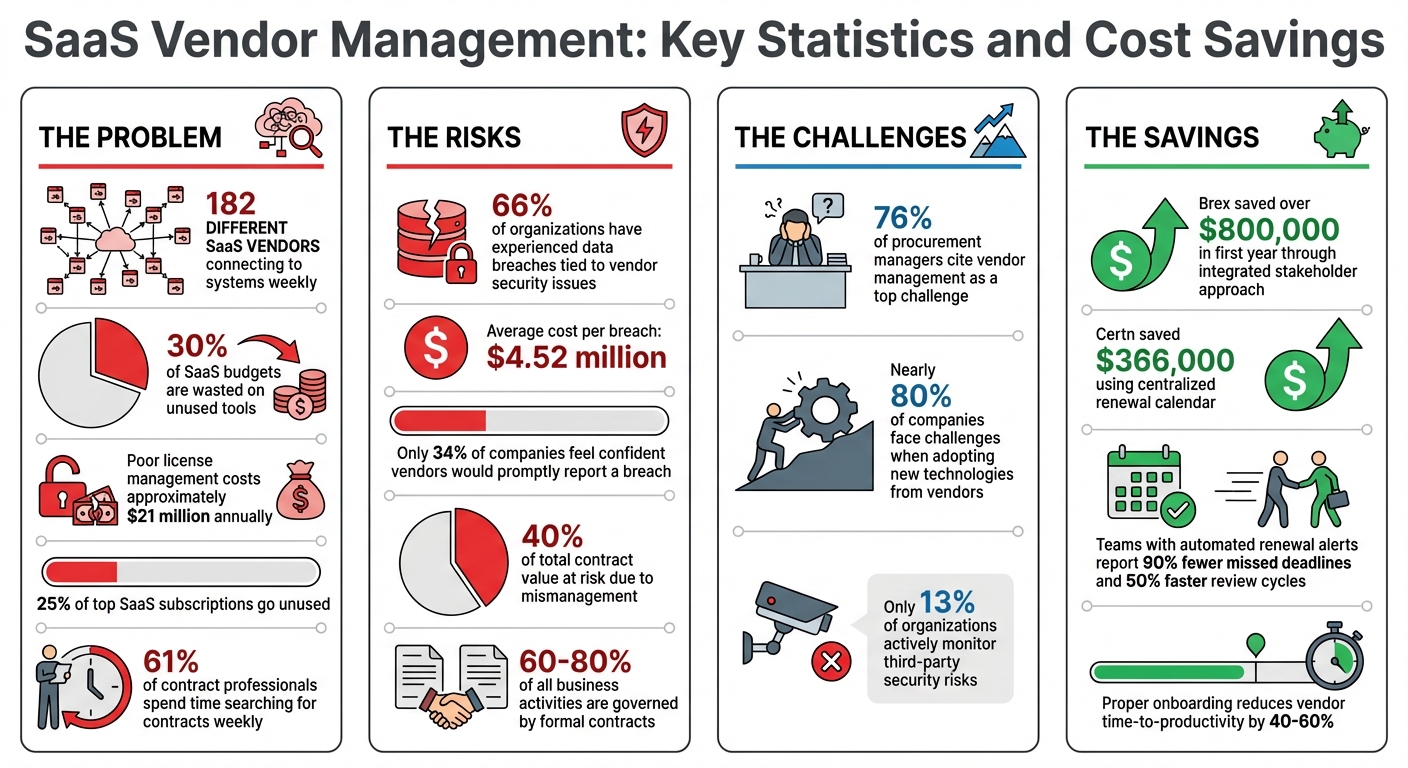
SaaS Vendor Management: Key Statistics and Cost Savings
9 Vendor Relationship Management Best Practices
sbb-itb-8132e49
Set Up Clear Communication Channels
Strong communication is the backbone of any successful vendor relationship. When you’re juggling multiple SaaS vendors – and the average organization works with 182 different vendors connecting to its systems every week – having clear communication protocols is non-negotiable.
Start by assigning a dedicated vendor relationship owner. Think of this person as your internal "software champion." They’ll handle documentation, monitor vendor performance, and act as the central point of contact. Without this role, communication can easily become fragmented across departments, leading to missed updates and duplicated efforts. A single point of ownership ensures nothing falls through the cracks and keeps everything streamlined.
Next, define how and when communication happens. Set clear expectations for escalation procedures during urgent issues – such as who to contact and how quickly they should respond. Share these protocols with the vendor’s support team during onboarding to avoid confusion later. For day-to-day updates, tools like Slack or Teams can be useful for quick check-ins with account managers, preventing minor issues from snowballing into bigger problems.
Regular check-ins are a must. The frequency will depend on how critical the vendor is to your operations. For many, monthly meetings are ideal for reviewing support tickets and performance metrics, while Quarterly Business Reviews (QBRs) are better suited for big-picture discussions like strategy, product roadmaps, and contract renewals. To stay ahead of deadlines, set automated reminders – such as a 60-day alert before contract renewals – for timely evaluations and negotiations.
"The successful long-term relationships we have observed were built on mutual trust and the vendors’ clear understanding of the client’s priorities."
– Anja Allen, Principal in the technology consulting practice, EY Consulting
Finally, make communication a two-way street. Share your business goals, sales strategies, and growth plans with your vendors. When they understand your direction, they’re more likely to tailor their services and even suggest creative solutions to meet your needs. Consistently offering both positive feedback and constructive criticism ensures they stay aligned with your expectations and continue evolving to support your business.
Aidey’s focus on clear, ongoing communication helps strengthen vendor relationships, creating a solid foundation for managing contracts and performance effectively. Once communication channels are in place, you’re ready to tackle the next step: managing contracts to solidify these partnerships.
Manage Contracts Effectively
After establishing clear communication channels, the next step is securing contracts that safeguard your interests and set clear expectations. A well-structured contract is more than just paperwork – it’s the backbone of accountability. These agreements not only protect financial interests but also build a strong foundation for long-term vendor partnerships. Mismanaging contracts can be costly, with up to 40% of the total contract value at risk. Precision is key.
Contracts play a central role in business operations. In fact, between 60% and 80% of all business activities are governed by formal contracts. For large companies managing as many as 19,000 contracts annually, a lack of organization can lead to missed renewals, price increases, or performance disputes. A comprehensive approach ensures that contracts include detailed performance metrics and clear termination provisions.
Negotiate Service Level Agreements (SLAs)
Service Level Agreements (SLAs) are essential for defining performance standards, such as uptime guarantees, response times, and resolution deadlines. Without them, you’re left with vague promises and no clear recourse when issues arise.
SLAs should follow the SMART-R framework: Specific, Measurable, Achievable, Relevant, Time-bound, and Reportable. For example, instead of a generic “reliable uptime” promise, specify 99.9% uptime while accounting for planned maintenance. Include penalties for underperformance, such as service credits (e.g., a 1% fee reduction for every 1% of downtime below the agreed threshold) or contract extensions.
"SLAs are more than contractual clauses. They are foundational tools for managing vendor relationships and mitigating the many risks FIs face."
– Chinyere Watson, Ncontracts
Involve a cross-functional team in SLA negotiations, including managers, legal counsel, and end-users. This ensures the SLA reflects actual business needs, not just what the vendor proposes. For critical services like cloud hosting, negotiate stricter non-performance clauses compared to less essential tools.
Define response times based on severity. For example, a critical outage might require a response within one hour, while a minor issue could allow for a 24-hour window. Schedule maintenance during off-peak hours to minimize disruptions. Additionally, include clear exit strategies in the contract to safeguard your data and interests.
Include Termination and Data Transfer Clauses
Vendor relationships don’t always last forever. Whether you’re switching providers or scaling down, an exit strategy is essential to protect your data and operations.
Include transition support clauses that outline the vendor’s responsibilities for data migration, such as delivering customer data in CSV format within 30 days of termination. Ensure the vendor deletes all your data from their systems after the contract ends and provides written confirmation.
Clearly define notice periods to avoid issues like auto-renewals or penalties. Some contracts require 60 or 90 days’ notice before cancellation, so proactively disable auto-renewal clauses by notifying vendors in advance.
Address data ownership explicitly. Your contract should state that your organization owns the data – not the vendor. Specify encryption responsibilities, backup schedules, and breach notification timelines to prevent disputes and ensure your assets are protected.
Track Contract Renewals and Milestones
Even the best contract is ineffective if you miss key deadlines. Yet 61% of contract professionals spend time searching for contracts weekly just to prepare for renewals. This inefficiency highlights the need for better tracking systems.
Centralize all agreements in a single, searchable repository instead of relying on scattered spreadsheets or email threads. Track critical details like end dates, auto-renewal deadlines, cancellation notice periods, and price escalation clauses. This ensures nothing is overlooked.
Set tiered alerts at 90, 60, and 30 days before renewal deadlines. These reminders give you time to review usage, compare pricing, and explore alternatives without rushing. Before renewing, request a three-month usage report from the vendor to identify underutilized licenses. Many companies find that 25% of their top SaaS subscriptions go unused, so don’t pay for what you don’t need.
Success stories prove the value of effective renewal strategies. In 2024/2025, Brex’s Chief Accounting Officer Eric Zhou saved over $800,000 in the first year by integrating stakeholders and centralizing contract data. Similarly, Certn’s Director of Operations Taylor Martin saved $366,000 by using a centralized renewal calendar and automated tracking.
Assign specific roles for each renewal process – such as reviewer, approver, and signer – to ensure accountability. Establish a clear approval workflow (e.g., Legal → Finance → Executive) to maintain an audit trail and avoid last-minute chaos. Teams that automate renewal alerts report up to 90% fewer missed deadlines and 50% faster review cycles.
Once your contracts are under control, you can focus on onboarding and integrating vendors into your systems seamlessly.
Onboard and Integrate Vendors Properly
After signing contracts, the next critical step is onboarding. This process isn’t just a formality – it plays a huge role in shaping the success of your vendor relationships. In fact, nearly 80% of companies face challenges when adopting new technologies from vendors. The first 90 days are crucial, setting the tone for everything that follows. Think of onboarding as a strategic investment, not just administrative red tape.
A strong onboarding process typically includes three main phases: due diligence and compliance checks, system integration, and resource provisioning. Each phase requires collaboration among teams like finance, legal, IT, and end-users to ensure the vendor is thoroughly vetted, properly connected, and fully enabled. With mid-market companies juggling over 130 SaaS applications, having a standardized onboarding framework is a must. This framework not only simplifies onboarding but also sets the stage for ongoing performance monitoring and improvement.
Perform Due Diligence and Compliance Checks
Before giving vendors access to your systems, ensure they meet all necessary financial, legal, and security standards. Collect essential documents like tax IDs, insurance policies, ownership details, and SOC 2 Type II reports. It’s also important to evaluate their security, encryption, and privacy practices.
Tailor your vetting process based on the vendor’s risk level. For example:
- Critical vendors (those whose failure could disrupt your operations or delay recovery beyond 24 hours) may require in-depth financial audits, penetration test results, and detailed Business Continuity Plans.
- Moderate-risk vendors might only need standard questionnaires and credit checks.
- Low-risk vendors can often be approved with basic business license verification.
| Vendor Tier | Risk Level | Oversight Requirements |
|---|---|---|
| Strategic | Critical/High | Comprehensive due diligence, custom contracts, quarterly reviews |
| Tactical | Moderate | Standard security checks, semi-annual performance reviews |
| Operational | Low | Minimal vetting, automated monitoring, standard agreements |
Make sure your vendors comply with industry regulations. For example, if your business handles sensitive customer data, confirm that vendors support GDPR, CCPA/CPRA, HIPAA, or PCI-DSS compliance. Secure signed agreements like Data Protection Agreements (DPAs) or Business Associate Agreements (BAAs) before sharing any information. You should also assess a vendor’s "fourth-party risk" by understanding their relationships with other third parties.
To streamline this process, consider automation. Approximately 94% of procurement teams now use AI weekly to scan documents like insurance certificates and contracts for missing or outdated information. Automating compliance checks not only reduces errors but also speeds up approvals, freeing up time for more strategic tasks.
"You are never ‘just’ buying software or a service. You’re buying a slice of someone else’s operational, security, and compliance reality – and welding it onto your own."
– Deqian Jia, Peony.ink
Integrate Vendors into Existing Systems
Integrating a vendor’s platform with your existing systems – like ERP, finance tools, and identity management systems – ensures data consistency, automates workflows, and reduces security risks.
Set up secure authentication measures such as multi-factor authentication (MFA) and single sign-on (SSO). Use SCIM (System for Cross-domain Identity Management) to automate user provisioning and enforce role-based access. Before rolling out the integration fully, conduct a Proof of Concept to confirm compatibility. A well-executed onboarding process can reduce a vendor’s time-to-productivity by 40% to 60%.
A centralized vendor portal can also make a big difference. This portal allows suppliers to update their contact details, check payment statuses, and submit compliance documents on their own. Automated workflows can route approvals through procurement, finance, and legal teams, cutting down on bottlenecks and misplaced paperwork. Assigning a dedicated internal relationship owner for each vendor ensures responsibilities are clear and performance metrics are tracked during the critical first 90 days.
Provide Onboarding Resources and Training
From the start, vendors need clear standards, workflows, and expectations. A detailed onboarding checklist with required documents, milestones, and deadlines can eliminate confusion.
Set up a training portal with resources like FAQ guides, sample forms, policy manuals, and walkthrough videos. Hosting a post-award conference right after signing the contract can also clarify administrative details, preferred communication methods, and invoicing requirements.
"The most critical item for all vendors to look for is an understanding of their customers’ quality metrics and on-time delivery demands."
– Mahmoud J. Alabbasi, General Manager, Hollingsworth Distribution Systems
Share clear documentation of your Key Performance Indicators (KPIs) and reporting procedures. For example, provide templates and deadlines for monthly usage reports. Establish a feedback loop by surveying vendors after the first 90 days. Their input can help you identify weaknesses in your onboarding process and improve it. Companies that use standardized onboarding templates and automated workflows report faster approval times and fewer missed deadlines.
A great example of strategic onboarding is Boeing’s "Partnering for Success" initiative. In 2017, Boeing worked with 13,000 suppliers, spending nearly $60 billion. By collaborating with vendors like GM Nameplate – responsible for 1.6 million placards and signs – Boeing improved production efficiency while helping vendors manage costs. This approach shifted vendor relationships from transactional to collaborative, leading to measurable improvements.
Proper onboarding and integration are the foundation for successful vendor management. For SaaS companies outsourcing critical functions, working with a partner like Aidey (https://aidey.net) can ensure that your onboarding process is smooth, setting the stage for streamlined operations and excellent support outcomes.
Monitor Vendor Performance and Drive Improvement
Keeping tabs on vendor performance is critical to ensuring your partnerships deliver value over time. Regular monitoring not only helps you stay aligned with your goals but also allows you to address issues before they become major problems. In fact, 76% of procurement managers cite vendor management as one of their biggest challenges. By combining clear performance metrics with consistent reviews, you can refine vendor outcomes to better support your business objectives.
It’s important to approach performance monitoring as a collaborative effort rather than a blame game. The aim is to identify trends, resolve challenges together, and align on shared goals. This approach moves beyond gut instincts and relies on solid data to guide decisions. As Doug Roginson, Head of Supplier Relationship Management at JPMorganChase, explains:
"You may have a gut feeling about which vendor to work with, but it’s important to substantiate that gut feeling through a formal process".
Track Key Performance Indicators (KPIs)
To measure vendor performance effectively, focus on KPIs that align with your business needs. These metrics should provide a clear picture of how well your vendors are meeting expectations.
Start with operational performance, which is often the easiest to quantify. Look at SLA adherence rates – typically between 95% and 99%, depending on the service’s importance – along with system uptime and average resolution times for support tickets. Even a 99.9% uptime rate translates to around 8.7 hours of downtime annually, which can be a big deal for critical systems. Financial performance is another key area. Monitor license utilization closely, as underutilized SaaS licenses can lead to 25%-30% in unnecessary spending. Keep an eye on ROI, budget variance, and pricing competitiveness to ensure you’re getting the most out of your investment.
Don’t forget risk and compliance metrics. Track the number of security incidents (ideally zero), audit readiness for standards like SOC 2 or GDPR, and the speed at which vendors address identified risks. Lastly, assess relationship and innovation by measuring stakeholder satisfaction and tracking vendor-led improvements.
| KPI Category | Key Metrics | Target/Benchmark |
|---|---|---|
| Operational | SLA adherence, system uptime, resolution time | 95%–99% adherence; 99.9%+ uptime |
| Financial | License utilization, ROI, budget variance | >90% utilization |
| Risk/Compliance | Security incidents, audit findings, remediation time | 0 incidents |
| Relationship | Satisfaction scores, innovation frequency | Vendor-led improvements tracked |
Whenever possible, automate data collection. Tools that pull uptime and ticket metrics directly from monitoring systems can save time and reduce errors. Use a weighted scorecard to evaluate vendors across performance, financial, and risk categories, assigning higher weights to critical areas. Track trends over 3-6 months instead of relying on one-off snapshots.
Conduct Performance Reviews
Once you have clear KPIs and automated tracking in place, structured performance reviews help turn raw data into actionable insights. These reviews ensure vendors remain accountable and aligned with your evolving goals. Schedule them based on vendor risk level: quarterly for high-risk or strategic vendors, semi-annually for moderate-risk vendors, and annually for lower-risk ones.
Before each review, compile key data – SLA metrics, incident reports, cost analyses, and stakeholder feedback. Include representatives from IT, legal, finance, compliance, and end-user teams to get a well-rounded view of performance [55,58]. Follow a structured agenda that covers highlights, challenges, and future goals. For new services, hold the first review 90 days after implementation to fine-tune KPIs and address early issues.
Make these reviews a two-way conversation. Invite vendors to share feedback on your processes and frame challenges as opportunities for collaboration rather than criticism. Use a consistent scoring system to turn subjective feedback into actionable data.
Document action items during reviews, assign owners and deadlines, and follow up in subsequent meetings to track progress. Set thresholds for escalation so that repeated metric failures trigger corrective action plans [52,54]. Automate reminders for reviews and contract renewals – ideally 60 days in advance – to avoid missed deadlines [57,15].
Work Together to Solve Problems
Collaboration is key when challenges arise. If issues occur, work with your vendors to identify root causes and develop solutions together [52,54]. Include success metrics in contracts to ensure vendors are invested in achieving your desired outcomes. Quarterly Business Reviews (QBRs) can serve as checkpoints to revisit expectations, discuss strategic changes, and hold vendors accountable. These regular touchpoints can prevent minor issues from growing into major disruptions.
Incentivizing performance can also drive better results. For example, offer bonuses or benefits for exceeding SLA standards. On the flip side, document unmet SLAs to strengthen your position during future negotiations, potentially securing discounts or service credits. The ultimate goal is to create a win-win framework where both parties benefit from exceptional results.
For SaaS companies outsourcing critical functions like customer support, a partner like Aidey (https://aidey.net) can simplify performance tracking. Their focus on scalable, high-quality support with clear KPIs helps ensure vendor relationships deliver continuous improvement.
Ensure Security, Compliance, and Risk Management
Vendor security failures are a serious concern. In fact, 66% of organizations have experienced data breaches tied to vendor security issues, with an average cost of $4.52 million per breach. Even more concerning, only 34% of companies feel confident their vendors would promptly report a breach. Jeff Hudgens summarized this risk perfectly:
"Your security is only as strong as your weakest vendor."
The numbers speak for themselves: over 60% of data breaches involve third parties, with vendor-related incidents posing a major risk in supply chain attacks. For healthcare organizations, the stakes are even higher, with the cost per compromised record reaching as much as $577. The key to mitigating these risks lies in assessing and monitoring your vendors’ security practices effectively.
Assess Vendor Security Practices
Start by demanding documented proof of your vendors’ security measures. Look for SOC 2 Type II reports that cover at least six months of operational effectiveness or ISO/IEC 27001 certifications. These provide a more reliable picture of ongoing security controls than SOC 2 Type I reports, which only offer a point-in-time assessment. Be cautious of vendors who try to rely solely on their cloud provider’s certifications instead of demonstrating their own security measures.
Key technical safeguards should include:
- AES-256 encryption for data at rest and TLS 1.3 for data in transit.
- Multi-Factor Authentication (MFA) for all vendor personnel accessing your systems.
- Role-Based Access Control (RBAC) to limit access based on job roles.
- A documented patching process, ensuring updates are applied within 30 days.
- Annual third-party penetration tests to identify vulnerabilities.
- A formal incident response plan requiring breach notifications within 24 to 72 hours.
Beware of vague assurances like "we follow industry standards" without independent certifications or reluctance to provide security documentation. These are red flags that could indicate weak security practices.
Monitor Compliance Regularly
A one-and-done approach to vendor assessments won’t cut it. Only 13% of organizations actively monitor third-party security risks, leaving many blind spots. As Konfirmity aptly puts it:
"Traditional tactics, such as annual spreadsheets, can’t keep up with fast-changing risk."
Adopt a tiered approach to vendor monitoring based on their risk level:
- Tier 1 (Critical vendors): Cloud providers, identity platforms, and payment processors should be reviewed quarterly.
- Tier 2 (High-risk vendors): CRM systems and similar tools require semi-annual assessments.
- Tier 3 (Medium-risk vendors): Marketing tools and less critical systems can be reviewed annually.
Standardized questionnaires like SIG Lite or CAIQ can help streamline this process. Additionally, include "right-to-audit" clauses in vendor contracts, allowing you to review audit reports or conduct independent assessments. For regulated industries, confirm that vendors comply with standards like GDPR Article 28, HIPAA, or PCI DSS 12.8. Automating alerts for vendor security updates, breaches, or regulatory changes can also keep you informed in real time.
Identify and Reduce Risks
Managing third-party risks involves three key stages: pre-contract due diligence, clear contractual obligations, and ongoing post-contract monitoring. Once compliance monitoring is in place, focus on identifying and addressing any remaining risks. These could include:
- Cybersecurity risks: Data breaches, unauthorized access, or cloud misconfigurations (which account for 19% of reported breaches).
- Financial risks: Vendor bankruptcy or instability.
- Operational risks: Service outages or disruptions.
- Compliance risks: Regulatory violations.
- Fourth-party risks: Issues stemming from your vendors’ own suppliers.
To mitigate these risks, enforce least-privilege access by limiting vendors to only the systems and data they need. Maintain regular data backups and have alternative vendors lined up to ensure business continuity. Keep an eye on vendors’ financial stability through credit ratings, and establish a clear data exit plan for when contracts end. Vendor management software can simplify this process, offering real-time updates, automated risk scoring, and centralized dashboards.
When a contract ends, don’t stop there. Immediately revoke the vendor’s access credentials and confirm that all your data has been securely destroyed. This ensures no loose ends that could lead to future vulnerabilities.
Build Long-Term Partnerships
With a secure and compliant foundation in place, building long-term partnerships can significantly boost vendor contributions to sustained business success. According to a McKinsey survey, strategic vendor collaboration leads to higher growth and profits. Moving away from the traditional "zero-sum" negotiation approach – where one side’s gain is the other’s loss – towards collaborative agreements delivers better results over time.
Sean-Michael Callahan, Principal at The NiVACK Group, emphasizes this point:
"The objective of vendor management is to fortify company success and overall marketplace performance."
Prioritizing long-term value rather than simply chasing the lowest price helps avoid common pitfalls like excessive downtime, inadequate support, or security vulnerabilities. The cost of poor contract management is staggering – it can drain an average of 9% of a company’s bottom-line profits.
Align on Business Goals and Plans
Sharing your business strategies and future roadmaps ensures vendors can align their services with your growth objectives. For example, if you’re transitioning from outbound sales to a product-led growth model or entering new markets, vendors who understand your direction can proactively adapt their support to meet your evolving needs.
Regular Quarterly Business Reviews (QBRs) are a great way to assess performance and align on upcoming challenges. These meetings should go beyond tracking KPIs, focusing instead on strategic discussions about your goals. Additionally, you can take advantage of Market Development Funds (MDF) to co-sponsor activities like marketing campaigns, webinars, or exploring new technologies together. By consolidating your vendor pool to a select group of highly qualified partners, you can increase communication frequency and create stronger incentives for them to invest in your success.
Recognize Successes and Address Problems
Acknowledging vendors who go above and beyond strengthens the partnership and reinforces their value. At the same time, providing clear, actionable feedback during regular reviews ensures continuous improvement. When challenges arise, focus on collaborative problem-solving rather than assigning blame. Creating joint initiative teams with members from both organizations can help co-develop solutions and speed up resolution.
Tools like issue logs and feedback mechanisms can help track recurring problems and assess how effectively they’re resolved. If a relationship becomes strained, take steps to repair it by opening direct communication channels, verifying delivery data, and considering external factors like global supply chain disruptions that may be affecting performance. Vendor scorecards are another useful tool, allowing you to evaluate performance objectively across areas like quality, delivery, cost, and service – removing subjective bias from the equation.
While collaboration is essential, it’s also important to guard against over-reliance on any single vendor.
Avoid Over-Dependence on Single Vendors
Diversifying your vendor portfolio is a smart way to reduce risks and maintain high service standards. For critical services – like cloud platforms or data backup – working with multiple qualified vendors ensures continuity in case one provider fails. However, this doesn’t mean spreading your resources too thin. Instead, focus on a diverse yet consolidated group of highly capable vendors for essential functions.
During initial negotiations, document clear exit provisions to protect your operations if a vendor’s performance declines or their business shuts down. Jon M. Quigley, Principal at Value Transformation LLC, offers this advice:
"Set goals. Everything that delivers success derives from your clarity. Gain approval from stakeholders. Then communicate those goals to potential or current vendors."
Having a well-defined exit plan safeguards your business and ensures you can pivot smoothly if necessary.
Conclusion
Managing SaaS vendor relationships requires more than just oversight – it calls for a well-coordinated system that brings together IT, Finance, and Procurement. Stephanie Solis from BetterCloud describes this as a "triad of accountability". This collaborative approach ensures your software investments meet security needs, financial objectives, and compliance standards all at once.
A staggering 30% of SaaS budgets go to waste on redundant tools, with poor license management costing companies around $21 million annually. By prioritizing clear communication, well-structured contracts, effective onboarding processes, and regular performance evaluations, businesses can reclaim this lost value. This recovered value not only improves operational efficiency but also strengthens vendor relationships, paving the way for more strategic collaborations.
Strong vendor management transforms transactional interactions into partnerships where both sides work toward shared goals. Simple yet impactful practices – like setting renewal reminders 90 days ahead, assigning internal owners for each application, and performing quarterly audits – can yield tangible benefits. These include better support, multi-year discounts, and vendors who proactively adapt their offerings to your changing needs.
Centralizing vendor data, defining clear service-level agreements (SLAs), and scheduling regular check-ins are key to fostering these collaborative relationships. These steps don’t just optimize current operations – they also create a solid foundation for future growth.
FAQs
Which SaaS vendors should we review first?
When evaluating vendors, begin with those that play a key role in your operations and align closely with your strategic objectives. Pay particular attention to vendors handling essential areas such as security, compliance, or core processes. It’s also wise to prioritize vendors with upcoming contract renewals, performance challenges, or security vulnerabilities. Additionally, reviewing vendors with high costs or those linked to shadow IT activities can uncover opportunities to reduce expenses and enhance overall efficiency.
What SLA metrics matter most for our business?
When it comes to SLA metrics, the ones that matter most will depend on what you’re aiming to achieve. However, some key metrics to keep an eye on include uptime, response time, and user satisfaction:
- Uptime: This measures how consistently your service is available. High uptime builds trust with customers, ensuring they can rely on your service when they need it.
- Response time: This tracks how quickly support or services respond to issues. Faster response times mean less downtime and better efficiency, keeping everything running smoothly.
- User satisfaction: This reflects how users feel about the overall quality of your service. High satisfaction scores indicate you’re meeting – or exceeding – customer expectations.
By closely monitoring these metrics, you can ensure your vendor’s performance stays in sync with your business goals, driving long-term success and keeping customers happy.
How do we prevent surprise auto-renewals?
To keep surprise auto-renewals at bay, start by organizing all contract renewal dates in a shared calendar, ensuring each contract has a clearly assigned owner. Regularly audit contracts to identify auto-renewal clauses and critical terms like "automatic renewal unless canceled." Set up automated alerts to remind you of upcoming renewal dates, and if possible, integrate these reminders into your SaaS platform. Make it a habit to review and renegotiate contracts well before their deadlines, giving you the upper hand and helping you avoid unexpected cost hikes.