

Outsourced appointment setting helps SaaS companies save time and boost sales by hiring external teams to handle lead generation and scheduling. Instead of having your Account Executives (AEs) spend hours prospecting, outsourcing ensures they focus on closing deals. Here’s why it’s a game-changer:
- Faster Results: Outsourcing builds pipelines 60% faster than in-house teams and delivers a 3–5x ROI within 90 days.
- Cost Savings: Hiring an in-house SDR costs $80,000–$125,000 annually. Outsourcing cuts this by 40–60%, typically costing $36,000–$96,000.
- Expertise: External teams use advanced tools like AI, intent data, and multi-channel outreach to book 2–10x more meetings.
- Efficiency: Outsourcing eliminates the need for recruitment, training, and managing SDRs, saving time and resources.
Ideal for SaaS companies with high ACVs, long sales cycles, or startups needing quick scaling, outsourcing offers a reliable way to generate qualified leads without the hassle of building an in-house team. With the right partner, you can focus on closing deals while they handle the heavy lifting.
The Ultimate Guide to B2B Appointment Setting
sbb-itb-8132e49
Benefits of Outsourcing Appointment Setting for SaaS
Building on the challenges outlined earlier, these advantages show why outsourcing appointment setting can drive growth for SaaS companies.
Lower Costs and Easier Scaling
The financial advantage of outsourcing is clear. Hiring an internal SDR (Sales Development Representative) can cost between $125,000 and $185,000 in the first year. This includes base salary ($60,000–$80,000), benefits, taxes, recruiting fees, and software licenses. In contrast, outsourcing typically costs $36,000–$96,000 annually – a 40–60% reduction.
Outsourcing providers also include essential tools like CRM systems, sales engagement platforms, parallel dialers, and intent data tools, saving an additional $15,000–$25,000 annually. Plus, you avoid the lengthy and costly process of hiring, training, and onboarding new SDRs.
Another big advantage is reduced risk. If an internal SDR leaves, you’re stuck with recruiting and training replacements. Outsourcing eliminates this headache by immediately backfilling the role at no extra cost. It also saves sales managers 5–10 hours each week that would otherwise go to coaching and supervising new hires.
"A $150K AE spending 10 hours weekly on prospecting burns $55K annually on non-revenue work while your pipeline stagnates."
– Bobby O, CEO, Tam to Target
Access to Trained Sales Professionals
Outsourced teams are ready to deliver results without the ramp-up time needed for internal hires. These professionals are skilled in handling complex B2B buying processes, qualifying leads with frameworks like BANT or MEDDIC, and executing multi-channel outreach strategies that drive engagement.
They also bring technical expertise that’s tough to match in-house. Using tools like parallel dialers, AI-driven workflows, and intent data, they achieve connect-to-meeting rates of 15–20%, far outperforming the 2–5% rates typical of traditional telemarketing. In fields like cybersecurity or DevOps, they speak the technical language that builds trust with prospects.
The results speak for themselves. Companies using outsourced appointment setting services report 2–10x increases in meeting volume. These programs can also build sales pipelines 60% faster than internal teams. With most sales reps struggling to meet quotas and nearly 90% burning out from relentless prospecting, outsourcing to specialists who excel in this area is a smart move.
More Time for Core Business Functions
When Account Executives are freed from cold calling, they can focus on what they do best: delivering demos and closing deals. This is especially important as SaaS companies face increasingly complex buying cycles.
Outsourcing also minimizes the management burden of overseeing entry-level SDRs, a role notorious for high turnover. Sales leaders can redirect their energy toward strategic goals, like optimizing the sales process or entering new markets. For founder-led teams, this means more time to close high-value deals while experts handle lead generation.
The operational benefits go even further. Outsourcing provides access to advanced prospecting infrastructure that would cost $30,000–$50,000 annually to build internally. This includes deliverability management (like SPF, DKIM, and DMARC configurations) and domain warming protocols – tasks that would otherwise require specialized IT support.
These advantages not only streamline operations but also create opportunities to explore competitive pricing models in outsourcing.
Pricing Models for Outsourced Appointment Setting
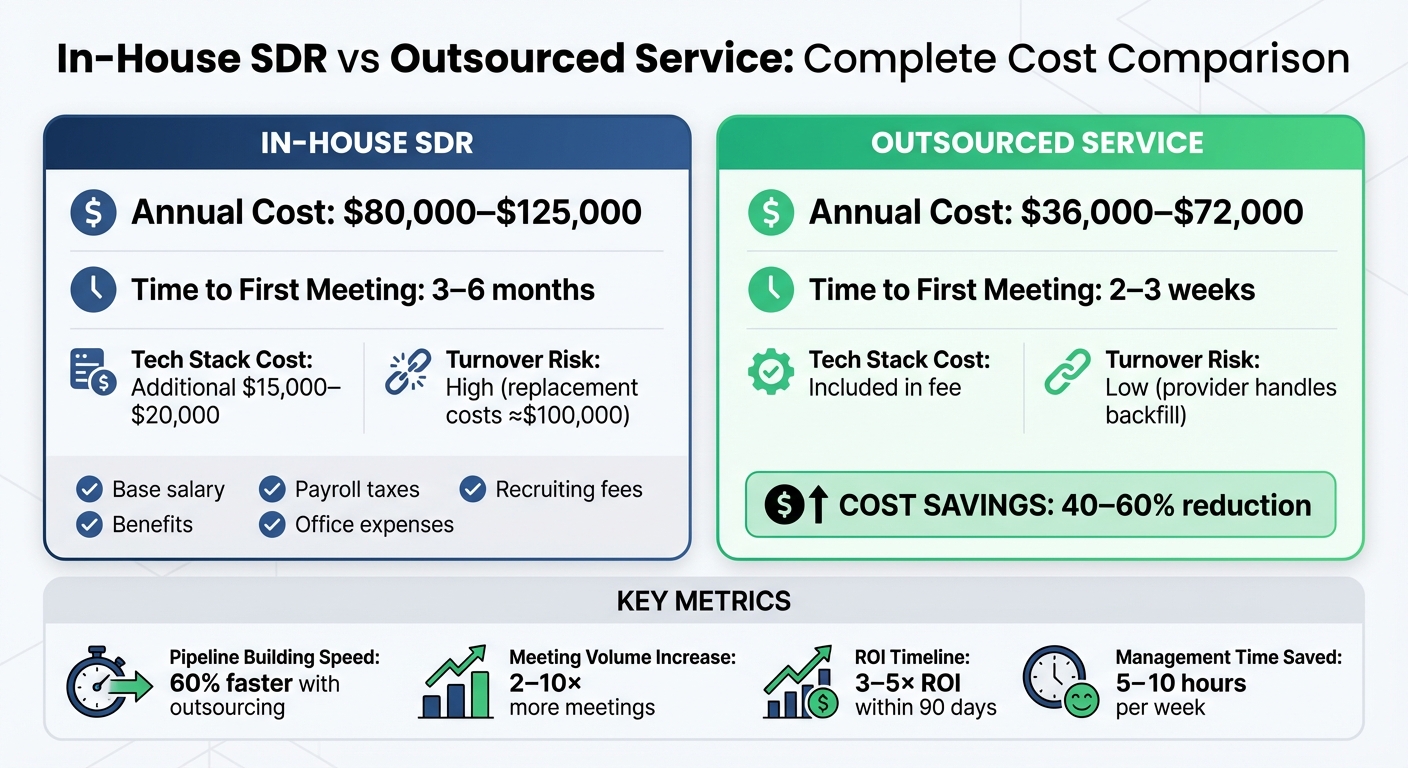
In-House SDR vs Outsourced Appointment Setting: Cost Comparison for SaaS Companies
Before choosing an outsourcing partner, it’s essential to understand how pricing models work. The structure you select affects your budget, the quality of leads, and how well the provider’s goals align with yours.
Pay-Per-Appointment vs. Retainer Pricing
The pay-per-appointment (PPA) model charges you only when a meeting is booked. Costs typically range between $150 and $600 for mid-market prospects and $800 to $1,500 or more for executive-level decision-makers. While this approach sounds appealing, it often encourages agencies to prioritize quantity over quality, potentially leading to a surge in unqualified meetings.
"If you are selling a complex SaaS solution or consulting services, you need a partner, not a bounty hunter."
– Alex Nikolov, Founder, Ground Leads
On the other hand, retainer pricing involves a fixed monthly fee, usually between $3,000 and $10,000 or more. This model incentivizes agencies to focus on building a qualified pipeline rather than chasing individual bookings. However, since you’re paying upfront, it might take 60 to 90 days to see a meaningful return on investment (ROI).
Many SaaS companies are now leaning toward a hybrid approach, combining a base retainer – typically $2,000 to $4,000 – with performance bonuses of $150 to $400 for each qualified meeting.
Now, let’s compare these options to the costs of building an in-house team.
Outsourcing vs. In-House Team Costs
Creating an in-house sales development team can be a hefty investment. A fully loaded sales development representative (SDR) costs between $80,000 and $125,000 annually. This figure includes base salary, benefits, payroll taxes, and office expenses. On top of that, you’ll need to budget an additional $15,000 to $20,000 for tools like CRM software and dialers.
Outsourcing, by contrast, can cut costs by 40% to 60% while also offering faster ramp-up times – no recruitment fees required.
| Factor | In-House SDR | Outsourced Service |
|---|---|---|
| Annual Cost | $80,000–$125,000 | $36,000–$72,000 |
| Time to First Meeting | 3–6 months | 2–3 weeks |
| Tech Stack | Extra $15,000–$20,000 | Included in fee |
| Turnover Risk | High (replacement costs ≈$100,000) | Low (provider handles backfill) |
These comparisons clarify the cost differences and set the stage for calculating ROI.
How to Calculate ROI for Outsourced Appointment Setting
The pricing model you choose directly impacts your ROI. Once you understand the cost efficiencies, it’s time to quantify the returns.
Here’s a basic formula for ROI:
ROI = (Appointments Scheduled × Close Rate × Average Contract Value) – Outsourcing Cost.
For example, if you schedule 40 meetings per month, close 20% of them, and your average contract value is $30,000, you generate $240,000 in revenue. With a monthly outsourcing cost of $6,000, this results in a 40:1 return.
For a more detailed analysis, consider profit margins:
ROI = ((Net Profit from Sales – Cost of Appointment Setting) / Cost of Appointment Setting) × 100.
In B2B appointment setting, a 3:1 to 5:1 ROI is solid, while anything above 5:1 is excellent.
Take this case study from early 2026: Agency A-Sales spent $5,500 over 45 days using cold email and social outreach. The result? 42 meetings, a 95% show rate, and 6–8 qualified opportunities. This campaign generated over $60,000 in pipeline, yielding a 10.9× ROI on pipeline and a 5.5× ROI on closed revenue.
Monitoring show rates is crucial. A healthy rate falls between 70% and 90%. Anything below 60% often points to poor targeting or low-quality data. Bad contact data can inflate your effective cost per meeting by 20% to 40%.
"The sticker price rarely tells the full story – show rates and qualification rates determine what you actually pay for pipeline."
– Prospeo Team
To safeguard your ROI, clearly define what a "qualified" lead means in your contract. Specify criteria like job title, company size, and intent signals. Include provisions to avoid paying for no-shows and ensure a replacement policy. Finally, allow 60 to 90 days for your outsourced partner to fine-tune their performance.
For SaaS companies considering outsourcing, providers like Aidey offer clear pricing models and performance guarantees, ensuring your investment builds a scalable, high-quality sales pipeline.
How to Implement Outsourced Appointment Setting
You can launch an outsourced appointment-setting campaign in as little as 2–4 weeks, moving from kickoff to your first booked meetings. This timeline covers everything from selecting a provider to onboarding and setting up outreach sequences.
Selecting an Outsourcing Provider
The first step is finding a provider with expertise in your industry. Look for one that understands your SaaS niche and has experience with your Ideal Customer Profile (ICP). They should grasp key details like pain points, buying cycles, and the personas of decision-makers in your market.
You’ll also want to review their qualification methods. Do they use frameworks like BANT (Budget, Authority, Need, Timeline), MEDDIC, or CHAMP? These systems help ensure your sales team gets in front of real decision-makers, not just casual browsers. Industry stats show that 79% of B2B leads don’t convert into sales, so proper vetting is critical.
Effective providers should offer multichannel outreach and robust tools. Check for essentials like parallel dialers, intent data platforms (e.g., G2, ZoomInfo), CRM integration, real-time dashboards, and call recordings. These tools provide transparency and help you monitor pre-meeting interactions.
"These companies worry that it’ll harm their brand. But it’s not about the small nuances. It’s about making sure that the right number of messages are being sent to the right people."
– Michael Maximoff, Co-founder and Chief Growth Officer, Belkins
Make sure the provider has clear replacement policies and can provide projections tailored to your Total Addressable Market (TAM), not just generic industry averages. This step ensures your sales pipeline is filled with qualified leads that can drive revenue growth.
Once you’ve chosen a provider, the next focus is onboarding and campaign setup to ensure a smooth launch.
Onboarding Process and Campaign Setup
A well-structured onboarding process lays the groundwork for success. Work closely with your provider to refine your ICP using factors like technographic signals (e.g., your tech stack), behavioral triggers (e.g., recent funding rounds), and the challenges your solution solves.
Equip your provider with key resources, such as product demos, sandbox access, competitor comparisons, brand guidelines, and case studies. Treat them like an extension of your internal sales team – the more they understand your business, the more effective their outreach will be.
Define a Sales Qualified Appointment (SQA) in writing. Be specific about criteria like job titles, company size, and intent signals to avoid confusion about what counts as a successful meeting.
Set up regular communication channels, such as weekly check-ins, a dedicated Slack channel, and reporting dashboards. During onboarding, your provider should also guide you through the structure of outreach sequences and messaging strategies. Modern campaigns often include 8–12 touches over 14–21 days across email, LinkedIn, phone, and video.
Most providers can get your campaign live within 2–4 weeks. During this period, they’ll integrate with your CRM (e.g., Salesforce, HubSpot), prepare email domains to avoid spam filters, and test messaging. You can expect your first qualified appointments within 30 days of launch.
For companies seeking a hassle-free setup, providers like Aidey offer free onboarding, covering recruitment, training, and system integration. This ensures your outsourced team is ready to represent your brand effectively from the start. These processes also feed into ongoing performance tracking, making it easier to fine-tune your sales pipeline.
Once your campaign is live, regular tracking and measurement are essential to maintain and improve its performance.
Tracking Performance and Measuring Results
Tracking the right metrics is key to identifying whether your program is delivering value or wasting resources. Start with a Meeting Quality Scorecard to align your team – Sales Development Representatives (SDRs), Account Executives (AEs), and leadership – on what constitutes a "qualified" meeting. Assess each meeting based on ICP fit, persona relevance, clarity of the problem, and sales acceptance.
Sales Acceptance Rate (SAR) is the most important metric. It measures the percentage of meetings your sales team finds valuable. A low SAR often indicates a mismatch between the provider’s definition of "qualified" and your team’s expectations.
Monitor three key performance areas:
- Reachability: Metrics like email deliverability.
- Engagement: Reply rates and the quality of conversations.
- Outcomes: Meetings booked and pipeline generated.
Aim for a show-up rate of 75–80%. Rates below 60% could signal poor targeting or inaccurate data. Additionally, track demo-to-close ratios – if more than 50% of meetings convert into opportunities, your provider is delivering high-quality prospects. Top-performing teams often hit connect-to-meeting rates of 15–20%.
| Metric | Baseline | Good | Excellent |
|---|---|---|---|
| Reply Rate | 3–5% | 5–8% | 8%+ |
| Meeting Rate | 0.5–1% | 1–2% | 2%+ |
| Show-up Rate | 60–70% | 70–80% | 80%+ |
| Bounce Rate | >2% | <2% | <1% |
Establish a 24–48-hour feedback loop to quickly adjust targeting and messaging.
Keep a close eye on technical metrics. Monitor SPF/DKIM/DMARC pass rates and aim for inbox placement of 80–85%. Keep spam complaint rates under 0.30% and bounce rates below 1% to maintain your domain’s health. Irrelevant outreach can hurt your brand – 73% of B2B buyers avoid suppliers who send irrelevant messages. This makes quality metrics far more important than sheer volume.
"Deliverability is a revenue metric. Exceeding a 0.30% spam rate can limit reach, reducing qualified appointments and pipeline creation."
– Google Email Sender Guidelines
Lastly, calculate ROI using this formula:
(Gross profit from closed-won deals attributed to sales-accepted meetings) ÷ (Total program cost).
Challenges and Considerations When Outsourcing
Outsourcing can save both time and money, but it comes with its own set of challenges. To succeed, you need to maintain quality, protect sensitive data, and find the right level of involvement without micromanaging. After all, you’re trusting an external team with a crucial part of your sales process.
Keeping Your Brand Voice Consistent
Your brand voice is what makes your company stand out in a crowded SaaS market. When outsourcing, it’s vital that the external team represents your company in a way that feels authentic, not robotic or generic. To achieve this, start with detailed onboarding workshops to teach the provider your brand’s voice, positioning, and sales strategies. Equip them with the same resources your in-house team uses: product demos, competitor insights, brand guidelines, and case studies. A well-crafted sales playbook with best practices, objection-handling scripts, and qualification criteria can also help ensure consistent messaging.
Communication is key. Set up a shared Slack channel for quick updates and questions, and dedicate time each week for your Account Executives to coach the outsourced team on lead quality and messaging tweaks. While AI tools can assist with research, human-led outreach is still critical for engaging high-level prospects like VPs or C-suite executives. These interactions require a personal touch to navigate the complexities of SaaS sales. Interestingly, companies that use three or more outreach channels see engagement rates up to 287% higher than those sticking to just one.
Once your brand voice is aligned, the next step is securing customer data.
Protecting Customer Data and Privacy
Maintaining consistent messaging is only part of the equation – data security is just as important. Sharing customer and prospect data with an external team introduces risks. A breach could lead to costly financial and reputational damage. To minimize these risks, limit the outsourced team’s access to only the data they absolutely need. Include specific contractual clauses to protect sensitive information, restrict access to authorized personnel, and outline procedures for storing and deleting data. Look for outsourcing partners with ISO 27001 certification, a global standard for information security.
"Data security within the sales outsourcing domain requires a precise balancing act. Businesses must ensure seamless and effective sales operations, whilst simultaneously safeguarding sensitive customer information with utmost vigilance." – Julien de Vonarkha-Varnak, Director Global Sales, Salescode
Encrypt all sensitive data, whether it’s being stored or transmitted, to guard against interception. Train your outsourced team on best practices like spotting phishing attempts, creating strong passwords, and practicing safe internet habits. Regular security audits can identify vulnerabilities and ensure compliance with regulations like GDPR and CCPA. Additionally, establish a clear incident response plan so both your team and the provider know how to handle potential breaches.
Once data security is addressed, the focus shifts to balancing how much control you retain versus the autonomy you give your provider.
Finding the Right Balance Between Oversight and Autonomy
After securing your brand and customer data, it’s important to strike the right balance between oversight and allowing your provider the freedom to operate effectively. Keep control over big-picture elements like defining your ideal customer profile (ICP), setting messaging guidelines, and approving campaign themes. At the same time, trust your provider to handle tactical tasks like prospecting, qualification, and scheduling. Avoid nitpicking minor details like wording; instead, focus on metrics like message volume and targeting.
"Companies that scrutinize every small detail in their outreach often see campaigns stall. Marketing is fundamentally a numbers game… Message volume and segment targeting drive results, not minor wording tweaks." – Michael Maximoff, Co-founder and Chief Growth Officer, Belkins
Establish a clear communication rhythm, such as weekly check-ins, and use shared dashboards to track key metrics like show rates, conversion rates, and cost-per-appointment. Make sure the outsourced team has full access to the necessary tools, domains, and CRM systems from day one to avoid inefficiencies. Define your goals early by creating a clear, written definition of a Sales Qualified Appointment to eliminate confusion and maintain quality.
Internal SDRs often need three months to learn a product and another three months to build a pipeline, leading to a six-month delay in ROI. Outsourced teams can skip much of this ramp-up time, but they still need the right resources and enough autonomy to achieve results.
Conclusion: Growing Your SaaS Business with Outsourced Appointment Setting
Outsourcing appointment setting can act as a powerful growth engine, allowing your team to focus entirely on closing deals rather than getting bogged down in prospecting tasks. By turning fixed overhead costs into flexible, performance-based investments, outsourcing removes the need to recruit, train, and manage SDRs. Plus, it gives you access to advanced tech stacks and multi-channel strategies without the operational hassle.
The numbers speak for themselves: outsourced teams build sales pipelines up to 60% faster than internal teams, save 40–60% in costs, and boost meeting volume by 2–10×. Many SaaS companies experience a 3–5× ROI within just 90 days, skipping the lengthy 3–6 month ramp-up period that in-house teams typically require.
"By outsourcing, you’re not just delegating a task; you’re acquiring a fully operational growth engine. It’s about leveraging external expertise to bypass internal bottlenecks and achieve faster, more predictable results." – Fypion Marketing
This approach allows your sales team to concentrate on high-value activities, driving revenue growth naturally and efficiently.
To make the most of outsourced appointment setting, three key elements are essential: clearly defining what qualifies as a Sales Qualified Appointment, maintaining tight communication with your provider, and carefully tracking metrics like Cost Per Appointment and show rates instead of just monitoring activity volume. A great outsourcing partner doesn’t just work alongside your team – they become a seamless extension of it, fully aligned with your brand voice, product knowledge, and qualification standards.
With SDR costs now exceeding $80,000 annually and buyer behavior becoming more complex, outsourcing offers a way to stay agile and cost-effective in today’s market. Whether you’re a startup testing product-market fit or a well-established SaaS company entering new markets, outsourced appointment setting provides the speed, flexibility, and expertise needed for steady growth.
For SaaS businesses looking to streamline their appointment-setting process, partnering with a provider like Aidey (https://aidey.net) can ensure you have a scalable and reliable system that aligns with your growth goals.
FAQs
What should I require in an SLA for a Sales Qualified Appointment (SQA)?
An SLA for a Sales Qualified Appointment (SQA) needs to clearly define the criteria that make an appointment worth pursuing. These criteria should include factors like ICP (Ideal Customer Profile) alignment, ensuring the prospect fits your target audience, and financial fit, confirming they have the budget to move forward. Additionally, it should address whether the prospect has decision-making authority, highlight specific pain points that your solution can solve, and outline the implementation timeline to gauge urgency. Prior engagement, such as previous conversations or interactions, should also be part of the qualification process.
Beyond qualification, the SLA should set expectations for response times, detailing how quickly follow-ups should happen after an appointment is set. It should also establish follow-up protocols and define quality standards to make sure the appointments have a strong chance of converting into actual sales. This level of structure helps maintain consistency and ensures that every lead is handled with care and efficiency.
How do I keep outsourced outreach on-brand without micromanaging it?
To keep outsourced outreach aligned with your brand without hovering over every detail, start by creating clear brand guidelines from the outset. These should include detailed messaging frameworks, your preferred tone of voice, and key value propositions.
Regular training sessions and quality checks – such as reviewing scripts and monitoring communications – are essential for maintaining consistency. Additionally, leverage collaboration tools that allow for streamlined feedback and ensure your outsourced team stays in sync with your brand. This approach ensures they can work independently while staying true to your messaging.
What security steps should an outsourced team follow to stay GDPR/CCPA compliant?
To comply with GDPR and CCPA regulations, outsourced teams should focus on several key practices:
- Educate staff: Train employees on compliance requirements to ensure everyone understands their responsibilities.
- Role-based access controls: Limit data access based on job roles to enhance security.
- Encrypt personal data: Protect sensitive information by using encryption.
- Maintain detailed audit trails: Keep thorough records of data access and processing activities.
Transparency is also crucial. Use clear privacy notices, disclose caller IDs, and explain data rights to individuals. Additionally, conduct regular audits of call lists, adhere to data retention policies, and securely delete or anonymize data when it’s no longer required. These steps help ensure compliance and build trust.