

Scaling a startup is tough. You’re juggling product development, customer acquisition, and investor pitches, all while running out of time and money. Here’s the deal: hiring a single employee costs an average of $4,000 before they even start contributing. That’s a big risk for startups with tight budgets.
Outsourcing solves this problem by giving startups access to skilled teams quickly and at a lower cost. It can cut product-launch timelines by 35% and reduce labor costs by up to 70%. Plus, you only pay for what you need, making it easier to scale up or down without long-term commitments.
Here’s what makes outsourcing a game-changer:
- Speed: Get a team up and running in days, not months.
- Cost Savings: Save on salaries, benefits, and back-office expenses.
- Specialized Talent: Access experts without hiring full-time staff.
- Flexibility: Adjust team size based on demand.
Startups like Slack and Canva used outsourcing to focus on growth while external teams handled tasks like coding and design. Many leaders also use a customer support outsourcing checklist to ensure their service scales alongside their product. With the right approach, outsourcing can help founders focus on their core business while staying lean and competitive.
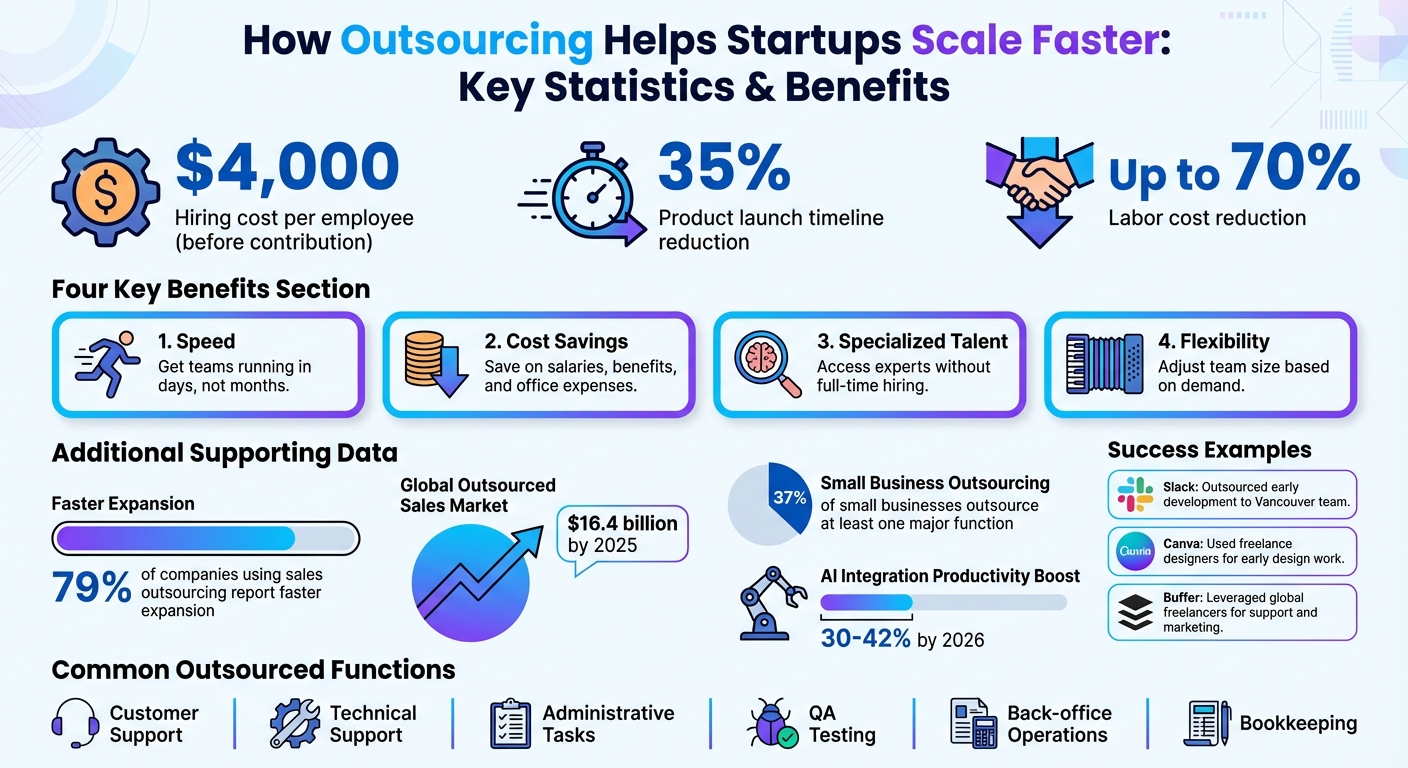
How Outsourcing Accelerates Startup Growth: Key Statistics and Benefits
How to Build an Outsourced Team That Scales | Cory Blumenfeld
sbb-itb-8132e49
Why Outsourcing Accelerates Startup Growth
Outsourcing turns common startup challenges – like limited time, budget constraints, and talent shortages – into opportunities for growth. It allows startups to set up operational teams in just days instead of months. Instead of committing to fixed salaries and office expenses, you only pay for services when you need them. Plus, outsourcing opens doors to global expertise that might otherwise be out of reach.
Lower Costs and Faster Scaling
Hiring in-house can be both expensive and time-consuming. Beyond salaries, there are added costs like benefits, payroll taxes, office equipment, and software licenses. Outsourcing helps cut these overhead expenses, freeing up resources for key growth areas like product development or marketing. For example, working with offshore providers in places like the Philippines can lower labor and operational costs by up to 70%.
But it’s not just about saving money – speed matters too. While traditional hiring can take months, outsourcing firms can provide full teams in just days. This speed translates to quicker product launches. In fact, companies that outsource technical work often cut their time-to-market by around 35%. For startups working against tight deadlines to find product-market fit, this agility can make all the difference.
Additionally, outsourcing gives startups access to seasoned professionals without the expense of maintaining a large payroll. Established outsourcing firms bring with them tested workflows, security measures, and management expertise that many early-stage startups lack. This combination of cost savings and operational efficiency allows startups to launch products faster and leverage specialized knowledge right away.
Access to Specialized Talent
Outsourcing doesn’t just save money – it also connects startups with specialized talent that might be too expensive or hard to find locally. Whether you need a DevOps engineer, a technical SEO expert, or a fractional VP of Sales, outsourcing providers can fill these roles without the long-term commitment of hiring full-time staff.
Take Slack, for example. Back in 2013, the company outsourced much of its early development to a team in Vancouver, Canada. This team handled architecture, design, and testing, allowing Slack’s internal team to focus on strategy. The result? A rapid market launch that helped establish Slack as a top messaging platform.
Similarly, Xero, the New Zealand-based cloud accounting firm, faced local talent shortages but overcame them by outsourcing development to freelance teams across Australia, the UK, and Singapore. This approach sped up product development and supported their expansion into over 180 countries. Canva’s founder, Melanie Perkins, also relied on freelance designers for early design work, which allowed her to concentrate on product innovation and scaling the business.
The benefits go beyond filling immediate gaps. Outsourcing can directly drive growth. For instance, 79% of companies using sales outsourcing say it has helped them expand faster. Looking ahead, incorporating generative AI into outsourcing workflows is expected to boost productivity by 30–42% by 2026, thanks to advancements like automated coding and bug detection. Essentially, outsourcing gives startups access to the tools and expertise they need to compete and grow in fast-moving markets.
Flexible Team Scaling
Startup growth is rarely linear. One month, you might need double the customer support for a product launch; scaling customer support effectively is key to SaaS growth, the next, demand might drop back to normal levels. Outsourcing turns fixed costs into variable ones, allowing startups to scale teams up or down based on immediate needs – without the financial strain or emotional challenges of layoffs. This flexibility is vital for staying agile in an unpredictable environment.
Buffer, the social media platform, has embraced this model. By working with a global network of remote freelancers for tasks like customer support, content creation, and marketing, Buffer kept its operations lean while rapidly growing its user base. This ability to adjust resources as needed helped the company stay efficient and adaptable.
The numbers back up this trend. By 2025, the global market for outsourced sales services is expected to hit $16.4 billion, and 37% of small businesses already outsource at least one major business function. Outsourcing has evolved from being a simple cost-saving measure to a strategic tool that empowers startups to compete with larger, better-funded rivals.
How to Use Outsourcing for Startup Growth
Step 1: Decide Which Tasks to Outsource
Start by evaluating your internal operations to separate essential tasks from non-essential ones. Core activities – like product development, strategic planning, and shaping your unique value proposition – should remain in-house because they directly influence your competitive edge and intellectual property. On the other hand, tasks that don’t require this level of involvement can often be outsourced.
Some common areas startups outsource include customer support, technical support, administrative tasks, quality assurance, and back-office operations like bookkeeping or data entry. Handing off these responsibilities can free up your team to focus on refining your product and growing your customer base.
To determine if a task is suitable for outsourcing, ask yourself: Does it demand in-depth knowledge of your product vision, or is it more process-driven and repetitive? If it’s the latter, it’s likely a strong candidate for outsourcing. This approach ensures your resources are directed toward activities that drive growth.
Step 2: Prioritize Customer Support Outsourcing
Once you’ve identified non-essential tasks, customer support should be a top consideration. For startups, customer satisfaction is crucial, and outsourcing this function can provide immediate advantages.
By outsourcing customer support, you gain access to experienced agents, often fluent or native English speakers, who can deliver fast and reliable service. For example, nearshore teams in Latin America can provide high-quality support at a lower cost while aligning with your business hours.
Another key benefit is scalability. Whether you’re launching a product or experiencing a seasonal surge, outsourcing allows you to quickly expand your support team. When demand slows, you can reduce the team size without the challenges of layoffs or extra payroll expenses. This flexibility is especially valuable during the early stages of product-market fit.
Step 3: Partner with Reliable Providers Like Aidey
After identifying tasks to outsource, the next step is finding a provider with a proven track record. Look for companies that bring structured workflows, quality assurance systems, and strong management practices. This concept, often called "borrowed maturity", means you’re not just hiring agents – you’re tapping into an established infrastructure that ensures smooth operations from day one.
Aidey specializes in helping startups scale their support functions. They provide 24/7 customer support outsourcing tailored for industries like SaaS, e-commerce, and hospitality. Aidey stands out by offering seamless onboarding, handling recruitment, training, and system setup at no extra cost. This allows you to launch a fully operational support team in just days, not months. Their teams include native English-speaking representatives and cover services like customer support, technical support, back-office operations, and outbound services.
To ensure Aidey is the right fit, consider starting with a pilot project. Use tools like Jira, Asana, or ClickUp to monitor metrics such as tickets resolved, customer satisfaction scores, and response times. This will help you assess their ability to deliver on quality, speed, and transparency.
Practical Examples and Success Methods
Example: Scaling Customer Support with Outsourcing
In June 2020, Urth, an Australian photography equipment startup, encountered a sharp rise in customer inquiries during the COVID-19 pandemic. To tackle this challenge, their support manager, Isaac Gray, collaborated with a reliable outsourcing provider. The results? Within just 60 days, Urth reduced its first response times by 35%, consistently meeting their 24-hour response target. Fast forward to September 2023, the outsourced team sustained impressive results, achieving an average Email CSAT of 91% and a Chat CSAT of 96%. Even more notable, team members stayed on for an average of 21 months, showcasing the stability of the partnership.
One of the key reasons behind this success was a shared commitment to values. Urth carefully selected its outsourcing partner based on mutual goals, including environmental responsibility, highlighted by the provider’s B Corp certification. To strengthen the relationship, Urth’s team visited the provider’s office in the Philippines and even participated in joint environmental initiatives, like mangrove planting. By treating the outsourced team as an integral part of the company, Urth fostered better retention and high performance.
How to Manage Outsourced Teams Effectively
Drawing from examples like Urth’s, managing outsourced teams successfully requires a structured approach. Here’s how to make it work:
- Set clear objectives and track performance: Define measurable goals, such as response times and customer satisfaction scores, and monitor them using project management tools.
- Conduct regular reviews: Weekly or bi-weekly check-ins ensure progress is on track and allow for quick adjustments when needed.
- Keep resources updated: Maintain up-to-date knowledge bases, SOPs, and product guides to streamline onboarding and ensure accuracy. Use templates and checklists to promote consistency across tasks.
- Foster collaboration: Prevent silos by integrating in-house and outsourced teams on shared platforms like Slack or Microsoft Teams. Include outsourced members in product updates, team meetings, and company announcements to build a sense of belonging.
- Delegate authority with clear protocols: Empower outsourced teams with decision-making authority to maintain efficiency and avoid delays. Pair this with regular performance evaluations and encourage two-way feedback to improve processes and morale.
How to Measure Outsourcing Results
Metrics to Track
Before diving into outsourcing, it’s critical to record baseline metrics like response times, error rates, and costs. These provide a solid benchmark for comparing performance after outsourcing begins.
When evaluating outsourcing success, focus on three core metric categories: financial, operational, and customer-focused. On the financial front, calculate your Cost Reduction Percentage by comparing in-house costs (e.g., salaries, benefits, office expenses, software) to outsourcing fees. For most startups, an ROI between 20% and 40% is a reasonable target to justify outsourcing.
Operational metrics include Task Completion Time and Schedule Adherence – essentially, how quickly and reliably tasks are completed. To gauge quality, monitor Error Rates and customer satisfaction metrics like CSAT (Customer Satisfaction Score) and Net Promoter Score (NPS). An NPS of +50 or higher is typically considered a strong result.
As Lisa Schwarz, Senior Director of Global Product Marketing at NetSuite, explains:
"For outsourcing to be successful, decision-makers must have visibility into every aspect of the outsourcing operation to fully extrapolate the value these relationships can deliver and understand where there’s room to improve."
- Lisa Schwarz
Rather than tracking hours worked, focus on output metrics such as the number of features delivered or tickets resolved. These metrics directly tie to faster time-to-market, which is a major driver of ROI.
Improving and Scaling Over Time
Once you’ve established and measured your key metrics, the next step is continuous improvement. Set up a system for regular performance reviews – weekly for new outsourcing arrangements and monthly or quarterly for stable partnerships. Real-time dashboards can replace spreadsheets to provide instant insights into vendor performance and help you identify trends early.
When issues arise – like high error rates, missed deadlines, or customer complaints – categorize them by their root cause. Is the problem due to a training gap, a flawed process, or a communication breakdown? Addressing these issues promptly ensures smoother operations over time.
As your startup grows, scale outsourcing gradually. Start with simpler, repetitive tasks like QA testing or data entry. Once trust is established and results are evident, expand to more complex areas. This phased approach allows you to grow without a proportional increase in labor costs, which is a strong indicator of a high ROI.
Additionally, measure internal productivity improvements. For example, track how much time your core team is able to dedicate to strategic projects after outsourcing begins. Anonymous employee surveys can also reveal whether your team feels less overburdened, giving you another perspective on outsourcing’s impact.
Conclusion
In today’s fast-moving business landscape, outsourcing has become a key tool for startups looking to grow efficiently. By handing off tasks like customer support, payroll, and administrative duties, founders can focus on what matters most – developing products, forming strategic partnerships, and driving revenue.
The numbers back this up: outsourcing reduces overhead while bringing in speed and expertise. Many startups have seen faster growth by tapping into specialized talent and scaling their teams flexibly.
When done right, outsourcing opens the door to established workflows and a global talent pool. It aligns with the idea of focusing on core strengths, giving startups access to resources and infrastructure that could otherwise take years to build.
For startups committed to delivering top-notch customer support while scaling, companies like Aidey offer a clear advantage. With 24/7/365 support, free onboarding, and scalable remote customer support teams, Aidey ensures excellent customer experiences across time zones – without pulling resources away from your main business goals.
The best approach? Start small, track results, and scale up gradually. With a thoughtful outsourcing strategy, your startup can grow faster, stay lean, and remain competitive in today’s dynamic market.
FAQs
What should a startup outsource first?
Startups often find that outsourcing sales is a smart first step. Why? It offers a way to scale quickly, adapt to market changes faster, and save money by sidestepping the lengthy and costly process of hiring and training an internal team. By outsourcing, startups can channel their energy into core business operations while tapping into external expertise to fuel growth effectively.
How do I protect IP when outsourcing?
When outsourcing, keeping your intellectual property (IP) secure is critical. Start by putting solid confidentiality and non-disclosure agreements (NDAs) in place before sharing any sensitive details. These agreements lay the groundwork for trust and provide legal protection.
It’s also wise to limit access to your IP strictly to the people who need it. This means identifying essential personnel and ensuring they are the only ones who can view or handle your sensitive information. Additionally, make use of secure communication channels to exchange data safely and reduce risks.
Finally, keep a close eye on how your IP is being shared and used throughout the partnership. Regular monitoring can help catch potential issues early and ensure your property stays safe. These precautions can go a long way in protecting your IP during outsourcing.
How do I measure outsourcing ROI?
To assess the return on investment (ROI) from outsourcing, focus on tracking key performance indicators (KPIs) such as cost savings, productivity improvements, work quality, and time-to-market reductions. These metrics provide a clear picture of whether your outsourcing strategy is achieving your business goals. Regularly review the data to uncover trends and identify areas for improvement. This ongoing analysis allows you to fine-tune your approach, ensuring greater efficiency and growth. Always aim to align the outcomes with your business objectives to maximize the value of the partnership.