
Seasonal support outsourcing helps businesses handle predictable spikes in customer inquiries during busy periods like holidays or product launches. Instead of hiring temporary staff, outsourcing provides access to trained teams who can quickly scale up or down, reduce response times, and maintain service quality. Key benefits include:
- Cost Savings: Pay only for support during peak times, avoiding fixed costs like salaries and training.
- Faster Setup: Outsourced teams are pre-trained and can start in days, unlike the weeks required for in-house hires.
- 24/7 Coverage: Global teams ensure round-the-clock support, crucial for international customers.
- Reduced Burnout: Outsourcing prevents overloading your core team, minimizing turnover and errors.
5 Circumstances where You Should Outsource to unlock your growth potential !
sbb-itb-8132e49
What Is Seasonal Demand in Customer Support
Seasonal demand refers to predictable spikes in customer support volume. These surges aren’t random; they align with specific events like holidays, industry trends, product launches, and promotions. Typically, a seasonal spike lasts between 7 and 13 weeks and unfolds in four main stages:
- Pre-season (2–3 weeks before peak): Support inquiries increase by 30–50% as customers research products and ask pre-sales questions.
- Peak period (1–2 weeks): Volume skyrockets to 3–10 times the usual level, with customers focusing on order tracking, shipping, and stock availability.
- Post-peak (2–4 weeks): Inquiries remain elevated – around 2–3 times normal levels – due to returns and exchanges.
- Tail phase (2–4 weeks): Volume gradually returns to normal, with inquiries centered on warranties and late returns.
"You know they’re coming, you know approximately how large they’ll be, and you know exactly what types of questions will drive the volume."
– Gabe Campbell, AI Genesis
How to Identify Your Peak Periods
Start by digging into your historical data. Look at past ticket volumes, peak hours (like 10 a.m. to 2 p.m. on Cyber Monday), and recurring customer pain points to spot patterns. Collaborate with your marketing team to align with promotional schedules and your product team to avoid launching updates during busy periods. Additionally, broader industry trends – such as tax season for finance or Black Friday for retail – can help predict not just when spikes will occur but also the types of inquiries to expect at each stage.
Once you’ve identified these high-demand periods, you’ll be better prepared to handle the challenges they bring. Understanding the truth about outsourcing customer support can help you decide if a partner is right for your peak season.
Common Challenges During Peak Seasons
One of the biggest issues is that hiring seasonal staff often lags behind demand. Recruiting for a 6-week peak requires starting 10–12 weeks in advance, leaving little time for proper training. Over-relying on your core team for overtime can lead to burnout and post-season turnover.
Slow response times during these periods can also frustrate customers, prompting them to reach out on multiple channels – email, phone, or social media – creating duplicate tickets. For example, Gary Nealon from RTA Cabinets noted that if emails were left unanswered for more than two hours, customers would call, leading to multiple agents working on the same issue.
Scaling a four-person team for seasonal demand can cost between $78,540 and $101,040 annually when factoring in hiring, training, overtime, and turnover costs. High support volumes can also overwhelm systems, pushing teams to focus on basic inquiries instead of initiatives like delivering exceptional customer experiences.
Industries with High Seasonal Fluctuations
Some industries face these challenges more frequently due to regular seasonal spikes.
- E-commerce and retail see surges during Black Friday, Cyber Monday, and the December holidays.
- SaaS and fintech experience peaks around tax deadlines, fiscal year-ends, and major software releases.
- Hospitality and tourism fluctuate during summer travel seasons and holiday breaks.
- Automotive businesses deal with seasonal demand during modification periods and promotional launches.
For example, in February 2026, RTR Vehicles, a company specializing in automotive performance parts, faced spikes during both modification season and holiday shopping. By using an AI Digital Hire™ capable of resolving 92% of inquiries automatically, they maintained response times under 30 seconds, eliminating the need for overtime or additional seasonal hires.
Why Outsource Seasonal Support
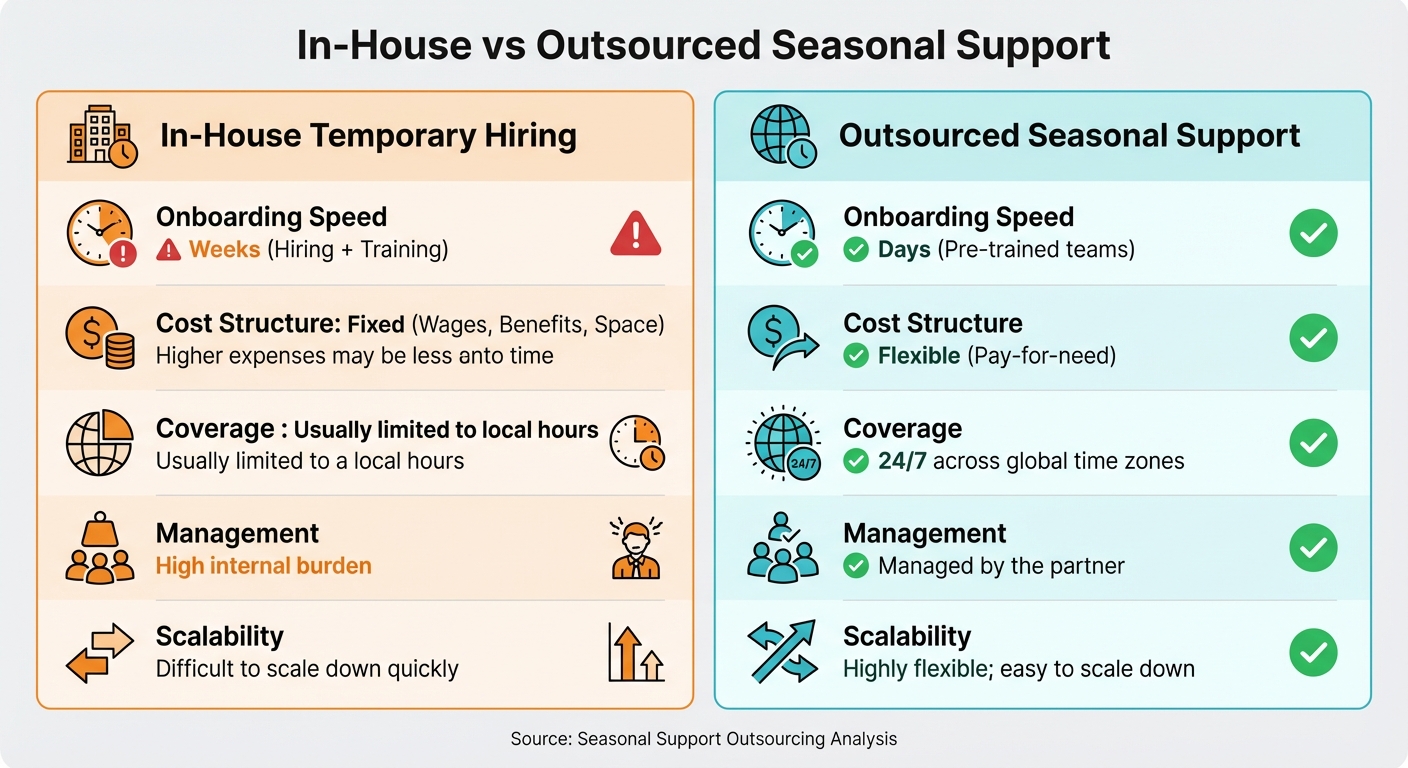
In-House vs Outsourced Seasonal Support: Cost, Speed, and Scalability Comparison
When the holiday rush or other seasonal peaks hit, outsourcing can be a quicker and more adaptable solution than trying to hire temporary staff in-house. The main appeal lies in its speed and cost-effectiveness. Outsourcing providers can expand your support team in just a few days, compared to the weeks or months it might take to recruit and train temporary employees. Plus, it shifts fixed expenses like salaries, benefits, and office costs into variable ones – you only pay during the high-demand period.
Outsourcing also goes beyond just saving money. It offers 24/7 global coverage, something that’s tough to achieve internally during busy seasons. With international teams, your customers can get help anytime – whether through chat, phone, email, or social media. During peak times, service standards often include live chat response times under one minute and email replies within 24 hours.
Another big plus? Outsourcing reduces the training load on your team. Many outsourcing partners already have agents trained in workflows like e-commerce, so they can quickly adapt to your brand’s tone and expectations without extensive onboarding. This allows your internal team to stay focused on strategic tasks instead of being swamped by support tickets.
Here’s how in-house temporary hiring stacks up against different customer support models:
| Feature | In-House Temporary Hiring | Outsourced Seasonal Support |
|---|---|---|
| Onboarding Speed | Weeks (Hiring + Training) | Days (Pre-trained teams) |
| Cost Structure | Fixed (Wages, Benefits, Space) | Flexible (Pay-for-need) |
| Coverage | Usually limited to local hours | 24/7 across global time zones |
| Management | High internal burden | Managed by the partner |
| Scalability | Difficult to scale down quickly | Highly flexible; easy to scale down |
Scale Your Team Quickly
One of the standout benefits of outsourcing is how quickly you can scale your support team. Professional providers can add trained agents in just a few days. This flexibility means you’re not stuck with long-term commitments or excess staff once the busy season ends.
The best outsourcing partners offer flexible contracts without lock-in terms. This allows you to adjust staffing levels as demand fluctuates, treating support capacity as a variable expense. You can scale up when orders spike and scale down just as easily when things slow down, all without the hassle of managing temporary infrastructure or offboarding staff.
Get 24/7 Coverage Across Time Zones
In today’s global market, customers expect round-the-clock support. But maintaining a 24/7 in-house team can be expensive and logistically challenging. Outsourcing solves this by leveraging teams across multiple time zones, ensuring continuous service. This is especially critical during peak times when customers shop at odd hours.
With about 80% of businesses worldwide already outsourcing at least one function, it’s clear this approach works for maintaining service quality during high-demand periods. The global outsourcing market, valued at over $1.2 trillion, underscores its importance in staying competitive.
Lower Costs vs. Temporary Hires
When comparing costs, outsourcing often comes out ahead of hiring temporary staff. In-house hires bring fixed expenses like recruitment, training, and office space, not to mention the management overhead. Outsourcing, on the other hand, operates on a pay-for-what-you-need model. This eliminates many of the extra costs while providing pre-trained agents who can start delivering results immediately.
"Outsourcing isn’t just a contingency plan – it’s a strategic capability that drives sustainable growth and competitive edge."
– Anastasia Aivaliotis, Sourcewiser
How to Plan Your Seasonal Outsourcing Strategy
To prepare for seasonal spikes in customer support, start by analyzing historical ticket data. Use the "Jump" method to compare pre-peak and peak data from past years to predict your needs. Keep in mind that new hires typically handle about 40 tickets per day, while experienced agents can manage around 80. Calculate your Average Handle Time (AHT) and overall resolution capacity to determine the number of agents – or "seats" – you’ll need to meet service level goals. Begin hiring at least two months before your busy season, and schedule onboarding to start a month prior so your team is fully prepared. Here’s a closer look at forecasting demand, structuring your team, and coordinating with marketing efforts.
Forecast Your Support Demand
Accurate forecasting requires combining multiple data points. Look at last year’s peak ticket volumes, establish a baseline from the month before your ramp-up, and get projected sales growth figures from your marketing and sales teams. Don’t forget to account for any product launches or promotions, as these often drive significant increases in support requests.
| Forecasting Input | Description |
|---|---|
| Historical Peak Volume | Total tickets received during the same period last year |
| Pre-Peak Baseline | Ticket volume from the month prior to the ramp-up |
| Expected Sales Volume | Predicted sales growth from marketing/sales teams |
| Agent Resolution Rate | Average tickets an agent resolves daily |
| AHT (Average Handle Time) | Average time spent on each customer interaction |
Keep in mind that different channels perform differently. For example, live chat and chatbots are faster for quick questions, while email is better for detailed, asynchronous issues. After the season ends, document what worked well and what didn’t – this review will make your next forecast even sharper.
Build a Flexible Team Structure
A hybrid staffing model works best: let your in-house team handle complex issues that require brand expertise, while outsourcing partners take care of high-volume, routine inquiries. This approach allows you to scale up without overwhelming your core team.
Design your team to adapt to the four seasonal phases. Use part-time roles, split shifts, or flexible hours to handle fluctuating demand. AI tools like chatbots can take care of repetitive tasks like order tracking, freeing up human agents for more nuanced cases. To prepare, implement and test new systems at least 6-8 weeks before peak season. Use tools like Applicant Tracking Systems (ATS) and automated onboarding platforms to quickly bring seasonal hires on board. Offer focused training through video tutorials or workshops to ensure new agents are ready for peak-season challenges.
Align Support with Marketing Campaigns
Once your team structure is set, align it with your marketing calendar. Your staffing plan should match the timing of promotions, product launches, and other campaigns to handle the surge in inquiries. When marketing ramps up, support feels the impact immediately – so synchronize hiring and onboarding with these activities.
Before major campaigns, hold briefing sessions with your outsourced team. Cover promotion details, potential customer pain points, and FAQs specific to the campaign. Provide a style guide to ensure customer interactions align with your brand’s voice and messaging. Integrated CRM tools can give outsourced agents real-time access to customer data, including which promotions or ads they’re responding to.
You can also use marketing to spread out demand. For instance, offer discounts for early shopping or off-peak times to reduce the load on your busiest days. This strategy helps maintain faster response times and reduces stress on your team.
"When staffing, remember you are putting people on the front lines who will inevitably take the brunt of someone else’s stress. Make sure to create space for your agents to calm them down, and for your agent to process those emotions too!" – Lexi, Head of Client Experience, Influx
To keep things running smoothly, set overlapping work hours between your marketing and support teams for real-time collaboration. Build regular feedback loops so both teams can quickly adjust if campaigns trigger unexpected issues or higher-than-expected ticket volumes. This ensures a seamless experience for customers, from their first interaction with an ad to post-purchase support.
How to Choose an Outsourcing Partner
Picking the right outsourcing partner for seasonal support goes far beyond hunting for the lowest hourly rate. While a cheaper option might seem appealing, it often comes with hidden costs – think errors, escalations, or even lost customers. This decision is about selecting a team that will represent your brand during its busiest and most critical moments, where first impressions and customer loyalty are on the line.
What to Look for in a Partner
When evaluating potential partners, consider their ability to scale and adapt. You want a provider who can quickly add extra staff during unpredictable demand spikes – like a viral post or a flash sale. This flexibility is essential to keep up with customer needs during such surges. Make sure they can handle rapid increases in volume and provide holiday-specific support.
If your business serves international customers, 24/7 global coverage is a must. Outsourcing to a provider with round-the-clock service across time zones is often more cost-efficient than maintaining an in-house team after hours. For industries like Fintech, Healthtech, or B2B SaaS, it’s also crucial to find a partner who understands your specific regulatory and technical requirements.
Technology is another key factor. Ensure the partner has robust systems – like IVR, ACD, and CRM integration – to keep operations smooth. Security and compliance should also be non-negotiable. Look for certifications such as ISO 27001 and SOC 2 Type II, and confirm adherence to GDPR and CCPA regulations.
You’ll also want a partner that aligns with your brand values to ensure a consistent customer experience. Before committing long-term, run a 30- to 90-day proof of concept (PoC) with a sample of your traffic. And don’t skip reference checks – ask how they’ve handled major mistakes or crises in the past. These insights can be invaluable.
"When you choose to outsource this function, you are not just buying labor; you are selecting the people who will manage your company’s most valuable asset: its reputation." – Voodesk
To make the evaluation process easier, use a weighted scorecard that focuses on what matters most to your business. For instance, a Fintech company might prioritize security over everything else, while an e-commerce business might rank scalability higher. During the contract phase, define clear KPIs like First Contact Resolution (FCR), Customer Satisfaction (CSAT), and error rates to ensure accountability from day one.
In-House vs. Outsourcing: A Comparison
Deciding between an in-house seasonal team and outsourcing often boils down to management effort and operational flexibility. Here’s a quick breakdown:
| Factor | In-House Support | Outsourced Seasonal Support |
|---|---|---|
| Cost Structure | High fixed costs (infrastructure, salaries, benefits) | Flexible costs – pay only for what you need |
| Scalability | Slow and challenging; requires hiring and onboarding | Rapid and flexible; scales up or down quickly |
| Ramp-up Time | Long (weeks or months for hiring and training) | Short; access to pre-trained agents |
| Availability | Limited to business hours due to cost | 24/7 global coverage |
| Expertise | Deep brand knowledge but limited high-volume experience | Skilled in handling peak demand across industries |
| Management | High internal effort required | Lower effort; partner handles QA and staffing |
Among 368 decision-makers from G2000 companies, cost savings emerged as the top reason for outsourcing. Many businesses also set a minimum ROI threshold of 20% to 40% to justify the investment. However, over 500 global leaders flagged the lack of benefit tracking and reporting as a common downside of outsourcing. This underscores the need for clear KPIs and operational transparency from the start.
"For outsourcing to be successful, decision-makers must have visibility into every aspect of the outsourcing operation to fully extrapolate the value these relationships can deliver." – Lisa Schwarz, Senior Director of Global Product Marketing, NetSuite
Aidey’s approach to seasonal support provides a real-world example of how outsourcing can meet these challenges effectively.
How Aidey Supports Seasonal Demand
Aidey takes the stress out of seasonal support by offering free onboarding. This eliminates upfront costs for recruitment, training, and system setup, so your team is ready to handle customer inquiries from day one without the financial strain of traditional hiring.
With 24/7/365 global coverage, Aidey ensures your SaaS, e-commerce, or hospitality business can serve customers around the clock. This is especially crucial during peak holiday seasons when international demand surges. Their scalable remote teams turn fixed labor costs into flexible expenses, allowing you to ramp up during busy months like November and December and scale back in January without long-term commitments.
Aidey specializes in industries with unpredictable seasonal trends, such as SaaS, startups, e-commerce, hospitality, and gaming. Their native English-speaking representatives ensure clear communication and strong brand alignment. Plus, they offer a comprehensive range of services, from basic customer support to complex technical troubleshooting. This integrated approach ensures your business can handle everything – whether it’s order tracking or resolving technical issues – seamlessly.
Setting Up Your Seasonal Support Program
Once you’ve chosen your outsourcing partner, the next step is integrating their team into your seasonal support program. This process is about more than just offloading tickets – it’s about creating a seamless extension of your brand that can handle peak demand without a hitch. Getting this setup right is crucial to ensure your seasonal team is ready to perform when the flood of customer inquiries begins.
Set Clear Goals and KPIs
Start by defining specific goals and measurable KPIs for your seasonal support team. For example, you might aim for a two-hour response time for all email inquiries during peak periods or strive to maintain a Customer Satisfaction (CSAT) score above 90%. Establish clear escalation paths so outsourced agents know exactly when and how to hand off complex issues to your internal team. Tools like help desk alerts can ensure dissatisfied customer feedback gets immediate attention. Keep in mind, 73% of customers stick with a brand because of friendly customer support representatives.
Train Your Outsourced Team
Your seasonal team needs thorough, role-specific training to succeed. Equip them with knowledge about your brand, products, and essential soft skills like active listening and de-escalation. The focus should be on efficient onboarding rather than lengthy corporate sessions. Start training 6–8 weeks before the peak season using practical tools like checklists, quick-reference guides, and hands-on shadowing. Assign a mentor or team lead to help new agents adjust quickly.
Positive language training is especially important during the holiday season when customers may feel stressed by tight deadlines. Teach agents to use phrases that defuse tension and turn frustrated shoppers into happy customers. At the same time, establish a clear policy empowering agents to manage or exit interactions involving abusive behavior, prioritizing your team’s well-being. Update your knowledge bases and FAQs with seasonal details like shipping timelines, holiday hours, and return policies. This ensures both agents and customers have quick access to essential information. Once trained, fully integrate your team into your technical systems.
Connect Your Systems and Tools
Seamless technology integration is key to making your seasonal support program run smoothly. Connect your outsourcing partner to your CRM and help desk platforms so agents have real-time access to customer data and conversation histories. Set up automated routing rules to direct specific inquiries – like refund requests or technical issues – to the right team members. Use autoresponders to set clear expectations for reply times and create saved replies for common seasonal questions to speed up response times.
Incorporate live chat and email ticketing to reduce wait times and provide consistent support across multiple channels.
"Customer support teams can’t thrive without having the right technology in place to help them do their jobs properly." – Nicereply
Finally, implement performance monitoring tools and CSAT surveys from day one. Real-time data on your team’s performance will help you make adjustments, provide additional coaching, or reallocate resources as needed to keep everything running smoothly.
Track Performance and Improve Over Time
Your seasonal support program doesn’t wrap up when the holiday rush ends. To keep improving, you need to measure results, address weak points, and fine-tune your strategy for future seasons. Without consistent tracking and analysis, there’s a risk of repeating mistakes or overspending. Regular evaluations not only improve peak-time support but also help create stronger strategies for the future.
Metrics That Matter
Focus on a mix of financial, operational, and customer-focused metrics. For cost savings, use this formula:
(In-house cost – Outsourced cost) / In-house cost × 100.
To measure ROI, use:
(Total benefits – Total costs) / Total costs × 100.
Many businesses set ROI benchmarks between 20% and 40% to assess the value of their outsourcing partnerships. If your partner doesn’t meet these benchmarks or misses cost-reduction goals, a post-season review can be the perfect time to renegotiate contracts or adjust your SLA.
Operational efficiency is another key area to monitor, especially during peak times. Metrics like completion rate, schedule adherence, and average resolution time highlight whether your outsourcing team had the capacity to meet demand or if staffing levels were off. On the customer side, CSAT scores and Net Promoter Score (NPS) provide valuable feedback on the user experience. For reference, an NPS of +50 or higher is generally considered strong.
Interestingly, Deloitte’s 2024 Global Outsourcing Survey found that “lack of benefit realization tracking and reporting” was the most common complaint among over 500 business and technology leaders surveyed. To avoid this, establish regular reporting cycles – weekly during busy seasons and monthly or quarterly during slower periods – as part of your SLA. This helps identify trends early and address issues before they grow.
Review and Adjust After Each Season
As soon as your peak period ends, conduct a thorough post-season review to capture key insights. Organize customer complaints by type, severity, and root cause to determine whether issues stemmed from vendor processes, training gaps, or system flaws. Compare outsourced team performance with in-house results to spot any quality gaps. For instance, if your outsourced team has lower satisfaction scores or more complaints in specific areas, use that data to refine training for the next season.
Look at metrics like completion rates and schedule adherence to separate one-off problems (like weather-related delays) from recurring bottlenecks in your workflow. These findings should directly inform your planning for future peak periods, ensuring that each season benefits from lessons learned.
Stay Ready Year-Round
Seasonal adjustments are important, but maintaining readiness year-round is just as critical. The best companies treat outsourcing partners as long-term collaborators, fostering a culture of feedback and ongoing improvement that continues between peak periods. Full visibility into your outsourcing operations helps uncover both successes and areas for improvement.
Integrated CRM systems are a must to ensure outsourced agents can access customer data in real time. This helps maintain high service standards during and after busy seasons. For post-peak transitions, have a plan to scale down teams while keeping skilled staff engaged. This could mean shifting them to other roles or retaining a smaller core team for off-season support. Additionally, set performance baselines before each peak season starts to create clear benchmarks for comparison, and tie specific goals to your SLA.
Conclusion
Seasonal demand doesn’t have to disrupt your operations or strain your budget. By outsourcing during peak periods, you can turn fixed labor costs into flexible expenses, potentially reducing support costs by 60%, scale your team as needed, and keep service quality intact – even when ticket volumes surge by 300% to 500%. When treated as a long-term partner, your outsourcing provider becomes a key part of your strategy. Early planning, clear metrics, seamless integration, and post-season reviews are all critical steps to success.
Smart businesses rely on historical data to predict demand, ensure outsourced agents are trained in brand voice and inquiry handling, track performance in real time, and refine strategies based on post-season analysis. This well-rounded approach ensures you find a partner that aligns with your specific needs.
Flexible cost structures and scalable teams are game-changers during seasonal spikes. Avoid the $4,700 cost per new hire or $1,105 per person on training expenses. Aidey offers 24/7/365 customer support outsourcing with no onboarding fees, flexible remote teams, and experienced agents. Whether you’re an e-commerce brand gearing up for Black Friday, a SaaS company rolling out a major feature, or a hospitality business preparing for summer travel, Aidey ensures you’re ready for anything.
With the right strategies in place, seasonal peaks can become opportunities to deliver standout customer experiences. Thriving during high-demand periods comes down to preparation, choosing the right partner, and committing to ongoing improvement. Start planning now to ensure your support operations shine, no matter how much demand grows.
FAQs
How far in advance should I start seasonal support outsourcing?
Starting your seasonal support outsourcing efforts 2–3 weeks before your peak season kicks off is a smart move. This gives you enough time to train your team, set up the necessary tools, and put strategies in place to manage the surge in demand. By preparing ahead, you can scale operations smoothly, streamline processes, and steer clear of rushed, last-minute fixes that might impact the quality of support during your busiest times.
What should an SLA include for peak-season support?
An SLA for peak-season support needs to lay out specific metrics like response times, resolution times, and uptime guarantees. These benchmarks help maintain consistent service quality during periods of high demand.
It should also detail escalation procedures, outline how performance will be monitored, and specify remedies if standards aren’t met. To address seasonal spikes effectively, the SLA should include provisions for scalability – such as flexible staffing or resource adjustments. This ensures businesses can handle surges in customer inquiries efficiently while keeping operations transparent and accountable.
How do I keep outsourced agents on-brand during busy periods?
To keep outsourced agents aligned with your brand during high-demand periods, focus on clear training and open communication. Start with thorough onboarding sessions that immerse them in your brand’s voice, values, and expectations. Provide detailed brand guidelines and well-crafted scripts to ensure messaging stays consistent.
Additionally, schedule regular check-ins and offer constructive feedback, especially during peak times. This ongoing support helps maintain quality and ensures they stay connected to your brand’s identity.