

BPO (Business Process Outsourcing) is a powerful tool for SaaS startups looking to scale efficiently without overloading their internal teams. By outsourcing tasks like customer support, startups can cut costs, access skilled professionals, and handle demand spikes faster than in-house teams. However, choosing between BPO and in-house support depends on your goals, budget, and operational needs.
Key Takeaways:
- Cost Savings: BPO reduces expenses by turning fixed costs (e.g., salaries, benefits) into variable costs. outsourcing customer service can save 20%–40%.
- Scalability: BPO providers can deploy trained teams in under 30 days, while in-house teams require months to hire and train.
- Expertise Access: Outsourcing gives startups access to specialized skills and advanced tools that may be costly to develop internally.
- Support Quality: BPO ensures 24/7 coverage and lower turnover rates, but in-house teams allow more control over brand alignment.
Quick Tip: A hybrid approach – outsourcing routine tasks while keeping core functions in-house – can balance cost-efficiency with brand control.
| Feature | BPO | In-House Support |
|---|---|---|
| Cost | Lower, variable | Higher, fixed |
| Time to Scale | Days to weeks | Months |
| Expertise | Access to specialized skills | Deep product knowledge |
| 24/7 Coverage | Easier and cheaper | Expensive and complex |
| Brand Control | Limited | High |
Conclusion: BPO is an effective option for startups aiming to grow quickly while managing costs and resources. However, in-house teams are better for tasks requiring deep product knowledge and brand consistency. Choose based on your startup’s needs and long-term goals.
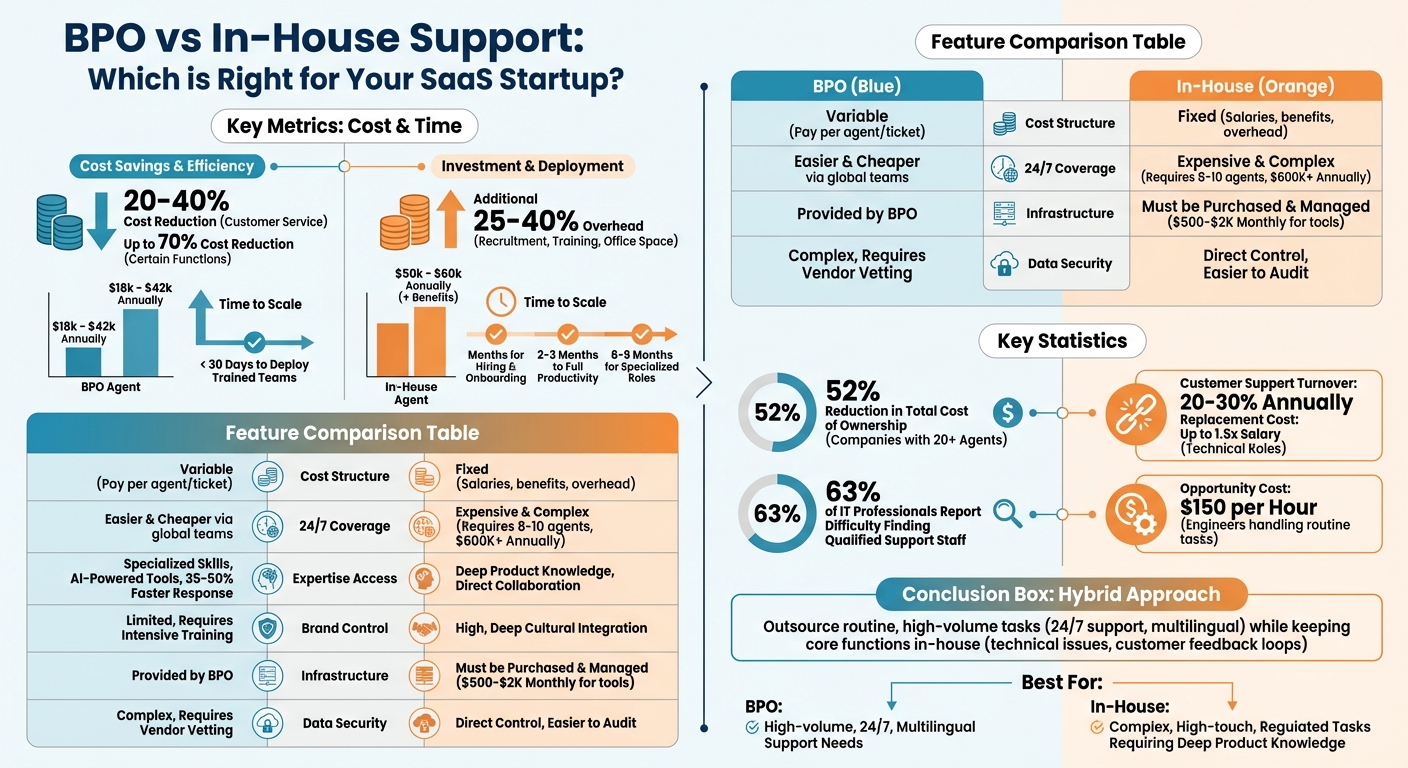
BPO vs In-House Support Comparison for SaaS Startups
1. Business Process Outsourcing (BPO)
Cost Efficiency
BPO helps SaaS startups turn fixed overhead costs into variable expenses, making operations more flexible. For example, outsourcing labor can cut costs by up to 70% for certain functions. Specifically, outsourcing customer service can reduce expenses by 20%–40%.
Here’s a breakdown: hiring a customer service representative in-house costs $35,000–$45,000 annually (or up to $60,000 when factoring in benefits). In contrast, BPO rates range from $18,000–$42,000 per agent. On top of that, outsourcing eliminates additional expenses like recruitment (which can cost 1.5 times the annual salary for technical roles), training ($5,000–$8,000 per agent), and support software (which typically costs $50–$200 per agent each month).
BPO also makes 24/7 coverage more affordable. Maintaining around-the-clock support in-house can cost double what outsourcing would. As Enshored points out:
Every hour your engineers spend resetting passwords costs you $150 in opportunity cost – Enshored
By outsourcing routine tasks, startups can keep their top talent focused on building and improving their product instead of handling repetitive support issues.
Scalability
Startups often face growing pains when demand spikes unexpectedly. For instance, a successful product launch could lead to a 400% increase in support requests, but hiring internally to meet this demand can take months. BPO solves this problem by offering rapid scalability. Providers can deploy trained teams in under 30 days, making it possible to handle surges in demand during launches, seasonal peaks, or unexpected growth.
This flexibility allows startups to adapt quickly to market changes without committing to long-term fixed costs. Plus, BPO providers bring specialized expertise that complements this scalability, ensuring startups can maintain quality even during rapid expansion.
Access to Expertise
Outsourcing firms often have specialized teams that startups may struggle to build internally. These teams include technical support experts skilled at debugging APIs and reading error logs, compliance professionals familiar with regulations like HIPAA and PCI DSS, and customer success specialists who excel at metrics and retention strategies.
Additionally, BPO providers invest in advanced technologies that would be prohibitively expensive for startups to develop on their own. Examples include AI-powered routing systems, sentiment analysis tools that escalate frustrated customer issues automatically, and omnichannel platforms. These tools not only enhance efficiency but also enable outsourced teams to respond 35%–50% faster than newly established in-house teams.
Customer Support Quality
BPO doesn’t just cut costs – it can also elevate the quality of customer support. Outsourcing providers typically achieve higher agent retention rates compared to internal SaaS teams, which means less turnover and a more experienced workforce. They also offer true 24/7/365 support across multiple time zones, something that’s often too expensive for startups to manage in-house.
For companies with 20 or more agents, outsourcing can reduce total cost of ownership by an average of 52%. It also improves key performance metrics like first response times and customer satisfaction scores. This combination of lower costs and better performance turns BPO into a strategic tool for growth, rather than just a way to save money.
Take Aidey, for instance. Their tailored 24/7/365 support demonstrates how scalable outsourcing can deliver both efficiency and quality. These advantages highlight why BPO has become an essential strategy for SaaS startups, setting the stage for a closer look at how it stacks up against in-house support in the next section.
sbb-itb-8132e49
2. In-House Support
Building an in-house support team comes with high fixed costs and limited flexibility, making it a stark contrast to the adaptable, variable-cost model of Business Process Outsourcing (BPO).
Cost Efficiency
Running an in-house support team isn’t cheap. A U.S.-based customer service agent typically costs between $50,000 and $60,000 annually when you include benefits, payroll taxes, and overhead. But that’s just the start – add recruitment, training, office space, equipment, and management time, and the total cost jumps 25%–40% higher.
Turnover adds another layer of expense. Customer support roles see annual churn rates of 20%–30%, which means constant hiring and onboarding cycles. Replacing an agent can cost up to 20% of their salary, but for technical employees, this figure skyrockets to 1.5 times their salary due to hiring, training, and productivity losses. For startups with tight budgets, these hidden costs pile up fast. Add the need for 24/7 coverage – requiring at least 8–10 agents – and annual costs can easily exceed $600,000, even before factoring in software or infrastructure.
Scalability
Scaling customer support for an in-house team is no easy feat. Unlike BPOs that can ramp up in under 30 days, internal teams face lengthy recruitment and training timelines. Hiring and onboarding new agents can take weeks or months, and for specialized roles like API troubleshooting or compliance, it can stretch to 6–9 months. Even after hiring, agents often need 2–3 months to reach full productivity.
This slow ramp-up becomes a major hurdle during product launches or seasonal spikes. Companies either overstaff to prepare for surges – wasting money during quieter periods – or understaff, risking customer dissatisfaction. As Peak Support explains:
In-house hiring takes time, often slows down operations, and adds long-term overhead
Scaling down during slow periods isn’t simple either, as layoffs can disrupt team morale and operations.
Access to Expertise
One advantage of in-house teams is their ability to develop deep, product-specific expertise. Being immersed in the company culture and having direct access to updates allows agents to provide detailed, accurate support. They can also collaborate closely with product and marketing teams to refine responses.
However, building this expertise comes at a high cost. Recruiting skilled technical talent is a challenge – 63% of IT professionals report difficulties in finding qualified support staff. Additionally, maintaining a cutting-edge tech stack requires significant investment in IT talent and infrastructure, diverting resources from core business priorities. There are also ongoing costs for tools like knowledge base platforms ($500–$2,000 monthly) and specialized software ($50–$200 per agent monthly).
Customer Support Quality
In-house teams provide unmatched control over brand voice and quality. Managers can directly oversee interactions, offer immediate feedback, and ensure agents align with the company’s values and standards. This level of oversight helps maintain a consistent customer experience.
However, this control comes with challenges. During high-demand periods, in-house agents often juggle multiple tasks, which can dilute focus and efficiency. True 24/7 support across time zones is another hurdle – it’s operationally complex and extremely costly for most startups. While in-house teams excel at delivering brand consistency, they lack the operational flexibility and cost efficiency that BPO solutions can provide.
Pros and Cons
Deciding between BPO and in-house support involves more than just comparing costs. Factors like scalability, quality of service, and alignment with your strategic goals play a critical role. Below, you’ll find a breakdown of the key advantages and challenges for each approach, giving you a clearer picture of what might work best for your business.
BPO stands out for its flexibility, offering quick access to trained teams while covering infrastructure costs. Providers can ensure seamless 24/7 coverage across time zones – something that’s often too complex and expensive for startups to replicate on their own.
However, BPO isn’t without its drawbacks. Outsourcing can limit your ability to oversee daily operations, making it harder to maintain your brand’s voice and values. Security and compliance also become more challenging, as third-party access to customer data requires careful vendor vetting and regular audits. Additionally, relying on a vendor can be risky if they face high staff turnover or fail to meet performance expectations, potentially impacting customer satisfaction.
In-house teams, on the other hand, offer unmatched integration with your product and company culture. This setup allows for quicker feedback loops and ensures your brand values are consistently communicated. But this control comes at a price. Building an in-house team involves higher salaries, longer recruitment cycles, and significant management effort, which can divert resources from other growth-focused initiatives.
Here’s a side-by-side comparison to help you weigh the options:
| Feature | BPO | In-House Support |
|---|---|---|
| Time to Scale | Days to weeks | Months for hiring and onboarding |
| Cost Structure | Variable (pay per agent/ticket) | Fixed (salaries, benefits, overhead) |
| Infrastructure | Provided by BPO | Must be purchased and managed internally |
| 24/7 Coverage | Easily accessible via global teams | Expensive and operationally complex |
| Brand Control | Requires intensive training | Deep integration with company culture |
| Data Security | Complex; requires strict vendor vetting | Direct control; easier to audit |
| Best For | High-volume, 24/7, multilingual support | Complex, high-touch, regulated tasks |
This comparison highlights the trade-offs. BPO excels in flexibility and scalability, while in-house support offers greater control and alignment with your brand. The right choice depends on your specific needs and long-term goals.
Conclusion
From the comparisons outlined earlier, it’s clear that Business Process Outsourcing (BPO) can be a game-changer for SaaS startups experiencing rapid growth. It offers a way to scale operations without descending into chaos. For instance, outsourcing can slash support costs by 30%–70% and deploy trained teams in less than 30 days. When combined with savings on recruitment and training, the financial benefits become even more compelling.
But BPO isn’t just about saving money. It’s about strategically reallocating resources. By outsourcing repetitive, high-volume tasks like password resets or tier-one support, your engineers can stay focused on driving core innovation. This approach fuels faster growth. As Peak Support aptly puts it:
BPOs aren’t just for back-office work anymore. They’re strategic partners in helping companies grow faster, serve better, and stay focused on their core mission.
To make the most of BPO, consider outsourcing non-core tasks that require 24/7 availability or multilingual support. At the same time, keep critical technical issues and customer feedback loops in-house. This hybrid model allows you to scale your support systems to match your business’s growth while maintaining control over your brand’s most vital aspects.
When BPO is approached as a strategic tool rather than just a cost-cutting option, it transforms into a competitive edge. With thoughtful implementation – clear documentation, measurable performance goals, and strong vendor relationships – BPO can accelerate your journey to market leadership. Providers like Aidey, for example, offer 24/7/365 customer support tailored specifically for SaaS startups, enabling you to focus on innovation while scaling operations seamlessly. This alignment positions BPO as a cornerstone of growth for SaaS businesses.
FAQs
When should a SaaS startup choose BPO instead of hiring in-house?
Startups in the SaaS world often hit a point where their internal teams feel stretched thin – support tickets pile up, response times lag, or customers need help outside regular business hours. This is where BPO (Business Process Outsourcing) can make a real difference. By outsourcing tasks like customer support or onboarding, startups can tap into scalable and budget-friendly solutions that keep operations running smoothly.
One major perk? Outsourcing lets you provide 24/7 support across time zones without the hassle of recruiting and training an in-house team. It’s a smart way to stay agile, meet growing market demands, and focus on what matters most: scaling your business.
What should I outsource first to a BPO team?
Start by delegating tasks such as customer support, data management, and back-office operations. These areas, while essential for smooth operations, don’t directly drive the core mission of your SaaS startup. Outsourcing them can help you maintain efficiency and focus on growth. For instance, customer support is often outsourced first to manage increasing ticket volumes effectively. Similarly, handing off back-office tasks like data entry and administrative work can free up your team to concentrate on priorities like product development and acquiring new customers.
How do I maintain brand voice and data security with outsourced support?
To maintain your brand’s voice and safeguard data, it’s essential to have a solid oversight system in place. Start by creating detailed brand playbooks that outline your tone, style, and messaging guidelines. Pair this with clear communication protocols to ensure everyone is on the same page. Regularly reviewing interactions can help you spot inconsistencies and adjust as needed.
On the security side, focus on strict access controls to limit who can handle sensitive information. Make sure your processes align with relevant data protection laws, and schedule regular audits to identify vulnerabilities. Providing ongoing training for your team ensures they stay informed about best practices. Together, these measures keep outsourced teams aligned with your brand while protecting critical data.