

Want to boost customer satisfaction and revenue? The right support model can make all the difference. Here’s what you need to know:
- Live Chat: Real-time help increases conversions by 12% and reduces cart abandonment. Costs $4–$8 per interaction, but 24/7 staffing can be expensive.
- AI-Driven Support: Automates 70% of inquiries at just $0.10–$0.50 per interaction. Perfect for repetitive tasks like "Where’s my order?" inquiries.
- Omnichannel Solutions: Connects email, chat, and social media for a consistent experience. Customers using multiple channels spend 1.5x more.
- Outsourcing: Scales easily for seasonal spikes. Offshore teams cost $6–$12 per hour, saving up to 70% compared to in-house teams.
Quick Tip: Start small with self-service tools and AI, then expand with hybrid models as your business grows.
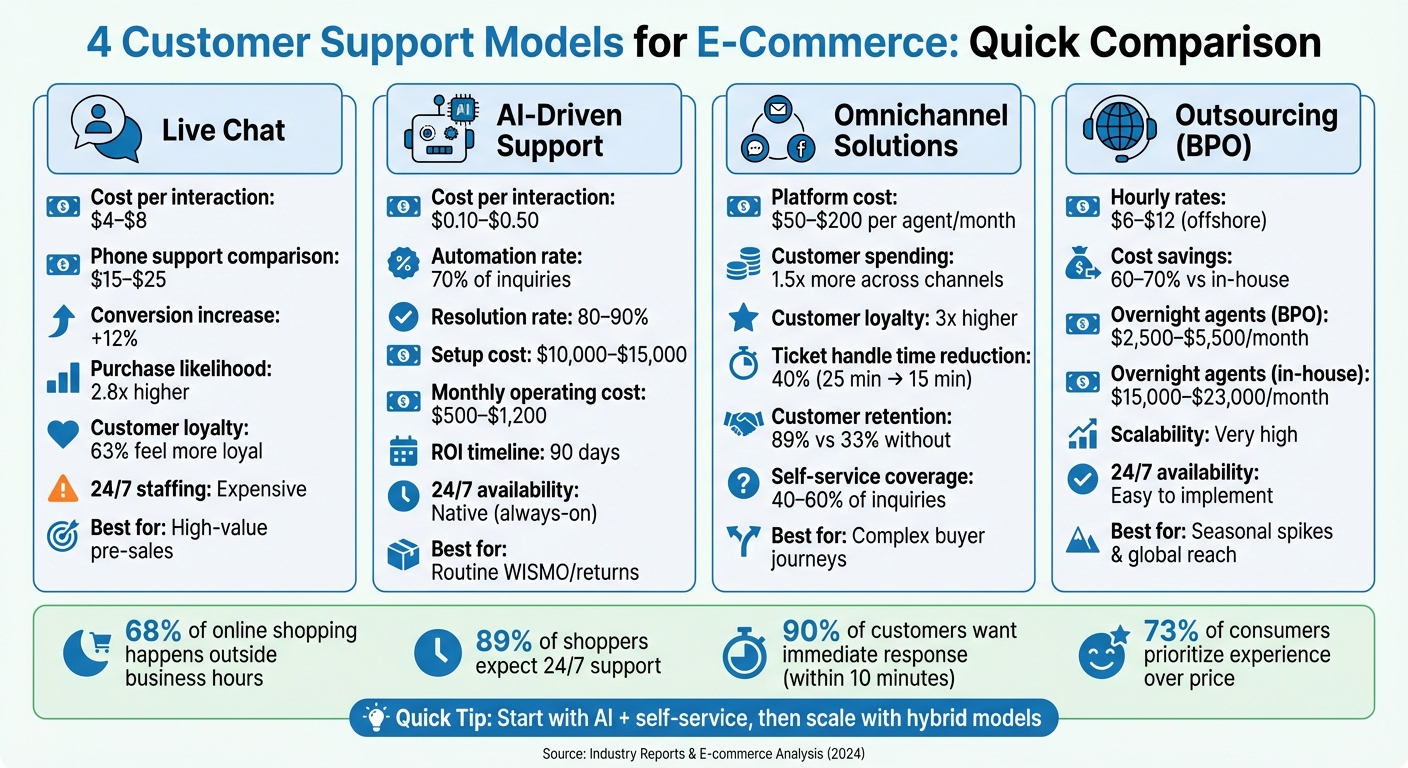
E-Commerce Customer Support Models Comparison: Cost, Scalability and Availability
How AI is Redefining E-commerce Support & Customer Loyalty with eDesk CEO Gareth Cummings
sbb-itb-8132e49
1. Live Chat Support
Live chat connects you directly with shoppers while they’re still browsing your website – right when they might need assistance the most. Whether they’re hesitating on a product page or stuck during checkout, a quick chat can help close the sale. In fact, customers who use live chat are 2.8 times more likely to make a purchase. This real-time interaction is what makes live chat both cost-efficient and scalable.
Cost
Live chat is more affordable than phone support because agents can handle multiple conversations at once. On average, a live chat interaction costs $4–$8, compared to $8–$15 for email and $15–$25 for phone support. Automating tasks like order tracking brings costs down even further to just $0.10–$0.50 per interaction, versus $2–$5 for human-led responses. Considering labor accounts for 60–80% of support expenses, the ability to manage multiple chats simultaneously can significantly lower costs.
Scalability
Scaling live chat doesn’t always mean hiring more staff. By incorporating pre-written macros for common questions, creating automated FAQ workflows, and deploying AI chatbots for repetitive inquiries like "Where’s my order?", support teams can handle more tickets without adding headcount. For example, a 2025 case study showed a mid-size e-commerce store with $2 million in annual revenue reduced its support team from four agents to two by using AI to manage 70% of inquiries. This lowered their cost per ticket from $6.50 to $0.80, saving $72,792 annually. This scalability ensures support remains efficient as demand grows.
24/7 Availability
With 68% of online shopping happening outside regular business hours, round-the-clock support is essential. If maintaining 24/7 in-house coverage is too expensive, alternatives like global teams or AI chatbots can fill the gap. A "Follow-the-Sun" approach, using teams in different time zones, is one option. Outsourcing to a BPO partner – such as agents in the Philippines, typically available for $8–$12 per hour – is another. AI chatbots can also handle after-hours inquiries seamlessly. If 24/7 coverage isn’t feasible, clearly display your chat hours and use an offline form to collect customer emails for follow-up.
E-Commerce Fit
Live chat is particularly effective in reducing cart abandonment by addressing customer concerns in real time. Speed is critical here: 90% of customers say an immediate response is important, with 60% defining "immediate" as within 10 minutes. The results speak for themselves – live chat can increase conversion rates by an average of 12%. It also fosters brand loyalty, with 63% of consumers who spend $250–$500 online per month stating they feel more loyal to brands that offer live chat support.
2. AI-Driven Support
AI-driven support builds on the strengths of live chat by taking automation to the next level. These systems can handle entire customer interactions independently – managing tasks like processing refunds, generating return labels, and updating shipping addresses. This allows your support team to focus on solving more complex issues that require a human touch.
Cost
One of AI’s biggest advantages is its ability to significantly reduce costs. While handling repetitive tickets with human agents typically costs around $6.50 per ticket, AI can manage the same tasks for approximately $0.80. This means AI can handle about 70% of tickets at just a fraction of the cost. For a mid-size business handling 1,500–5,000 tickets monthly, operating costs range from $500 to $1,200 per month after an initial development investment of $10,000 to $15,000. Pricing models vary, with some platforms charging per resolution – Zendesk AI starts at $2.00 per automated resolution, while Gorgias begins at $1.00 per resolution. Many businesses see measurable returns on their AI investment within just 90 days.
Scalability
AI offers unmatched scalability, enabling support systems to handle a surge in customer queries without adding staff. For example, during peak periods when queries might increase fourfold – or even tenfold – AI can manage the load seamlessly. In January 2026, fashion retailer Motel Rocks implemented Zendesk AI agents and saw their self-service rate climb by 206%, along with a 9.44% boost in customer satisfaction scores. AI also achieves resolution rates of 80–90% for straightforward questions, far surpassing the 40–60% resolution rates of traditional rule-based bots. This ensures that customer support remains efficient and responsive, no matter the time or demand.
24/7 Availability
With 89% of shoppers expecting round-the-clock support, AI bridges the gap when your team isn’t available. Operating 24/7, AI systems can deliver immediate responses in over 100 languages, reducing ticket volume and enhancing customer satisfaction. Automated order updates alone have been shown to increase customer satisfaction by 23%.
E-Commerce Fit
AI’s ability to integrate directly with platforms like Shopify and Magento makes it especially useful for e-commerce. By accessing live order data, AI can efficiently handle "Where Is My Order" (WISMO) requests, which often dominate support inquiries. Starting with these high-volume, straightforward queries can lead to quick returns on investment. AI can also assist in reducing cart abandonment by detecting hesitation at checkout and offering incentives like discounts or sizing guides. For instance, OPPO, a global smart device company, partnered with Sobot to implement AI-driven support. The results? An 83% resolution rate, a 94% positive feedback rate, and a 57% increase in customer repurchase rates. Additionally, seamless handoffs to human agents – where the full conversation context is preserved – ensure customers don’t have to repeat themselves when their issues are escalated.
3. Omnichannel Solutions
Omnichannel solutions are reshaping customer support by seamlessly connecting interactions across platforms, ensuring a smooth and consistent experience that can directly impact revenue. While AI-driven support focuses on automation and scalability, omnichannel strategies emphasize continuity, making every customer interaction feel connected.
This approach doesn’t just offer multiple communication options – it integrates them. Omnichannel support ties together email, chat, and social media into a unified system. For example, if a customer starts a conversation on Instagram and later follows up via email, the agent can access the entire conversation history. This eliminates the frustration of repeating information, a factor that 60% of consumers say negatively affects their experience.
Cost
Implementing omnichannel solutions involves some upfront investment, with platform licensing typically costing between $50 and $200 per agent per month. However, these systems often lead to significant efficiency gains. Take Tile, the tracking device company, as an example: after adopting an omnichannel workspace in 2013, Tile cut average ticket handle time by 40% – from 25 minutes to 15 minutes – and achieved a 14% increase in customer satisfaction.
For businesses requiring around-the-clock support, a hybrid model with a BPO (Business Process Outsourcing) partner can offer cost savings. Two overnight agents through a BPO cost around $2,500–$5,500 per month, compared to the $15,000–$23,000 required for in-house staffing.
Scalability
Omnichannel systems are designed to scale efficiently by blending self-service options with intelligent ticket routing. A well-maintained knowledge base can handle 40–60% of routine inquiries, such as order tracking, freeing up agents to focus on more complex issues. BoxyCharm, a beauty subscription service, is a great example of this. By consolidating its social media channels into an omnichannel platform, the company achieved 100% resolution of private social media tickets and saw a 17% increase in customer satisfaction scores.
These systems also use intelligent routing to assign tickets based on factors like agent expertise, customer priority, or past interactions. This ensures quicker resolutions without requiring additional staff, making it a highly efficient solution for growing businesses.
E-Commerce Fit
For e-commerce businesses, omnichannel support isn’t just a convenience – it’s a revenue driver. Customers who interact across multiple channels spend 1.5x more than single-channel shoppers and are three times more loyal. Popular platforms like Shopify and BigCommerce offer native integrations, enabling agents to manage order histories, process refunds, and update shipments all within one system.
Nissan Europe demonstrated the potential of omnichannel by adopting a mobile-first strategy that used Rich SMS and app notifications. The result? A quadrupling of customer engagement and an 80% conversion rate for new campaigns.
Raphael Fontes, Vice President of Customer Operations at Squarespace, summed up the customer-first advantage:
"An omnichannel approach is best for the customer because they can choose how they want to reach out. We can flex to their needs".
With 70% of consumers willing to spend more with companies that offer seamless conversational experiences, the benefits of omnichannel support for businesses are hard to ignore.
4. Outsourcing Models
Outsourcing customer support offers e-commerce businesses a way to manage costs more flexibly and scale operations efficiently. Instead of dealing with fixed expenses like salaries, benefits, and office space, outsourcing shifts these to variable costs that align with your support needs [39, 43]. For example, outsourcing to regions like the Philippines can cut operational costs by 60% to 70% compared to maintaining in-house teams in the U.S..
The global outsourcing market was valued at nearly $246 billion in 2021 and is expected to grow to $525.2 billion by 2030. While cost savings drive much of this growth, access to specialized expertise is equally important. Modern BPO (Business Process Outsourcing) providers train their agents on platforms like Shopify and Magento, as well as marketplaces like Amazon Seller Central [41, 43]. These benefits – cost efficiency, scalability, 24/7 availability, and tailored integration – make outsourcing a strategic choice for e-commerce businesses.
CallZent captures this shift perfectly:
"Outsourcing customer service is no longer a tactical decision about saving money. It’s a strategic choice to improve customer satisfaction, build loyalty, and drive long-term growth by leveraging specialized expertise."
Next, let’s break down the specific advantages of outsourcing.
Cost
Outsourcing pricing depends on the region and service model. Hourly rates range from $6–$10 in India, $8–$14 in the Philippines, and $20–$30 in the U.S. and Canada. For example, live chat support costs between $15–$60 per agent monthly, while U.S.-based email support specialists earn $11–$28 per hour.
Consider this comparison: hiring two overnight agents through a BPO costs around $2,500–$5,500 per month, whereas doing so in-house would cost $15,000–$23,000. Over a year, this could mean saving more than $7,000 per agent. However, it’s important to account for hidden costs like setup fees, training, technology upgrades, and management overhead [40, 41].
BPO providers typically offer four pricing models:
- Fixed price: A standard monthly fee.
- Time and materials: Billed based on actual hours worked.
- Consumption-based: Charged per ticket or interaction.
- Incentive-based: A base rate plus performance bonuses.
For e-commerce brands with seasonal sales spikes, the consumption-based model is particularly effective. However, it requires careful oversight to avoid unnecessary ticket churn.
Scalability
Outsourcing shines when it comes to managing sudden increases in demand. Seasonal events like Black Friday or viral product launches can overwhelm in-house teams, which often require lengthy hiring processes to scale up [43, 45]. BPO providers, on the other hand, can expand or reduce support capacity quickly without the delays of traditional recruitment [38, 40].
Take Embark, for example. In September 2024, they partnered with Peak Support to handle high live chat volumes. By combining an AI chatbot with human agents, they automated 75% of their live chat interactions, achieved a 96% resolution rate, and maintained a 97% CSAT score. Scalability like this can also boost order accuracy by 15% and increase repeat purchases by 12%. Additionally, since 80% of e-commerce tickets typically involve standard issues like order tracking or returns, BPO teams can streamline workflows as demand grows.
This ability to scale ensures constant support, which is crucial for global e-commerce operations.
24/7 Availability
About 68% of online shopping happens outside regular business hours. Without round-the-clock support, e-commerce brands risk losing sales, facing negative reviews, and dealing with chargebacks. Outsourcing enables a follow-the-sun model, where teams across time zones provide seamless 24/7 coverage [9, 45]. This approach is far more affordable than staffing domestic overnight shifts, which can cost $180,000–$280,000 annually for minimal coverage – or more than $500,000 for full operations.
For example, in July 2025, the online Asian supermarket Weee! partnered with Sobot to tackle language barriers and rigid IVR systems. By introducing a flexible IVR system and multilingual support, they increased agent efficiency by 20%, cut resolution times by 50%, and achieved a 96% customer satisfaction score. Many e-commerce brands adopt a hybrid approach, where in-house teams cover peak daytime hours (7 a.m.–11 p.m.), and BPO partners handle overnight shifts (11 p.m.–7 a.m.). During after-hours, AI chatbots can handle routine inquiries at $0.10–$0.50 per interaction, compared to $2–$5 for human agents.
E-Commerce Fit
Outsourcing isn’t just about cost – it’s also about aligning with the specific needs of e-commerce. BPO providers often integrate directly with platforms like Shopify, Magento, Zendesk, or Gorgias, giving agents access to critical customer data [43, 45]. This integration allows them to handle tasks like reviewing order histories, processing refunds, and updating shipments seamlessly within a unified system.
The impact on customer loyalty is undeniable. Around 89% of customers are more likely to make a repeat purchase after a positive support experience, while 55% won’t return after a negative one [43, 42]. In e-commerce, where repeat business drives profitability, outsourcing becomes an investment in growth rather than just a cost-saving measure.
Security is another key consideration. E-commerce businesses must ensure their BPO partners comply with regulations like PCI DSS for handling credit card data and privacy laws such as GDPR or CCPA. With GDPR fines reaching up to 4% of annual global revenue, vetting vendors for certifications like SOC 2 or ISO 27001 is essential [43, 46].
Success in outsourcing depends on setting clear goals. As CallZent advises:
"The most successful outsourcing partnerships begin with a crystal-clear definition of success. Document your desired outcomes, from CSAT scores to resolution times, before you ever speak to a potential provider."
Many brands find that a hybrid model works best – keeping complex or high-priority issues in-house while outsourcing routine tasks and after-hours support. This approach balances control with the flexibility and cost advantages of outsourcing.
Pros and Cons
Each support model comes with its own advantages and challenges, which can significantly influence your e-commerce operations. Here’s a breakdown to help you weigh the options.
Live chat is a standout for driving conversions, especially during high-value pre-sales interactions. However, maintaining 24/7 live chat coverage can be costly and resource-intensive.
AI-driven support is a game-changer for cutting costs. By automating responses and enabling self-service, AI can handle 25–45% of ticket volume, significantly reducing per-interaction expenses. For example, Klarna‘s AI assistant managed 2.3 million customer interactions in a single month, equating to the workload of 700 full-time agents. But AI has its limits – it struggles with emotional or complex customer issues, and setup costs can range from $6,000 to over $50,000 depending on your business size.
Omnichannel solutions excel at delivering a seamless customer experience by preserving conversation history across platforms. This feature addresses a common frustration for 56% of consumers who dislike repeating themselves. Businesses with strong omnichannel strategies retain 89% of their customers, compared to just 33% for those without. However, these systems come with added complexity and software costs, which can range from $10 to over $100 per agent monthly. They also require a well-integrated tech stack to function effectively.
Outsourcing models offer an affordable way to scale your support operations quickly, with offshore teams charging $6–$12 per hour. This approach is ideal for managing seasonal demand and ensuring 24/7 availability. That said, outsourcing can lead to concerns about product knowledge and maintaining consistent brand messaging. Additionally, human error remains a significant risk, with 95% of data breaches in customer support tied to mistakes. Proper vendor evaluation is essential to mitigate these risks.
| Support Model | Cost | Scalability | 24/7 Availability | E-commerce Fit |
|---|---|---|---|---|
| Live Chat | High cost | Low to Medium | Expensive to staff | Best for high-value pre-sales |
| AI-Driven | Low after setup | Infinite | Native (always-on) | Excellent for routine WISMO/returns |
| Omnichannel | Medium to High | High (efficiency gains) | Depends on staffing | Essential for complex buyer journeys |
| Outsourcing (BPO) | Low to Medium | Very High | Easy to implement | Ideal for seasonal spikes and global reach |
This comparison underscores the key factors to consider as you design a support strategy tailored to your e-commerce needs. Each model has its strengths, but understanding their limitations will help you make a well-informed decision.
Conclusion
Selecting the right customer support model depends on your business’s growth stage and what your customers expect. If you’re running a small e-commerce store just starting out, a simple setup like email support paired with a well-organized self-service knowledge base can go a long way. This combination can handle 40–60% of routine questions while keeping costs low.
As your business expands, you might want to explore a hybrid approach. Use AI to manage routine inquiries, such as "Where is my order?" (WISMO) or return requests, and reserve live agents for more complex or high-value interactions. It’s worth noting that 73% of consumers prioritize customer experience over price and product quality. For mid-sized businesses generating $500,000 to $5 million in revenue, on-call rotations can provide 24/7 emergency coverage without the hefty expense of full overnight staffing.
To further refine your support system, start by analyzing your top five reasons for customer contact. From there, create targeted self-service resources to address those specific issues. Implementing tools like a shared inbox or an omnichannel platform ensures your agents have a complete view of customer interactions, reducing frustration and improving retention. Even a small increase in retention – just 5% – can lead to a profit jump of 25% to 95%.
This multi-layered strategy aligns with scalable support models. The best-performing e-commerce businesses don’t rely on just one method. Instead, they combine approaches based on factors like query complexity, customer value, and time of day. AI and self-service can form the base, while live chat can help convert pre-sales inquiries. For global operations, outsourcing or follow-the-sun staffing ensures you’re available when customers need you. With 68% of online shopping occurring outside typical business hours, your support strategy should reflect your customers’ shopping habits.
In the early stages, prioritize quality over availability. As your revenue and team grow, scale your support model to meet evolving demands. By aligning your strategy with customer expectations, you set the stage for sustainable growth.
FAQs
Which support model should I start with for my store size?
Start with a customer support system that aligns with the size of your store and the resources you have. For smaller to mid-sized stores, email and social media support can be both practical and efficient. These channels are easy to manage and cover the basics well.
As your business grows, you might want to introduce live chat to provide real-time assistance. This can be a game-changer for improving customer satisfaction. For larger stores handling higher volumes, consider investing in omnichannel support or even 24/7 availability to keep up with demand and ensure a seamless experience for your customers.
The key is to start with scalable options that can evolve as your store grows. This way, your support system can adapt to meet your customers’ needs without overwhelming your team.
What should AI handle vs. a human agent?
AI works best for handling routine tasks, such as answering FAQs, giving order updates, processing returns, and suggesting products. Its strengths lie in its speed, precision, and ability to operate around the clock.
On the other hand, human agents are essential for managing complex or sensitive situations that call for empathy and sound judgment. These include handling escalations, addressing exceptions, or managing high-value customer interactions. By combining AI’s efficiency with the empathy and critical thinking of human agents, businesses can provide effective e-commerce support while maintaining high levels of customer satisfaction.
How can I add 24/7 support without high costs?
To maintain 24/7 support without breaking the bank, outsourcing to third-party providers can be a smart move. By tapping into global time zones, these providers can offer continuous service at a lower cost than building a full in-house team.
On top of that, AI-powered tools like chatbots can handle routine questions, streamlining operations and reducing expenses. For a balanced approach, consider a hybrid model: combine automation with carefully planned staffing, like rotating shifts. This way, you can ensure seamless round-the-clock support while keeping resources optimized and costs in check.