

Finding the right SaaS support vendor is critical for your business’s success. The vendor you choose will directly impact customer satisfaction, operational efficiency, and your ability to scale. Here’s what you need to focus on:
- Experience Matters: Look for vendors with proven SaaS and startup expertise. Ask about their years in the industry, case studies, and references.
- Scalability: Ensure they can grow with your business, quickly onboard agents, and handle technical challenges like API integrations and product updates.
- 24/7 Availability: Verify they provide round-the-clock support across multiple channels (email, chat, phone) with dedicated teams for consistent service.
- Security and Compliance: Confirm certifications like SOC 2 Type II, GDPR, and ISO 27001 to safeguard customer data.
- Cost Transparency: Understand pricing models (per-user, per-ticket, hybrid) and clarify hidden fees or overage costs.
- Performance Metrics: Check for clear SLAs, fast response/resolution times, and regular reporting on metrics like CSAT and FCR.
- Onboarding and Training: Ensure they provide free onboarding, tailored training, and ongoing support for your team.
Key Takeaway:
The right vendor isn’t just a service provider – they’re a partner who supports your growth, ensures customer satisfaction, and protects your reputation. Ask the right questions to make an informed decision.
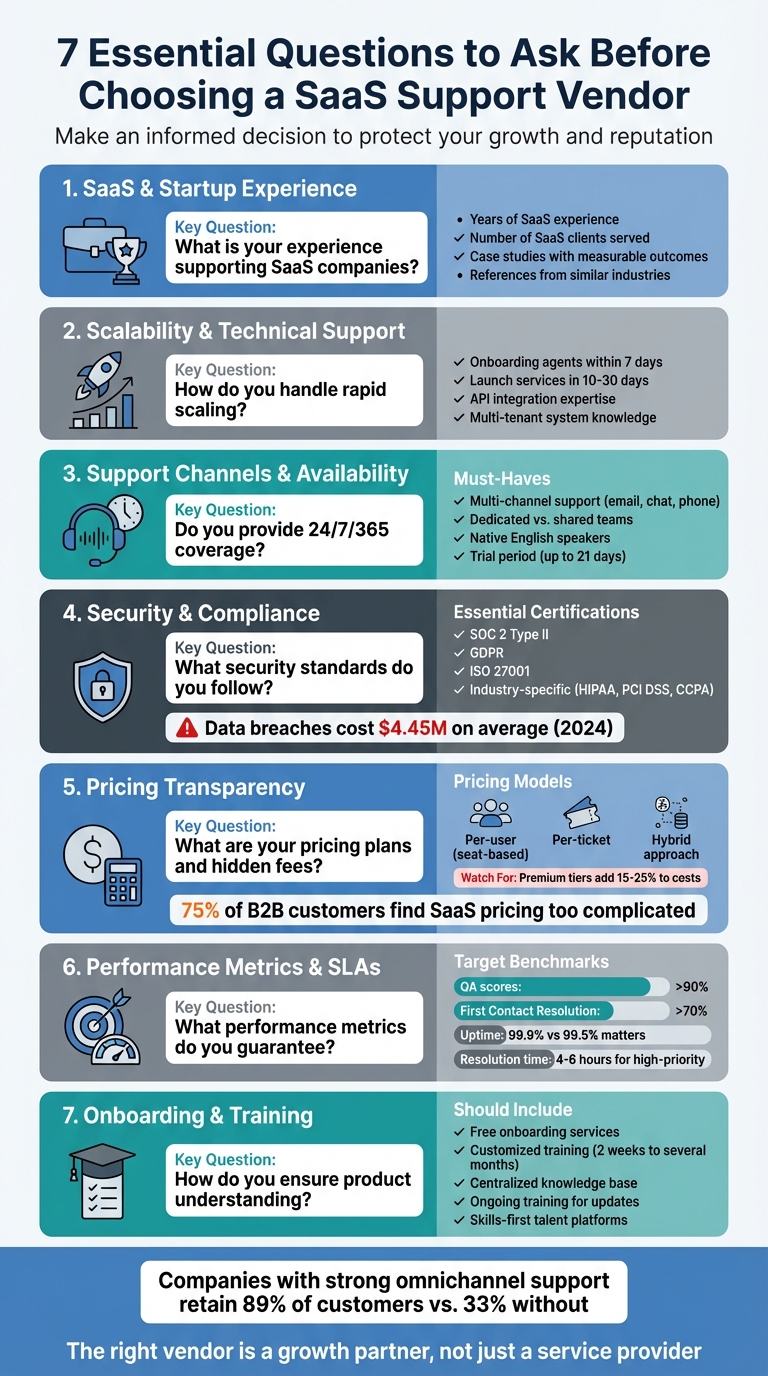
7 Essential Questions to Ask Before Choosing a SaaS Support Vendor
Questions About SaaS and Startup Experience
What is your experience supporting SaaS companies and startups?
When evaluating a vendor, it’s crucial to understand their experience in supporting SaaS businesses. SaaS companies face unique hurdles, such as managing subscription models and handling rapid growth, which demand specialized expertise. To gauge their qualifications, ask for specifics like:
- Years of SaaS experience
- Number of SaaS clients served
- Case studies showing measurable outcomes, such as helping a client grow from 10 to 500 employees or achieving a 40% faster ticket resolution
- References from similar industries, like CRM, fintech, or e-commerce
A strong track record should highlight their ability to address challenges like reducing churn and demonstrate that they can be a proactive partner, not just a reactive service provider.
Take Aidey, for example. With over seven years of experience, they specialize in customer support for startups and SaaS companies. Based in Tel Aviv, their management team has a deep understanding of the global startup landscape. Their clients include Shiji Guest Solutions, MyCheck, and Cyber-Duck. Tatiana Ozanikova, Head of Global Operations at Shiji Guest Solutions, shares:
"I would highly recommend its services for SaaS companies that are looking to scale up."
This kind of expertise is invaluable when navigating the complexities of SaaS growth.
How do you scale customer support during rapid growth and technical support?
Startups often grow at lightning speed, and your support team needs to keep up without compromising quality. A reliable vendor should show they can scale their team quickly – from just a few agents to 20 or more – while maintaining high standards. Look for clear timelines, such as onboarding agents within seven days and launching services in 10–30 days.
Technical know-how is just as critical. SaaS products often involve complex elements like API integrations, multi-tenant systems, and troubleshooting issues like bugs, installation errors, or payment glitches. Your vendor should not only resolve these problems but also collaborate closely with your developers during updates or new releases. The best vendors will assess your product’s technical needs thoroughly and hire agents with the right expertise.
Shlomit Kugler, CEO of MyCheck, highlights her experience with Aidey:
"Aidey managed to cut the cost of our customer service significantly while providing high quality & consistent level of support. The setup was fast and efficient and the team was quick to adapt to our product."
This combination of scalability and technical proficiency ensures your support team can grow alongside your business while meeting the demands of your SaaS product.
sbb-itb-8132e49
Questions About Support Capabilities and Availability
What communication channels do you support?
Today’s customers expect support through a variety of channels like email, live chat, and phone. For SaaS companies with global audiences, having multi-channel communication is essential. When evaluating vendors, ask them to outline the channels they support and how they ensure consistency across each one.
Top-tier vendors often integrate seamlessly with your existing systems. This means your support team can start working efficiently without needing to switch to unfamiliar tools. Ram, a satisfied user of Aidey’s services, shared his experience:
"They offer 24/7 phone, email and chat support."
Additionally, verify that the vendor employs native English speakers for clear and effective communication. It’s also worth checking if they offer a trial period (up to 21 days) so you can test the quality of their multi-channel support before committing to a long-term agreement.
This multi-channel approach should also include reliable coverage during busy times or emergencies. Ensuring 24/7 availability is just as important as having multiple communication options.
Do you provide 24/7/365 coverage with dedicated teams?
Beyond offering multiple communication channels, consistent availability is key. Since SaaS companies operate around the clock, your support team needs to do the same. 24/7/365 coverage ensures that customers in any time zone can get the help they need without delays. When speaking with vendors, ask about their staffing strategies for maintaining full coverage and whether they provide dedicated or shared team options.
Dedicated teams are particularly useful for SaaS businesses. These agents gain in-depth knowledge of your platform, from complex API integrations to troubleshooting subscription-related issues. While shared teams might suffice for simpler, low-volume tasks, dedicated teams deliver the expertise and consistency that SaaS companies often require. Aidey, for instance, offers both shared and dedicated team models, giving businesses the flexibility to choose what works best for them.
Danny Bluestone, CEO of Cyber-Duck, emphasized the benefits of dependable support:
"Since we started using Aidey services for our back-office operations, we see great enhancement in productivity, scalability and accuracy."
Finally, ask how the vendor handles peak periods and emergencies. The best providers can scale quickly, onboarding and deploying new agents within days, so your support quality remains steady during product launches or sudden increases in demand.
Questions About Scalability and Tool Integration
How do you scale teams to match business growth?
As your business grows, it’s critical that your vendor can keep up without compromising on quality. Be sure to ask vendors how quickly they can scale your team and what strategies they use to maintain service standards during rapid expansion. For instance, Aidey can recruit new agents within seven days of signing an agreement and deploy a trained team within 10 to 30 days. It’s worth discussing flexible team models, such as shared teams for overflow or trials, and dedicated teams for roles requiring deeper SaaS knowledge. Additionally, inquire about a 60-day evaluation period so you can fine-tune team size and protocols based on actual performance.
What integrations and onboarding services do you offer?
Scalable support is only as good as its ability to integrate with your existing systems. Find out which ticketing systems, CRM platforms, and helpdesk software the vendor supports, and confirm their API capabilities and system configuration options. A thorough onboarding process should include recruitment, training, system setup, and process management – and ideally, this should be offered at no cost until the system goes live, minimizing your upfront expenses.
Tatiana Ozanikova, Head of Global Operations at Shiji Guest Solutions, shared her experience:
"Throughout the entire setup of the project, Aidey have delivered exactly what they promised. We found Aidey to be a highly suitable supplier for our unique requirements."
Trial periods are another important consideration. A 21-day free trial, for example, allows you to test whether integrations work smoothly and ensure agents can easily access the information they need without jumping between platforms. Your goal should be a seamless integration process that feels invisible to your customers.
Questions About Pricing and Cost Structure
What pricing plans do you offer, and are there hidden fees?
Before committing to a service, make sure you fully understand the pricing structure. Vendors typically use models like per-user (seat-based), per-ticket, or a hybrid approach that combines a fixed monthly fee with variable costs based on ticket volume. These models aim to balance predictability and flexibility for businesses.
It’s also essential to identify any additional fees beyond the base cost. These might include charges for onboarding, training, technology licensing, integration setup, or minimum volume commitments. Be aware that opting for premium support tiers could increase your subscription fee by 15% to 25%. Interestingly, research shows that 75% of B2B customers find SaaS pricing overly complicated, and 68% would pay more for a simpler structure. To avoid surprises, request a detailed quote that clearly outlines which fees are included and which are not.
Once you’ve clarified the pricing details, consider how this structure aligns with your business growth objectives.
How do you ensure cost-effective scaling?
Understanding the scalability of a vendor’s pricing model is just as important as clarity. The cheapest option isn’t always the best value. Ask vendors how they calculate cost per resolved issue – this ensures they focus on efficiency rather than just activity. Vendors that integrate AI for routine tasks can cut operational costs by around 20%, freeing up human agents to handle more complex and nuanced issues.
Make sure the pricing model adjusts as your business grows. Ask about potential overage fees for unexpected ticket volume spikes and whether you can scale down during slower periods without penalties. Additionally, check their quality assurance processes – vendors should review at least 5–6 interactions per agent to maintain service standards even as costs are optimized. Don’t forget to review contracts 90 days before renewal to negotiate timely adjustments to pricing.
A flexible and transparent pricing model is a strong indicator of a vendor’s commitment to delivering scalable, high-quality support for your business.
Questions About Security, Compliance, and Performance
What security and compliance standards do you follow?
When you share customer data with a support vendor, you’re placing a lot of trust in their ability to protect that information. Considering that data breaches cost companies an average of $4.45 million in 2024, it’s essential to evaluate a vendor’s security measures carefully.
Start by asking about specific certifications like SOC 2 Type II, GDPR, and ISO 27001. These certifications indicate a vendor’s commitment to robust security practices. For example, SOC 2 Type II assesses the effectiveness of security controls over an extended period. If a vendor only has a SOC 2 Type I report, which is more limited in scope, it’s worth questioning their overall readiness.
Depending on your industry, additional compliance standards may be necessary. Healthcare organizations should confirm HIPAA certification, while businesses handling credit card payments need PCI DSS compliance. For companies serving customers in California or Europe, CCPA and GDPR compliance are critical. Always request detailed security documentation during the vetting process. If a vendor hesitates to provide this, it could be a warning sign.
Beyond certifications, dig into their actual security practices. Do they use end‑to‑end encryption for data at rest and in transit? What does their incident response protocol look like? Where is your data stored, and does the location meet your jurisdictional requirements? Additionally, check if they have a Business Continuity and Disaster Recovery (BCDR) plan with redundant systems and regular backups. These measures are essential for ensuring your data remains protected and accessible under all circumstances.
By addressing these security aspects upfront, you’ll be in a better position to evaluate how the vendor can meet your performance needs.
What performance metrics and SLAs do you provide?
Performance metrics and Service Level Agreements (SLAs) directly influence customer satisfaction and operational success. SLAs define the standards you can expect from a vendor, making them a critical part of your evaluation. Even small differences in uptime can have a big impact. For instance, moving from 99.5% to 99.9% uptime could save you several hours of downtime each year.
It’s also important to distinguish between response time (how quickly the vendor acknowledges an issue) and resolution time (how long it takes to fix it). For high-priority issues, resolution times typically fall between 4 to 6 hours. Ensure your SLA specifies these timelines clearly, avoiding vague terms like "reasonable efforts."
Ask about additional quality metrics, too. Top vendors often achieve Quality Assurance (QA) scores above 90% and First Contact Resolution (FCR) rates over 70%. Some providers even use AI to analyze customer interactions, offering a more detailed view of performance. Request regular performance reports – either weekly or monthly – and schedule review meetings to monitor these metrics consistently.
Finally, ensure that your SLA includes enforceable consequences for missed targets. For example, service credits should increase with additional downtime. Moreover, the agreement should allow you to terminate the contract without penalties if the vendor repeatedly fails to meet the agreed standards.
Questions About Onboarding and Training
How do you approach free onboarding and training?
Getting onboarding right is crucial for a productive partnership with a vendor. The timeline for onboarding depends on the complexity of the product – simpler setups might take around two weeks, while more intricate integrations could stretch over several months.
When evaluating vendors, ask them to detail their step-by-step onboarding plan, including recruitment, system integration, and ongoing support. It’s also important they handle system configuration properly and implement security measures like two-factor authentication from the start.
Many vendors adopt a "train-the-trainer" strategy, where they train "Super Users" or Subject Matter Experts (SMEs) who then pass on their knowledge to other users. Make sure they also provide customized documentation and standard operating procedures (SOPs) to support this process.
To keep onboarding on track, assign a single process owner to oversee the timeline and ensure all steps are completed on schedule. Also, centralize communication for the entire process – use a shared portal or folder instead of relying on scattered email threads or chats.
For instance, companies like Aidey offer free onboarding services that cover recruitment, training, and system setup.
After onboarding, the focus shifts to ensuring your team fully understands the product.
How do you ensure your team understands our SaaS product?
A solid understanding of the product can transform your team’s support capabilities. Top vendors use a combination of live webinars, one-on-one sessions, and on-demand videos to cater to different learning preferences.
Before training begins, ask if the vendor conducts a needs assessment to understand your specific use cases. They should analyze your workflows and align them with the software’s features. Training that includes hands-on practice with real-life scenarios helps prepare your team for the challenges they’ll face. Interactive product tours and realistic walkthroughs can also make a big difference in adoption and comprehension.
A reliable vendor should also establish a centralized knowledge base – a single, go-to resource for all product details and troubleshooting guides. This should include everything from security protocols and access instructions to data handling guidelines and quick-reference "cheat sheets".
Don’t forget to ask about ongoing training as your product evolves. By 2026, many leading vendors are using "skills-first" talent platforms to monitor agent proficiency and identify training needs before launching new features. ClearCompany emphasized this shift:
"The skills-first revolution is here. Act now to win the talent race".
Find out if the vendor uses a formal skills framework or a unified talent platform to help managers track progress and ensure the support team stays current with product updates.
Questions About Quality Assurance and Reporting
How do you monitor and improve agent performance?
Continuous quality assurance and clear reporting are just as essential as scalable teams and strong technical support. These practices demonstrate a vendor’s dedication to delivering a great customer experience. Start by asking if the vendor uses QA scorecards to evaluate key areas like tone, accuracy, empathy, writing style, and adherence to processes. Typically, this involves reviewing around 10% of interactions, such as five tickets per agent each week.
Find out if their system includes multiple layers of quality checks, such as recorded reviews, regular audits, and customer feedback. The best-performing vendors often maintain internal QA scores above 90% and aim for first-contact resolution (FCR) rates above 70%. They should also explain their feedback loop, detailing how they collect performance data, apply coaching strategies, and reassess outcomes to address any gaps.
Ask whether they use AI-driven tools for ticket scoring and sentiment analysis. Many vendors now leverage platforms like AmplifAI and Klaus to analyze all customer interactions automatically. This matters because 73% of customers will switch to a competitor after multiple poor experiences, and improving retention by just 5% can increase profits by 25% to 95%.
Also, inquire about their Service Delivery Managers (SDM) – dedicated professionals who use data insights to enhance quality. It’s crucial that their QA scores align with high Customer Satisfaction (CSAT) ratings.
Strong monitoring practices like these naturally lead into actionable reporting, giving you valuable insights into performance trends.
What analytics and reports do you provide?
Once you’ve explored performance monitoring, shift your focus to the vendor’s reporting capabilities. Ask for examples of standard reports that cover metrics like Average Response Time, Workload, First-Call Resolution (FCR), Customer Satisfaction (CSAT), and Net Promoter Score (NPS).
For SaaS companies, advanced vendors should go further by tracking specialized metrics like funnel performance, feature adoption, and retention curves. These analytics can highlight friction points in the customer journey.
Be sure to clarify how reports are delivered and how often. Common formats include automated dashboards, scheduled email updates, or Slack notifications. Real-time dashboards allow you to monitor support activity and agent performance immediately, while weekly or monthly summaries provide a more detailed analysis. Also, confirm how quickly data becomes available – some systems have a lag of up to 34 hours before analytics are updated.
Before signing a contract, request to see their QA scorecard. This will give you insight into how they measure agent empathy, technical accuracy, and brand voice. Remember, companies with strong omnichannel strategies retain 89% of their customers, compared to just 33% for those with disconnected support systems. Make sure their reporting covers all your communication channels consistently.
Top 5 Factors To Consider While Selecting A SaaS Vendor
Conclusion
When it comes to choosing a SaaS support vendor, the focus should be on how well they align with your business strategy and their ability to deliver long-term benefits. This decision isn’t just about outsourcing – it’s about creating a partnership that fuels growth and safeguards your brand reputation. Using a customer support outsourcing checklist is key to finding a vendor that can grow alongside your business and avoid potential challenges during expansion.
As highlighted:
"Choosing the wrong customer support outsourcing partner can quietly damage your brand long before the impact shows up in metrics."
– SupportYourApp
Look for vendors with a strong track record in SaaS, the ability to scale, and clear quality assurance processes. A reliable partner can bring cost efficiencies without compromising on quality, often supported by dedicated Service Delivery Managers who ensure smooth scaling.
Security and compliance should be at the top of your checklist. With data breaches averaging $4.88 million in 2024, certifications like ISO 27001, GDPR, and other relevant standards are essential. Always verify these through third-party audit reports rather than taking verbal assurances at face value.
To ensure a vendor is the right fit, consider pilot programs, client testimonials, and a thorough onboarding process. These steps help confirm that the vendor understands your product, your customers, and your growth objectives. Ultimately, the vendor you select will act as an extension of your team, so it’s worth the effort to find one that truly aligns with your goals.
FAQs
What should I ask to verify a vendor’s SaaS support experience?
To gauge a vendor’s experience with SaaS support, start by asking about their history working with SaaS companies. Specifically, explore their understanding of support tiers like tier 0 and tier 1 and how they manage requests promptly and effectively. It’s also a good idea to request case studies or references from their SaaS clients – this can offer insight into their expertise and track record.
Additionally, dig into the types of support services they’ve delivered in the past. Have they consistently met quality standards and adhered to SLAs? These questions can help you determine if the vendor is equipped to meet your needs.
How can I confirm a vendor can scale fast without quality dropping?
To make sure a vendor can expand their support team quickly without compromising quality, ask about their track record in scaling operations. Specifically, inquire if they’ve successfully grown support teams while keeping important metrics, like response times and customer satisfaction, on target. Request concrete examples or case studies to back up their claims. Additionally, check whether they have systems in place to adjust resources effectively while maintaining high standards. Finally, review their contract terms to ensure they offer the flexibility and scalability needed to match your growth demands.
What security proof should a SaaS support vendor provide before we sign?
When evaluating a SaaS support vendor, it’s essential to confirm they prioritize security and compliance. They should provide proof of strong encryption for both data at rest and in transit. Additionally, ensure they comply with industry standards such as SOC 2, ISO, GDPR, HIPAA, and PCI.
Ask for detailed information on their access controls, backup systems, disaster recovery plans, and incident response measures. These elements are critical to safeguarding your data and ensuring the vendor aligns with required security protocols.