

When your global customers face issues like failed payments at 3:00 a.m., waiting hours for help isn’t an option. The follow-the-sun support model solves this by distributing customer service teams across time zones, ensuring 24/7 assistance without requiring night shifts. Here’s why it works:
- Faster Responses: Tickets are handled in real time during local business hours, cutting response times by 40% and boosting customer satisfaction scores by 25%.
- Healthier Teams: Employees avoid night shifts, reducing burnout and turnover while improving productivity.
- Cost Savings: Eliminates overtime and night-shift premiums, although global hiring and coordination add expenses.
- Better Coverage: No overnight backlogs – issues are passed seamlessly between regions like APAC, EMEA, and AMER.
In contrast, in-house support models often lead to overnight delays, stressed employees, and higher costs due to night-shift pay and high turnover. SaaS companies with global customers can benefit from this model, especially for urgent issues like payment errors or outages.
Key takeaway: Follow-the-sun support ensures round-the-clock service while keeping employees happier and customers satisfied. However, smooth handoffs and proper tools are critical for success.
What Is a Follow the Sun Support Model?
sbb-itb-8132e49
1. Follow-the-Sun Support Model
The follow-the-sun model organizes support teams across three key regions – APAC, EMEA, and AMER – ensuring that every region receives support during its daytime hours. For example, when the Manila team finishes their 4:00 PM shift, they hand off unresolved tickets to the Warsaw team starting their day at 8:00 AM. This process continues as the European team transitions work to New York or Toronto, which then loops back to APAC. The result? Continuous coverage without requiring night shifts.
Response Times
This model eliminates the overnight backlogs common in traditional support setups. Each regional team begins their day with a clean slate, addressing customer inquiries in real time. Data from global staffing shows impressive results: a 40% drop in average response times and a 25% boost in CSAT scores. Agents working during daylight hours are naturally more alert, which directly impacts the quality of interactions. As sleep expert Bryan Vila, PhD, explains, "When you’re drowsy, local parts of the brain shut down for milliseconds or seconds at a time, then come back online". However, the model’s success hinges on how well the handoffs are managed.
Coverage Gaps
Smooth ticket handoffs are critical to making this model work. Mark Sherwood, a CX strategist, cautions: "The follow-the-sun model only works if you can facilitate great handoffs between different time zones. Without that, you’re dead on arrival". Poorly written notes or inconsistent tools can leave tickets unresolved. To avoid this, teams should standardize handoff templates that include ticket status, completed tasks, and next steps. Additionally, scheduling a 15–30 minute overlap between shifts allows outgoing and incoming agents to discuss urgent issues live, minimizing confusion.
Employee Well-being
By aligning shifts with local daytime hours, this model eliminates the health risks commonly associated with night shifts. Studies show that working overnight increases the risk of depression and anxiety by 40%. In the U.S., call centers experience turnover rates between 30–45%, largely due to the strain of graveyard shifts. The follow-the-sun approach flips this trend. Mark Sherwood points out that it benefits both customers and support teams: happier employees with predictable schedules are less likely to burn out, leading to improved retention. This is especially important for SaaS teams, where retaining agents with deep product expertise is essential.
Cost Efficiency
While this model improves agent well-being, it also optimizes costs. By avoiding overtime and night-shift bonuses, companies can save significantly. However, global hiring, training, and coordination do introduce new expenses. To maintain consistent SLAs across regions, SaaS teams need robust tools like Zendesk or Jira. Despite these costs, the investment often pays off: businesses using 24/7 virtual teams have reported Net Promoter Score increases of up to 30%. For companies that want to adopt this model without building the infrastructure themselves, partnering with Aidey offers a streamlined way to set up remote teams across key time zones.
2. In-House Support Model
The in-house support model brings all support agents together in a single location. Unlike the follow-the-sun approach, this setup struggles to maintain around-the-clock service without affecting either customer satisfaction or employee health. Extending in-house support to 24/7 often forces companies to choose between implementing graveyard shifts or delaying responses.
Response Times
When support is centralized in one location, tickets from other time zones pile up overnight. This means customers in distant regions often wait until the local office opens to get help. As a result, local customers enjoy faster service, while international users can face delays of up to 8–12 hours. CX strategist Mark Sherwood highlights the impact of these delays:
"When someone’s checkout fails at 3 AM, that’s not a ‘wait until morning’ problem. It’s lost revenue happening in real time".
This time zone bias creates significant service gaps for customers outside the primary region.
Coverage Gaps
Operating from a single region leaves certain areas underserved, like the "APAC gap", where Asia-Pacific customers lack live support during their business hours. For urgent issues – such as failed transactions, system outages, or payment errors – these gaps can lead to immediate revenue losses. Small teams, especially those with fewer than five agents, face additional challenges as they often lack the resources to provide 24/7 coverage without overworking staff or sacrificing service quality.
Employee Well-being
The in-house model doesn’t just affect operations; it also takes a toll on employees. Night shifts are linked to higher risks of depression, anxiety, and chronic health problems. U.S. call centers, for instance, report turnover rates as high as 30–45%. It can take employees at least three days to recover from a single night shift, and prolonged exposure to irregular hours increases the likelihood of metabolic syndrome, heart disease, diabetes, and obesity.
Cost Efficiency
While consolidating support in one location might seem straightforward, it often becomes expensive. Running 24/7 in-house support requires paying overtime and night shift premiums, which can cost more than hiring regional talent in other time zones. Additionally, small teams face hidden expenses from the constant need to recruit and train new staff due to high turnover.
Pros and Cons
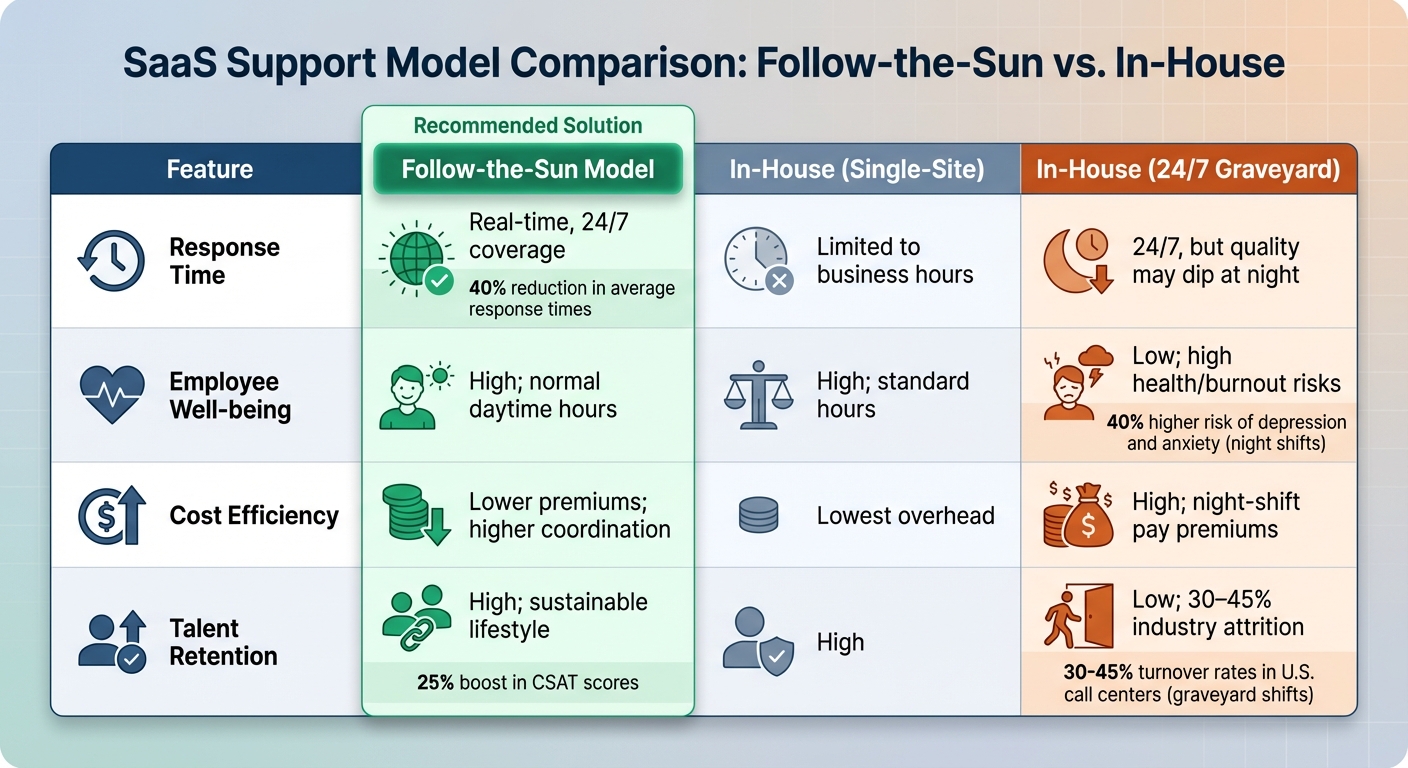
Follow-the-Sun vs In-House Support: Performance Comparison
Both support models aim to meet the demands of 24/7 coverage, but each comes with its own set of challenges and benefits. For example, in-house setups often require night shifts, which have been linked to a 40% higher risk of depression and anxiety among workers. On the other hand, the follow-the-sun model allows agents to work during their local daytime hours, which helps maintain productivity and reduces the risk of errors caused by fatigue. Studies confirm that tired agents tend to underperform.
The follow-the-sun approach also ensures real-time responses to customer queries, while in-house models risk accumulating overnight backlogs.
Cost and coordination are other key factors to consider. The follow-the-sun model eliminates the need for night-shift pay premiums but may involve extra expenses for managing and training teams across different regions. In contrast, in-house 24/7 models require overtime and night-shift pay, and they face high turnover rates – 30–45% in the U.S. call center industry. This high attrition drives up recruitment and onboarding costs.
| Feature | Follow-the-Sun Model | In-House (Single-Site) | In-House (24/7 Graveyard) |
|---|---|---|---|
| Response Time | Real-time, 24/7 coverage | Limited to business hours | 24/7, but quality may dip at night |
| Employee Well-being | High; normal daytime hours | High; standard hours | Low; high health/burnout risks |
| Cost Efficiency | Lower premiums; higher coordination | Lowest overhead | High; night-shift pay premiums |
| Talent Retention | High; sustainable lifestyle | High | Low; 30–45% industry attrition |
The differences between these models become even clearer when looking at real-world results. A 2025 case study involving Aidey showed that switching to a follow-the-sun model led to a 40% reduction in average response times, a 25% boost in CSAT scores, and a 15% increase in repeat purchases. These improvements highlight the benefits of having well-rested agents available to handle customer inquiries at all hours.
For SaaS teams aiming to balance strong customer service with employee satisfaction, the follow-the-sun model could be a smart solution. Providers like Aidey specialize in offering 24/7/365 customer support through skilled remote teams who work during their local daytime hours. This approach ensures high-quality, scalable, and cost-effective support that benefits both customers and employees.
Conclusion
The follow-the-sun support model provides SaaS teams with a way to deliver round-the-clock service while maintaining a healthy work-life balance for employees. By spreading support responsibilities across different time zones, companies can ensure 24/7 real-time responses without requiring agents to work overnight shifts. This not only reduces the health risks and burnout tied to graveyard shifts but also eliminates frustrating overnight delays for customers dealing with urgent issues like payment failures or system outages – key challenges highlighted earlier.
However, before implementing this model, SaaS companies need to weigh essential operational factors. For instance, a team size of at least 5 to 8 agents is typically needed to justify the coordination efforts required for managing multiple time zones. It’s also crucial to assess ticket volume by region; if the majority of customers (e.g., 80%) are concentrated in one time zone, adopting this model may not be practical. The approach is particularly effective in scenarios where delays could result in immediate financial losses, such as checkout problems or security breaches.
"Scaling Customer Experience (CX) is a continuity challenge, not a headcount equation." – Sunil Maurya, Global CX Architect
Operational readiness is the cornerstone of success. This includes standardizing tools and processes across regions, enforcing clear "next action" steps for ticket handoffs, and starting with a pilot program in two nearby time zones before scaling globally.
For companies ready to make the leap, partnering with an expert can simplify the transition. Providers like Aidey manage recruitment, training, and system setup at no extra cost, allowing SaaS teams to expand their support operations efficiently and cost-effectively – without requiring any single team to take on overnight shifts.
FAQs
How do you prevent ticket handoff mistakes between regions?
Clear communication and proper ticket visibility are essential to avoid mistakes during ticket handoffs in a follow-the-sun support model. A few key practices can make a big difference:
- Shared ticket access: Support groups should have the ability to view each other’s tickets. This ensures everyone involved has the context they need.
- Minimize handoffs: The fewer handoffs a ticket goes through, the lower the chance of miscommunication or errors.
- Standardized procedures: Establish clear and consistent handoff protocols to streamline transitions between teams.
- Effective permissions management: Set up permissions carefully to ensure the right people have access to the right information.
These steps help create smoother transitions, reduce mistakes, and maintain reliable support across different regions.
What tools do you need to run follow-the-sun support smoothly?
To make follow-the-sun support work smoothly, you’ll need the right mix of tools to handle collaboration, communication, and ticket management across time zones. Start with a strong customer support platform to keep track of and resolve inquiries efficiently. Real-time communication tools like Slack are crucial for staying connected, while automation software helps simplify workflows and reduce manual tasks. Additionally, shared knowledge bases play a vital role in maintaining consistent support and providing quick access to information, ensuring seamless transitions between your global teams.
When is follow-the-sun not worth it for a SaaS team?
The follow-the-sun model, while offering the promise of 24/7 coverage, can sometimes create more problems than it solves for SaaS teams. If communication and coordination become too complicated, the system can quickly lose its effectiveness.
For instance, time zone differences can make real-time collaboration nearly impossible. When one team is logging off, another is just starting their day, leaving little overlap for discussions or quick problem-solving. Add to that cultural differences, which can sometimes lead to misunderstandings or mismatched working styles, further complicating team dynamics.
Technical misalignments can also crop up. If teams are using different tools or processes, it can result in inconsistent workflows or delays. Instead of streamlining operations, these challenges can create inefficiencies that outweigh the potential benefits of constant global coverage.
While the idea of round-the-clock productivity is appealing, these hurdles show that the model isn’t always the best fit for every SaaS team.