

68% of customers expect support in their native language, yet 73% of SaaS companies only offer voice support in English. This gap leads to longer resolution times, higher churn (35% in non-English markets), and a drop in customer lifetime value (28%). Understanding how communication styles differ globally – like Japan’s indirectness vs. Germany’s directness – can help bridge this divide.
Here’s how to address the challenge:
- Hire native speakers or use hybrid staffing for key markets.
- Train teams to recognize and adjust to regional communication styles.
- Use tools like AI translation for efficiency but ensure human oversight for accuracy.
- Personalize interactions by respecting local norms, time zones, and holidays.
Tracking metrics like CSAT scores and resolution times by region ensures progress. Outsourcing multilingual support can save costs while maintaining quality. Ignoring these steps risks customer frustration and revenue loss.
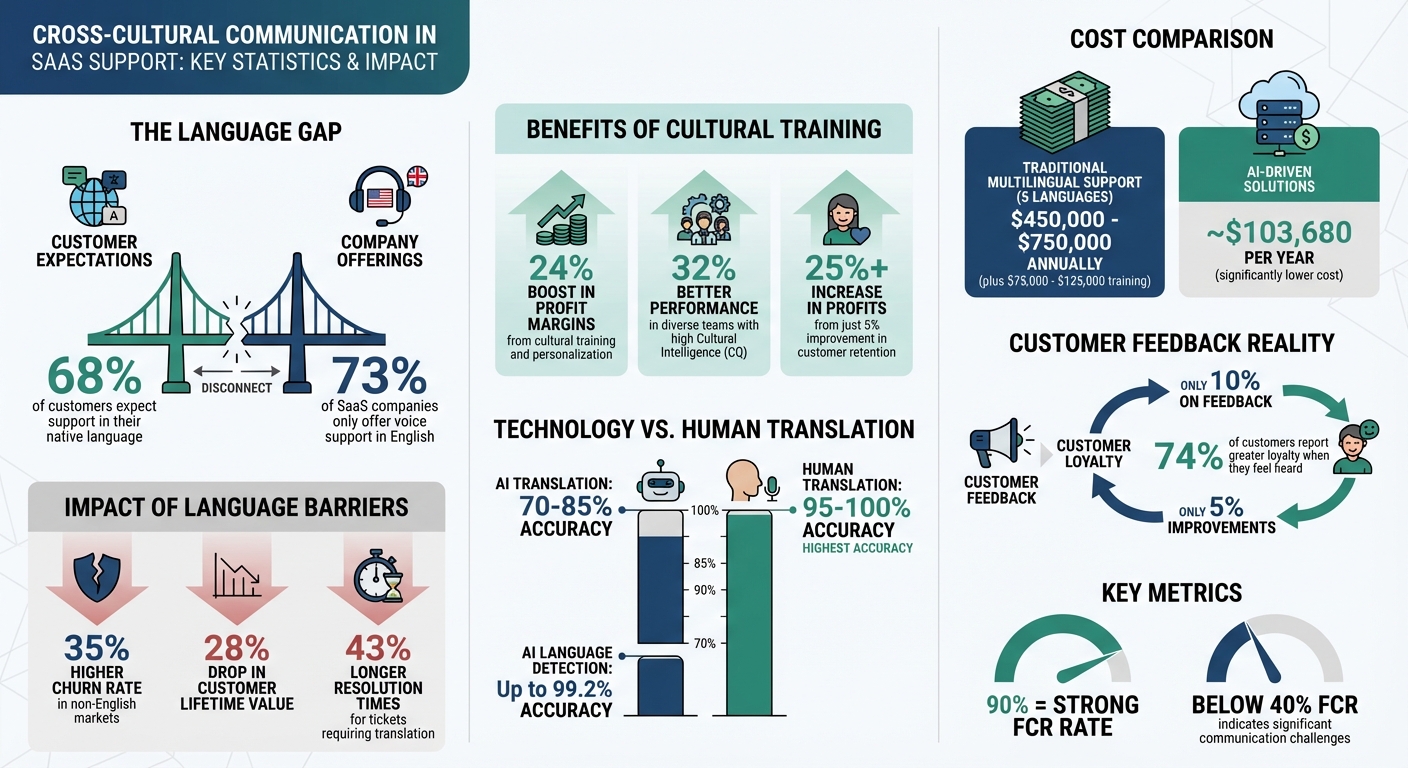
Cross-Cultural Communication Statistics in SaaS Support
Delivering Exceptional Customer Service Across Cultures
sbb-itb-8132e49
Understanding Cultural Differences in Customer Support
To scale your SaaS support, it’s crucial to understand how cultural differences influence communication, urgency, and trust. For instance, what feels like polite formality in Tokyo might seem overly rigid in San Francisco, while Berlin’s directness could come across as rude in Mumbai. Recognizing these nuances allows you to tailor your approach to meet diverse customer expectations.
Key Models for Understanding Culture
Two key frameworks can help you make sense of cultural differences in customer interactions.
The first is the concept of high-context versus low-context communication. High-context cultures – like Japan, China, and many Arab nations – rely on relationships, shared history, and subtle cues. Customers from these regions often expect formal greetings, small talk, and polite introductions. On the other hand, low-context cultures – such as the United States, Germany, and the Netherlands – value directness and prefer to get straight to the point without unnecessary pleasantries.
Another perspective comes from Hofstede‘s cultural dimensions, particularly power distance and individualism versus collectivism. In high power distance cultures, like India or Mexico, customers may defer to your expertise and avoid questioning your advice. In contrast, lower power distance cultures, such as Denmark or Australia, favor more equal and open interactions. Similarly, individualistic cultures prioritize personal accountability and quick decision-making, while collectivist cultures emphasize group harmony and may take longer to reach decisions as they consult with others.
Real Examples of Cultural Differences
Theory becomes reality in everyday customer support. Help Scout, which supports users across more than 140 countries, has observed clear differences in communication preferences. German and American customers often prefer concise, factual answers and quick resolutions. When managing global teams, using a customer support outsourcing checklist can help ensure these cultural standards are met consistently. Meanwhile, Japanese and Indian customers tend to appreciate a relationship-focused approach, complete with politeness and detailed context.
Formality also varies widely. High-context communications might include lengthy greetings and a recap of previous discussions, while low-context interactions often cut straight to the chase, sometimes even using emoticons to keep things casual. Technical conventions can also trip up support teams. For example, date formats differ: "12/11" means December 11 in the U.S., but November 12 in many other countries. Even number formatting – such as the placement of commas and periods – changes by region.
Language adds another layer of complexity. In places like India and Latin America, customers often mix languages in the same sentence, such as blending Hindi and English ("Hinglish") or Spanish and English ("Spanglish"). This requires support staff to interpret meaning beyond literal translations. Additionally, channel preferences vary: WeChat is widely used in Asia, while WhatsApp dominates in many other regions.
Building a Culturally Aware Support Team
Grasping cultural differences is one thing – building a team that can apply that understanding in real-world scenarios is another. To handle customers from Tokyo to Toronto with ease, your support team needs the right mix of evaluation, hiring practices, and continuous training.
Evaluating Your Team’s Cultural Awareness
Start by assessing your team’s current level of cultural sensitivity. Tools like the Intercultural Development Inventory (IDI) offer a structured way to measure cultural awareness, tracking progress from "denial" of cultural differences to "integration". Another option is the Cultural Intelligence (CQ) Assessment, which evaluates four areas: Drive, Knowledge, Strategy, and Action. Research reveals that individuals with high CQ perform up to 32% better in diverse team environments.
In addition to formal assessments, examine patterns in your support interactions. For example, track what Help Scout calls "conversational landmines" – recurring topics that lead to misunderstandings, such as feedback styles or time management. Evaluate whether your team adapts to the cultural communication styles discussed earlier. Are they mirroring the customer’s tone and approach effectively? Test your support templates with translation tools; if the meaning gets distorted, it might indicate overly complex language.
Pay close attention to seven areas of potential cultural bias: communication style, time orientation, hierarchy, decision-making, conflict resolution, task versus relationship focus, and uncertainty avoidance. Unchecked biases in these areas can lower team effectiveness by as much as 50% in diverse settings. Encourage your team to pause during difficult interactions and consider whether cultural differences might be contributing to the tension.
Once you’ve assessed your team’s current capabilities, the next step is to hire team members with the right language skills and cultural background.
Hiring for Language Skills and Cultural Experience
When it comes to live chat, phone support, or resolving complex issues, hiring native speakers is often the best approach. However, fluency alone isn’t enough. During interviews, screen candidates for their understanding of regional business practices. For instance, can they navigate the contrast between German directness and Japanese indirectness? This ensures they are prepared to connect with your specific audience.
"Directly hiring agents that are native speakers ensures you have a team that can handle live chat, phone, or complex issues, all while matching the voice and tone of your organization." – Help Scout
The financial commitment is significant: providing human support in just five languages can cost between $450,000 and $750,000 annually, with training expenses adding an extra $75,000 to $125,000. Despite the cost, investing in culturally aligned team members can reduce escalations and improve customer satisfaction. Many SaaS companies address this challenge with a hybrid staffing model – employing in-house native speakers for key markets while outsourcing secondary markets or fluctuating workloads to Business Process Outsourcing (BPO) providers like Aidey. When working with BPOs, ask for language samples and proof of their experience in your target markets to ensure they meet your cultural standards.
Don’t stop at hiring multilingual staff. Involve them in shaping strategies by using their expertise to develop language-neutral style guides and cross-cultural communication playbooks.
Once your team is in place, equip them with the tools they need through ongoing cultural sensitivity training.
Training Your Team on Cultural Sensitivity
Continuous training is critical for equipping your team to handle diverse customer interactions. Focus on helping them recognize and adapt to different communication styles, from low-context (direct) to high-context (indirect). Teach them to match the customer’s level of formality while staying true to your brand voice. As Dale Coulter, Head of English TLC International House, points out:
"English speakers with no other language often have a lack of awareness of how to speak English internationally".
Simplify language wherever possible. Train your team to use straightforward sentence structures and avoid idioms like "heads-up", replacing them with clearer terms like "alerting us". Always spell out months (e.g., December 11 instead of 12/11) and specify time zones. Define acronyms in your first response, even if the customer used them initially. Break down complicated processes into numbered steps instead of lengthy paragraphs.
Visual aids such as screenshots or videos can help bridge language gaps. For customers struggling with language barriers, encourage the use of yes/no or multiple-choice questions to clarify their needs. For lengthy or technical discussions, end with a concise summary of the solution and any next steps the customer needs to take.
Implementing Cross-Cultural Communication Strategies
Once your team is equipped with cultural knowledge, the next step is turning that understanding into action. Support agents need practical ways to adapt their communication methods to match each customer’s regional background and preferred style.
Adjusting Communication Styles by Culture
Start by identifying whether a customer uses low- or high-context communication. For example, customers in the U.S. or Germany typically prefer direct communication. Use clear instructions, numbered steps, and solution-focused language that prioritizes efficiency. On the other hand, customers from Japan, Korea, or Arab countries often value relationship-building. In these cases, begin with a polite greeting and acknowledge their concerns empathetically.
Small adjustments in etiquette can go a long way. For instance, engaging in brief small talk with Saudi Arabian customers before addressing technical issues can help establish rapport. Meanwhile, using formal language with Japanese customers aligns with their cultural expectations. As Denis Leclerc from Thunderbird School of Global Management points out:
"Being able to adapt your communication style to accommodate different cultural norms not only benefits professional relationships but also personal growth".
Avoid relying on stereotypes by practicing active listening and asking open-ended questions to understand each customer’s unique needs. Mirroring their tone and level of formality can further enhance the interaction. To address language challenges, technology can be a valuable ally.
Using Technology to Overcome Language Barriers
Strategic use of technology can help bridge language gaps. Real-time translation tools integrated into ticketing systems or live chat platforms allow agents to stay focused without switching between applications. AI chatbots that detect and respond in the customer’s language can handle routine inquiries, freeing up human agents for more complex tasks. However, since AI translation accuracy typically ranges from 70% to 85%, compared to the 95% to 100% accuracy of human translators, a hybrid approach works best – combining AI for speed with human oversight for nuanced interactions.
Maintaining digital glossaries of brand-specific and technical terms ensures consistent translations. Additionally, configuring tools to automatically adjust regional formats – such as number styles (1,000 vs. 1.000), date formats (12/11/2026 vs. 11/12/2026), and currency symbols – can improve clarity. Modern AI tools even support code-switching, allowing customers to naturally blend languages like Hinglish or Spanglish in conversations. While technology is essential, personalizing interactions remains key to building stronger customer connections.
Personalizing Customer Interactions
Personalization involves more than just addressing customers by name. Use time zone intelligence to ensure messages align with the customer’s local time – a "Good Morning" message sent at 8:00 PM can feel disconnected. Acknowledge local holidays and festivals in your communications, and adjust availability messaging to reflect these events. Additionally, referencing region-specific details, like UPI payment options for Indian customers or quarterly billing cycles for U.S. enterprise clients, can make interactions more relevant.
Pamela Ghosal, Director of Brand & Communications at Phrase, highlights this importance:
"Words matter… choosing the right words can help you stand out. When you get it right, you’re not just solving problems – you’re sparking loyalty, trust, and a feeling that, no matter what language they speak, your customers are heard".
Develop cross-cultural playbooks that outline key etiquette, preferred communication channels, and cultural nuances for each region you serve. Tracking language-specific metrics, like CSAT scores, resolution times, and NPS, can help measure the success of your personalization efforts. Companies that implement cultural training programs and personalization strategies often experience a 24% boost in profit margins.
Aidey exemplifies this approach by training specialized teams, employing advanced translation tools, and tailoring interactions to regional expectations. This dedication ensures customers across the globe feel understood and valued.
Measuring and Improving Cross-Cultural Communication Performance
Tracking the right metrics is essential for identifying strengths and weaknesses in your support system. Instead of relying on global averages, break down data by language and region. For example, analyze Average First Response Time (FRT), Customer Satisfaction (CSAT) scores, and resolution times for each language your team supports. This approach can help pinpoint areas needing improvement. If, for instance, German-speaking customers report lower CSAT scores, it’s worth investigating whether delays in response times or mismatched communication styles are contributing factors. Additionally, monitor First Contact Resolution (FCR) rates – a strong FCR rate hovers around 90%, while anything below 40% indicates significant communication challenges.
Key Metrics for Cross-Cultural Support
To understand cultural and linguistic challenges, focus on metrics that highlight friction points. Segmenting CSAT scores by region can reveal if certain groups are less satisfied with your support approach. Studies show that tickets requiring language translation take 43% longer to resolve, making it crucial to monitor resolution times by language. Other important metrics include translation error rates and financial indicators like cost per contact and ROI on localization.
For teams using AI-powered tools, measuring AI language detection accuracy is critical. Advanced systems can achieve up to 99.2% accuracy and even support code-switching, where customers mix languages like Hinglish or Spanglish. Ketty Tirrito, Localization Manager at Zendesk, highlights the importance of data-driven decisions:
"Data is so important, not only to show the impact, but also to make informed decisions on what languages to prioritize and which markets are important to expand into".
Once you’ve identified key metrics, the next step is to use customer feedback to refine and improve your strategies.
Creating Feedback Loops
Metrics alone aren’t enough – feedback loops are essential for continuous improvement. Shockingly, only 10% of companies act on customer feedback, and just 5% share their improvements with customers. A robust feedback loop includes four steps: collecting input (ideally in the customer’s native language), analyzing patterns to identify cultural misunderstandings, prioritizing and implementing changes, and finally, closing the loop by informing customers about these improvements. This process fosters trust, with 74% of customers reporting greater loyalty when they feel heard.
To make this process effective, set up language-specific reporting dashboards to compare performance across regions and spot bottlenecks. Involve in-country reviewers to provide cultural insights, ensuring your team isn’t just translating words but adapting to local norms. Additionally, track communication breakdowns to identify recurring issues that might require further team training. Keep in mind, even a 5% improvement in customer retention can increase profits by more than 25%.
While improving internal processes is critical, outsourcing can also play a key role in scaling culturally sensitive support.
Using Outsourcing to Scale Culturally Sensitive Support
Outsourcing offers access to native speakers who understand local business etiquette, values, and non-verbal communication cues. For example, Aidey provides 24/7/365 support with teams trained in cultural sensitivity, allowing SaaS companies to scale across languages and time zones without the cost of building in-house multilingual teams. This approach addresses a common gap – many companies still limit support to English.
When done right, outsourcing combines human cultural expertise with technology for maximum efficiency. Traditional multilingual support for five languages can cost up to $1.2 million annually, but AI-driven solutions can cut this down to around $103,680 per year. The key is partnering with providers who go beyond basic translation services and focus on cultural profiling, adapting communication styles to meet local expectations. By scaling your support with culturally aware partners, you demonstrate a commitment to seamless global customer engagement.
Conclusion
Cross-cultural communication has become a must-have for SaaS support. With 68% of customers wanting assistance in their native language and 73% of SaaS companies sticking to English-only voice support, there’s a clear chance to stand out in the market. Language barriers, however, are no small issue – they drive up customer churn rates by 35% in non-English-speaking regions. Ignoring these realities doesn’t just hurt relationships; it also impacts revenue.
The way forward rests on three key pillars: understanding cultural differences, customizing communication strategies, and leveraging technology alongside outsourcing. Knowing whether your audience comes from high-context or low-context cultures can help your team adjust its approach. Small tweaks – like writing dates as "December 11" instead of "12/11", skipping idioms, and using clear visuals – can make communication much smoother.
While technology is a powerful tool, it’s not a standalone solution. AI tools can deliver impressive accuracy but still need the human touch. That’s where outsourcing comes in. Partnering with services like Aidey combines the precision of AI with the empathy of human agents. Aidey offers round-the-clock, culturally aware support across time zones – without the hefty $735,000–$1,225,000 price tag of outsourcing vs in-house support for a five-language team.
FAQs
Which languages should we support first?
To strengthen communication in SaaS support across different regions, it’s crucial to focus on the languages most relevant to your audience. If you’re operating in the United States, English should be your primary language. Adding Spanish can be highly effective, given its popularity in the US and across Latin America. For businesses eyeing expansion into Asia, languages like Mandarin Chinese or Japanese can open doors to major markets. Tailoring your language offerings to match your customer demographics and growth strategy can significantly improve customer satisfaction and broaden your global presence.
When is AI translation ‘good enough’ for support?
AI translation can be effective for customer support when it ensures clear and efficient communication with a reasonable level of accuracy and the right tone. It’s particularly useful for handling routine tasks such as support tickets, live chats, and knowledge base content. Paired with workflows that maintain quality and consistency, it can streamline these processes. However, when it comes to more sensitive matters – like refunds, legal issues, or safety concerns – human oversight is still crucial to guarantee accuracy and appropriateness.
How do we measure cross-cultural support success by region?
Customer satisfaction metrics play a key role in evaluating cross-cultural support success across different regions. These metrics include customer feedback, satisfaction scores, and assessments of support experiences. By tailoring these evaluations to align with regional cultural nuances and language preferences, companies can adopt a localized approach that meets customer needs more effectively.