

Cross-selling is a powerful way for SaaS support teams to drive revenue while maintaining customer satisfaction. Here’s why it matters and how to measure its success:
- Existing customers are key: Selling to them has a success rate of 60-70%, compared to just 5-20% for new prospects.
- Revenue impact: Cross-selling contributes 21% of total revenue on average, boosting sales by 20% and profits by 30%.
- Customer lifetime value (CLV): Cross-selling can increase CLV by 20% by deepening loyalty and reducing churn.
- Timing is crucial: Introduce cross-sell offers only after resolving customer issues to maintain trust.
Key Metrics to Track:
- Revenue Metrics:
- Expansion Revenue % = (Upsell + Cross-sell revenue) / Total revenue
- Attach Rate = Cross-sell items / Total orders
- Net Revenue Retention (NRR) = (Start MRR + expansion – contraction – churn) / Start MRR
- Sales Performance Metrics:
- Cross-Sell Conversion Rate: Percentage of successful cross-sell attempts.
- Time-to-Close: How quickly cross-sell opportunities are converted.
- Product-Specific Cross-Sell Rates: Measure success of individual add-ons.
- Customer Satisfaction Metrics:
- CSAT: Customer satisfaction after cross-sell interactions.
- NPS: Measures loyalty and the likelihood of customers recommending your brand.
- Churn Rate: Compare churn between customers who received cross-sell offers and those who didn’t.
- Operational Efficiency Metrics:
- Cost-Per-Cross-Sell Attempt: Evaluate financial viability.
- Support Team Engagement Levels: Assess how well agents identify and act on cross-sell opportunities.
- Segment-Specific Performance: Tailor strategies based on customer segments.
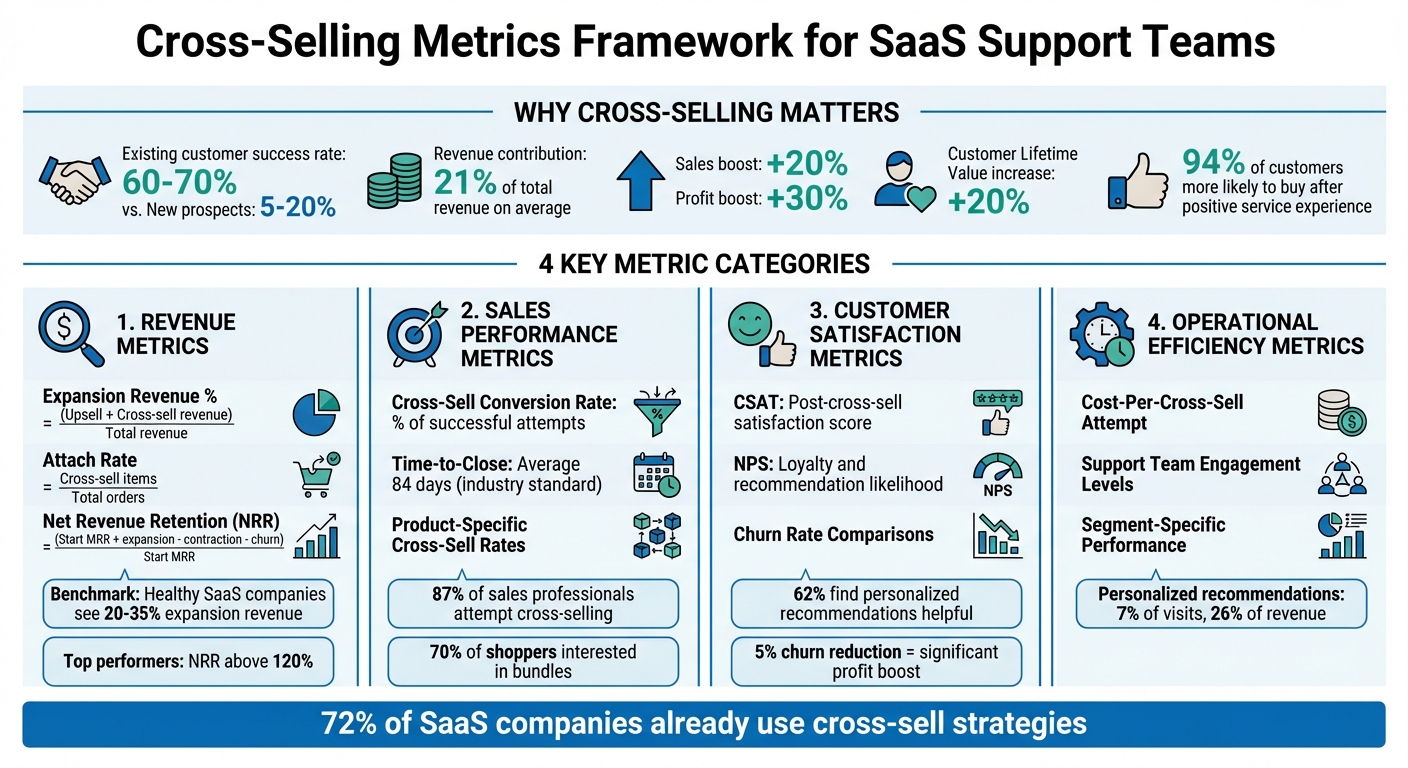
Cross-Selling Metrics Framework for SaaS Support Teams
SaaS Metrics That Matter: NRR, Rule of 40 & Sale-Ready KPIs
Revenue Metrics for Cross-Selling
Tracking revenue impact makes cross-selling a crucial strategy for any business. These metrics highlight how support teams directly contribute to revenue, helping justify investments in training, tools, and staffing. For instance, at Aidey (https://aidey.net), effective revenue attribution practices enable support teams to turn customer interactions into revenue opportunities. The metrics below quantify this impact and guide decisions on support team resources.
Cross-Sell Revenue Attribution
Attribution links customer support interactions to the revenue they generate. This starts with connecting billing data (from platforms like Stripe or Chargebee) to customer engagement data in CRMs using a unique Customer ID. Without this connection, it’s impossible to measure attribution accurately.
One way to track revenue is by tagging helpdesk tickets that lead to conversions or upgrades. Another approach is monitoring "adjacent" feature adoption – when customers use a free version of a feature tied to a paid module, signaling readiness for a cross-sell opportunity.
For teams looking to scale, automation becomes critical. Tools like Zapier or Make can sync "New Subscription" events from billing systems directly into CRM accounts, ensuring real-time tracking without relying on manual spreadsheets. For smaller teams or early-stage setups, a central spreadsheet using functions like VLOOKUP or INDEX/MATCH can serve as a workable starting point before upgrading to more advanced tools.
| Metric | Formula | Purpose |
|---|---|---|
| Expansion Revenue % | (Upsell + Cross-sell revenue) / Total revenue | Tracks the financial impact of cross-sell and upsell activities |
| Attach Rate | Cross-sell items / Total orders | Measures how often additional products are added to a primary purchase |
| Net Revenue Retention (NRR) | (Start MRR + expansion – contraction – churn) / Start MRR | Shows the growth and sustainability of revenue from existing customers |
Customer Lifetime Value (CLV) Growth
Cross-selling doesn’t just boost immediate revenue – it also increases long-term value. Compare the CLV of customers who purchase cross-sold products with those who don’t. Strategic cross-selling often leads to significant CLV growth. As customers adopt more products, they become more integrated into your ecosystem, making them less likely to churn and more likely to stick around.
Healthy SaaS companies typically see expansion revenue (from cross-sells and upsells) make up 20–35% of total revenue. Top-performing companies achieve Net Revenue Retention rates above 120%.
"Acquiring a new customer is 5–25x more expensive than retaining an existing one."
- Invespcro
This makes CLV growth driven by support teams one of the most efficient ways to grow revenue. Existing customers are far more likely to buy additional products, converting at rates of 60–70%, compared to just 5–20% for new prospects.
Cross-Sell Influence Rate
Building on attribution and CLV metrics, the influence rate measures how much of your revenue comes from support-driven cross-sells. This insight is invaluable for forecasting and resource planning. To calculate it, divide the revenue from support-initiated cross-sells by total company revenue.
Another key metric to monitor is Expansion MRR – monthly recurring revenue generated from existing customers through support interactions. Additionally, track the Recommendation Conversion Rate, which is the percentage of support suggestions that lead to accepted or clicked recommendations. By focusing on these metrics, companies can see dollar-based net retention improve by 5–15%.
Amazon, for example, attributes 35% of its total revenue to its recommendation engine. While most support teams don’t operate at Amazon’s scale, this demonstrates the potential of systematic cross-selling efforts when backed by accurate attribution and measurement.
Sales Performance Metrics
Sales metrics provide a clear picture of how well support teams are identifying and converting cross-sell opportunities. While revenue metrics measure overall impact, these sales-focused metrics drill down into the effectiveness of individual interactions. They show which agents excel at cross-selling and which products resonate most with customers. Without these insights, you’re left guessing about performance and potential.
Cross-Sell Conversion Rate
This metric measures the percentage of successful cross-sell attempts compared to the total number of offers made. For example, if your team suggests 100 add-ons and 25 customers accept, your conversion rate is 25%. Customers often trust support agents as problem solvers, so when agents suggest a product, it feels like helpful advice rather than a sales pitch.
87% of sales professionals attempt to cross-sell during the sales and support process. Cross-selling can boost total sales by 20% and profits by 30%, contributing to about 21% of an organization’s total revenue.
Real-world examples highlight the impact of tracking this metric. Axwell Wallet used HubSpot deal-stage automation to suggest popular product bundles via email, leading to a 27% increase in Average Order Value. Similarly, Candida Diet implemented automated, personalized recommendations, which resulted in a 12% increase in Customer Lifetime Value.
To improve conversion rates, train agents to practice active listening. This means paying attention to tone, hesitations, and unspoken concerns to uncover hidden needs. Interactive playbooks can guide agents with pre-built questions designed to surface related customer needs during routine troubleshooting. For example, RapidDirect used these playbooks to suggest complementary services, like die casting for high-volume sheet metal orders, resulting in a 15% increase in quotes that included multiple services.
"If the cross-sell products/services bring additional value and enrich the customer outcomes, then it is less ‘selling’ and more ‘solving.’"
- Natalie Hogg, President and Head of Marketing, Method Q
Timing is key. Avoid cross-selling to frustrated customers – focus on resolving their issues first to preserve trust. Use CRM data to segment customers and tailor recommendations based on their purchase history and lifecycle stage. Reviewing recorded calls can also help identify missed opportunities where a customer’s needs aligned with an add-on service.
Once you’ve optimized conversion rates, the next step is to assess how quickly these transactions are completed.
Time-to-Close Metrics
Time-to-close measures how long it takes to convert a lead into a paying customer. For support teams, this metric reveals how effectively they identify and act on high-intent opportunities. In the SaaS industry, the average sales cycle is about 84 days. However, support-driven cross-sells often close much faster, as customers are already engaged and have immediate needs.
A shorter time-to-close indicates that agents are seizing opportunities at the right moment and passing warm leads to sales with minimal delay. For instance, if a customer contacts support about hitting usage limits, that’s the perfect time to suggest an upgrade – not weeks later during a routine follow-up.
"Time to Close, or sales cycle length, is a key metric for evaluating the efficiency of your sales process. It tracks the average time it takes to convert a lead into a paying customer, highlighting potential bottlenecks in the sales pipeline."
- Luster
To optimize timing, monitor product usage analytics and identify peak activity periods. AI chatbots can also play a role by making initial cross-sell suggestions and routing interested customers to live agents or account executives. Using time-to-close data, teams can refine their approach to ensure offers are made when customers are most receptive, such as after they’ve experienced positive results from a product.
Even small reductions in time-to-close can significantly enhance operational efficiency.
Product-Specific Cross-Sell Rates
Not all add-ons perform equally well. Product-specific cross-sell rates measure how often customers purchase a particular complementary product or service after their initial purchase. This metric highlights "Product Affinity", or the likelihood of customers buying specific products together.
High cross-sell rates for certain products indicate a strong fit with customer needs, while low rates may point to gaps in agent training or pricing strategies. For instance, if 45% of customers who buy your workflow software also purchase the time-tracking module, but only 8% choose the advanced reporting add-on, you know which product to emphasize during support interactions.
Support teams can use these insights to recommend the most effective add-ons, reinforcing their role as trusted advisors. Data also helps identify opportunities to bundle products, simplifying decisions for customers. Nearly 70% of shoppers express interest in product bundles or package deals.
To tailor cross-sell suggestions, leverage CRM data to align recommendations with the customer’s industry, goals, and usage patterns. Look for triggers, such as frequent data exports or license limits, which often correlate with higher conversion rates for specific add-ons. This targeted approach ensures that agents focus on the right products at the right time, increasing both conversion rates and customer satisfaction.
Customer Satisfaction Metrics
Cross-selling works best when customers feel supported, not pressured. While revenue metrics show what happened, satisfaction metrics reveal how those sales impacted relationships. In fact, 94% of customers are more likely to buy additional products if they’ve had a positive customer service experience. That’s why tracking satisfaction is essential for building sustainable cross-selling strategies.
Customer Satisfaction Score (CSAT) After Cross-Selling
CSAT scores collected after cross-sell interactions provide valuable insight into how customers perceive these offers. A high score indicates that the recommended product genuinely improved the customer’s experience. On the other hand, a low score could signal that the approach felt pushy or misaligned with the customer’s needs.
"A high CSAT score suggests that customers are finding value in the additional products or services they’ve purchased."
- FasterCapital
Take Staples Canada as an example. The company shifted its focus from traditional sales tactics to personalized service. By offering tailored product recommendations for home office setups, they achieved a 15% increase in customer satisfaction. Their success came from treating agents as personal shoppers rather than salespeople, emphasizing customer loyalty over immediate sales.
To maintain trust, only pitch products that align with the customer’s actual needs. This approach reduces reputational risks and limits high return rates. It’s worth noting that 62% of customers find personalized recommendations helpful. By monitoring CSAT, leaders can differentiate between short-term revenue gains and long-term relationship health.
For a broader view of cross-selling’s effectiveness, consider pairing CSAT with loyalty metrics like the Net Promoter Score (NPS).
Net Promoter Score (NPS) Correlations
NPS measures customer loyalty and their likelihood of recommending your brand. High scores suggest strong loyalty and a greater openness to cross-sell offers. When cross-selling is done with care, it can turn satisfied customers into enthusiastic advocates by solving specific problems with complementary solutions.
Timing plays a crucial role here. Offers made after a positive support interaction can build trust, while poorly timed pitches – such as during a service issue – can harm relationships and lower NPS.
"The right product at the wrong moment feels like spam, not service."
- ECOSIRE
Focus on "Promoters" (NPS scores of 9-10) for premium cross-sell opportunities and referral programs, as these customers are already highly satisfied. Avoid targeting "Detractors" (scores 0-6) with expansion offers; instead, prioritize retention efforts for this group. Meanwhile, "Passives" (scores 7-8) represent an opportunity to convert neutral customers into promoters by offering targeted value.
Strategically time cross-sell offers after positive customer milestones, like a favorable review or improved health score. Avoid making offers after a price hike or to customers with declining satisfaction, as this could increase churn.
Churn Rate Comparisons
Churn rates provide another lens to evaluate cross-selling’s impact. Comparing churn rates between customers who received cross-sell offers and those who didn’t can help you assess whether your approach feels helpful or intrusive. Even a 5% reduction in churn can significantly boost profits. If customers who received offers have higher churn rates, it may indicate that the offers were irrelevant, poorly timed, or overly aggressive.
Monitoring churn alongside cross-sell performance ensures that short-term gains don’t come at the expense of long-term Customer Lifetime Value (CLV). For instance, Salesforce maintains a net revenue retention rate above 120%, largely driven by customers spending more each year through thoughtful cross-selling. This demonstrates how well-executed cross-selling can increase customer loyalty and engagement.
"Pushing upgrades on unhappy customers accelerates churn."
- ECOSIRE Research and Development Team
Don’t measure cross-sell success by conversions alone. Track return rates and churn to gauge the long-term impact. Avoid offering upgrades to customers with declining health scores; focus on stabilizing the relationship first. If customers repeatedly reject or complain about specific offers, reduce the frequency or adjust the offer’s relevance.
Treat cross-sell rejections as learning opportunities. If an offer is consistently declined, pause it for 60–90 days and refine the value proposition before reintroducing it. Regularly compare churn rates between single-product and multi-product customers to measure the "stickiness" of your cross-selling efforts.
sbb-itb-8132e49
Operational Efficiency Metrics
Efficient use of resources is just as important as revenue and sales conversion when it comes to profitable cross-selling. Without keeping an eye on operational efficiency, support teams risk spending more on cross-sell efforts than what they bring in. Since these efforts target existing customers, tracking efficiency requires detailed data and clear benchmarks. By measuring these metrics, businesses can connect revenue impact with resource management, ensuring cross-selling remains a smart investment.
Cost-Per-Cross-Sell Attempt
Understanding the cost per cross-sell attempt is key to evaluating its financial viability. This metric factors in the time spent by support staff, the technology used to manage offers, and any costs related to incentives or training. To determine this, divide your total cross-selling expenses by the number of attempts made during a given period.
"Cross-selling, akin to upselling, is intended to derive more revenue from customers that already have their ‘foot in the door’. Hence, such strategies are viewed as easier (and more cost-efficient) relative to acquiring a new customer, which tends to be costly at times."
- Wall Street Prep
Precise customer-level data is crucial for accuracy. For example, in June 2023, a B2B SaaS company with 100 customers achieved 10 cross-sell conversions, resulting in a 10% cross-sell rate. Cross-selling revenue made up $40,000 of their $400,000 total revenue. Comparing these numbers to the cost of achieving those 10 conversions can reveal whether the efforts were worthwhile.
To get a full picture, track both the Customer Cross-Sell Rate (conversions divided by total customers) and the Revenue Cross-Sell Rate (cross-sell revenue divided by total revenue). If these rates fall below industry standards, dig into historical data to refine targeting and better align product recommendations.
Support Team Engagement Levels
The success of cross-selling heavily depends on how engaged your support team is. When team members prioritize solving customer issues over simply promoting products, they tend to perform better. Selling to an existing customer has a success rate of 60% to 70%, compared to just 5% to 20% for new prospects, making support-led cross-selling a high-impact activity.
Engagement levels can be measured by evaluating individual performance against cross-sell metrics in sales reports. Many organizations separate "farming" (managing accounts and cross-selling) from "hunting" (acquiring new customers), as each role requires unique skills.
"A support representative can make the same sales attempt [as a salesperson] seem positive if the product can solve a customer’s problem."
- Josh Bean, Senior Director of Product Marketing, Zendesk
Train your support team to act as problem-solvers and brand ambassadors. Encourage active listening and ensure they address customer concerns before proposing an upgrade. This approach makes cross-sell recommendations feel like genuine solutions rather than extra expenses. Using AI chatbots to handle initial suggestions can help filter out uninterested customers, allowing your team to focus on high-intent leads.
Regular Quarterly Business Reviews (QBRs) can help measure account managers’ performance on cross-selling goals and fine-tune strategies. Simplifying your tech stack can also make a difference – companies that streamline their tools often see double the adjusted EBITDA compared to others. Evaluating performance by customer segments can further sharpen your approach.
Segment-Specific Performance
Different customer segments respond differently to cross-sell offers. Analyzing performance by segment helps identify which groups are most receptive and which may need a tailored approach. By combining behavioral data with insights into the customer lifecycle, you can pinpoint the right moments to present specific offers.
For example, Candida Diet used automated, personalized recommendations to increase add-on purchases by 37%, boost Average Order Value by 25%, and raise Customer Lifetime Value (CLV) by 12%.
"Paying customers who received our personalized recommendations were 37% more likely to add at least one additional product to their basket and 25% more likely to increase their average order value."
- Lisa Richards, CEO and Founder, Candida Diet
Track metrics like Expansion MRR by segment and Average Revenue Per Account (ARPA) for each customer tier to compare revenue performance. Use feedback from support interactions to identify unmet needs and introduce complementary products. Developing post-purchase personas and offering tailored bundles can further improve cross-sell results. If certain segments consistently reject offers, consider pausing those campaigns for 60–90 days to refine the value proposition before trying again.
Setting Up a Cross-Selling Metrics Framework
Building a framework to track cross-selling metrics is more than just measuring success – it’s about making informed decisions that can shape your SaaS support strategies. A well-integrated system lays the groundwork for identifying what works and what doesn’t.
Data Infrastructure Requirements
The first step is setting up a centralized CRM platform. This serves as the core hub for customer data, purchase history, and interaction logs, helping your team spot cross-selling opportunities and track Expansion MRR – revenue growth from existing customers. To streamline financials and automate billing, pair your CRM with an ERP system like NetSuite.
Next, add service and support tools such as Help Scout or HubSpot Service Hub. These tools help you gather customer feedback through surveys like NPS and CSAT, while also monitoring how support interactions contribute to retention and revenue growth. For real-time insights, integrate BI dashboards to track KPIs such as Customer Lifetime Value (CLV) and churn.
Finally, AI-powered tools can identify skill gaps in your team and suggest the best products to offer at the right time. In fact, 86% of U.S. salespeople say AI helps them recommend products more effectively, boosting cross-sell conversion rates.
By recording transactions from the start, you build a database that transforms raw data into actionable metrics. Once your data infrastructure is in place, you can configure your CRM and analytics platforms to deliver meaningful insights.
Configuring CRM and Analytics Platforms
Modern CRMs like HubSpot make it easy to set up cross-sell-focused tools that analyze your product catalog and customer data to uncover new opportunities. Start by defining a clear value proposition and specifying the necessary inputs – such as customer ID, target company, and CRM objects – to guide the analysis.
You can also enrich your CRM with knowledge assets, like PDFs and articles, to create more effective outreach strategies. Use workflow automation to trigger cross-sell emails or notifications based on deal-stage changes or keywords from customer conversations. For example, Axwell Wallet used HubSpot’s deal-stage automation to recommend complementary products before checkout, leading to a 27% increase in Average Order Value (AOV).
Interactive playbooks are another powerful feature. These pre-built question sets help uncover customer needs during support interactions. RapidDirect used such playbooks to improve sales discussions, resulting in a 15% increase in quotes that included multiple service lines.
With these tools in place, you can refine your strategies further by segmenting your customer base.
Segment-Based Tracking Methods
Not all customers respond the same way to cross-sell offers, so tracking performance by segment is key. Start by unifying data from multiple channels – email, website, app, mobile, and desktop – to get a full picture of customer behavior. Then, use ROI-based segmentation to prioritize high-value customer groups.
Create post-purchase personas using demographic, psychographic, and feedback data to track changing customer needs. A Customer Data Platform (CDP) can help by updating profiles in real time based on new interactions, ensuring your segmentation stays accurate.
Focus on metrics like conversion rates, AOV, and CSAT for each segment. Keep cross-sell suggestions limited to three or four highly relevant products to avoid overwhelming customers. Platforms like Salesforce or HubSpot can automate feedback loops, helping you refine your approach based on how each segment responds.
Analyzing transaction data can also reveal which products are frequently bought together. Use these insights to automate targeted recommendations. However, steer clear of cross-selling to customers who’ve recently had a poor experience or have unresolved support tickets, as this could erode trust.
It’s worth noting that while personalized cross-sell recommendations account for only 7% of web visits, they drive 26% of total revenue. That’s the power of understanding your audience and tailoring your approach.
Conclusion
Tracking the right metrics turns support teams into key contributors to revenue growth. Here’s why: selling to an existing customer boasts a success rate of 60% to 70%, compared to just 5% to 20% for new prospects. By focusing on metrics like Expansion MRR, Customer Lifetime Value, cross-sell conversion rates, and customer satisfaction scores, you gain a clear understanding of what’s working – and where to improve.
For example, data can reveal when a customer would benefit from an additional feature, such as after reaching usage limits or requesting integrations. This kind of insight aligns perfectly with broader support strategies, making your approach more precise and effective.
Cross-selling alone can boost sales by 20%, profits by 30%, and accounts for 21% of total revenue. With 72% of SaaS companies already leveraging cross-sell strategies, the real challenge isn’t deciding if these metrics are worth tracking – it’s about how quickly you can implement a system that works for your team.
By building a structured metrics framework, you set the foundation for scalable growth. Centralizing customer data, automating triggers for key milestones, and segmenting audiences for personalized recommendations are all steps toward making every support interaction a chance to strengthen customer relationships and fuel growth.
Aidey uses these data-driven strategies to transform every customer interaction into an opportunity for growth, ensuring that every metric contributes to the long-term success of SaaS businesses.
FAQs
How do we attribute cross-sell revenue to support tickets?
Cross-sell revenue is tracked by measuring the extra income generated from support interactions where cross-sell suggestions were made. This process involves connecting sales to specific support tickets, using data from agent recommendations or actions that directly resulted in purchases.
What’s the best time to make a cross-sell offer in support?
The ideal moment to present a cross-sell offer is when a customer’s current needs or usage habits indicate they could gain from a complementary product or service. Pay attention during support interactions – customers’ feedback, questions, or specific requests often reveal these additional needs.
Which metrics show cross-selling won’t hurt CSAT or churn?
Metrics such as customer satisfaction (CSAT) scores and churn rates are essential for monitoring how cross-selling affects the overall customer experience and retention. These indicators reveal whether cross-selling strategies are meeting customer expectations and addressing their needs effectively.